

Life-long fans of Saturday Night Live have been eating well over the past eight months.
Not only did SNL air its 50th anniversary special earlier this year, but the 2024 fall movie season graced us with a high-profile feature film chronicling the sketch comedy show’s inaugural broadcast in 1975.
As a casual fan, it’s still hard to believe this show has been on the air for half a century, serving as a pop culture incubator for several generations of comedy superstars (not just Molly Shannon).
SNL has had such a lengthy run that its producers have been trying to mine nostalgia for certain sketches as far back as the early 90s.
While Wayne’s World (1992) was greenlit to capitalize on a skit that was popular at the time, Coneheads (1993) was a much more confusing prospect, since those characters hadn’t appeared on TV (in live action) since 1979.
But SNL creator Lorne Michaels, in his infinite wisdom, clearly thought that people would flock to the theatres to watch Dan Aykroyd shuffle around in a phallic cranial prosthetic, since he managed to secure a $30 million budget for this project.
In retrospect, this probably wasn’t the wisest of investments, since Coneheads was a commercial and critical flop, harbingering the public’s less-than-stellar reception to SNL movies over the remaining decade.
While I’d like to be a typical film bro contrarian and tell you how critics and audiences were wrong for casting this movie aside, it’s hard to break from this consensus over 30 years later.
As it stands, the Coneheads movie is just off putting and unpleasant a lot of the time, even though its central schtick did eventually grow on me.
For this film adaptation, Aykroyd and Jane Curtain reprise their roles as Beldar and Prymaat, two aliens from the planet Remulak who crash land on Earth.
With repair to their spaceship impossible and rescue being years away, the extraterrestrial couple must carve out a living amongst the humans, all the while eluding the U.S. government.

While Coneheads has plenty of faults, the filmmakers at least do a better job of justifying its existence compared to other SNL movies.
Unlike Superstar (1999) or The Ladies Man (2000), the plot and characters are far better suited to a feature-length runtime. Beldar and Prymaat’s struggle to navigate life on Earth actually evolves over time, and the writers put in some nice details that parallel their story with the American immigrant experience.
Probably the best example of this is when the film introduces Connie, the couple’s offspring whose upbring on Earth clashes with her alien heritage.
Not only does Connie take to human customs (like shopping and blasting popular music) much more naturally, but actress Michelle Burke also embeds this generational divide into her performance by shedding her parents’ nasally monotone in favour of a kind of Valley Girl accent.
This injects the movie with a tangible sense of thematic conflict, giving the characters a lot more to do in the second half of the film beyond leaning into jokes about the Coneheads’ strange biology and inability to understand idioms.
The producers should also be commended for putting that $30 million budget to good use, leaning into the sci-fi aspect of the story by staging impressive scenes of space travel and a charming stop-motion monster fight on Remulak.
Unfortunately, you have to wade through a lot of unfunny BS to arrive at the goods parts, with the first third of the movie being a major slog.
Maybe it’s because I wasn’t familiar with these specific SNL skits ahead of time, but my introduction to the Coneheads’ signature tics and idiosyncrasies in this film was like hitting a brick wall.
Within the first ten minutes, Aykroyd and Curtain’s screeching and cartoonish mugging had already grown tiresome, and I seriously considered turning down my TV’s volume to minimize the impact.
To make matters worse, the first third of the film relies on a lot of shock humour that isn’t clever or insightful, with many of the gags boiling down to the writers thinking “what’s the grossest thing we can shove into Aykroyd’s mouth?”
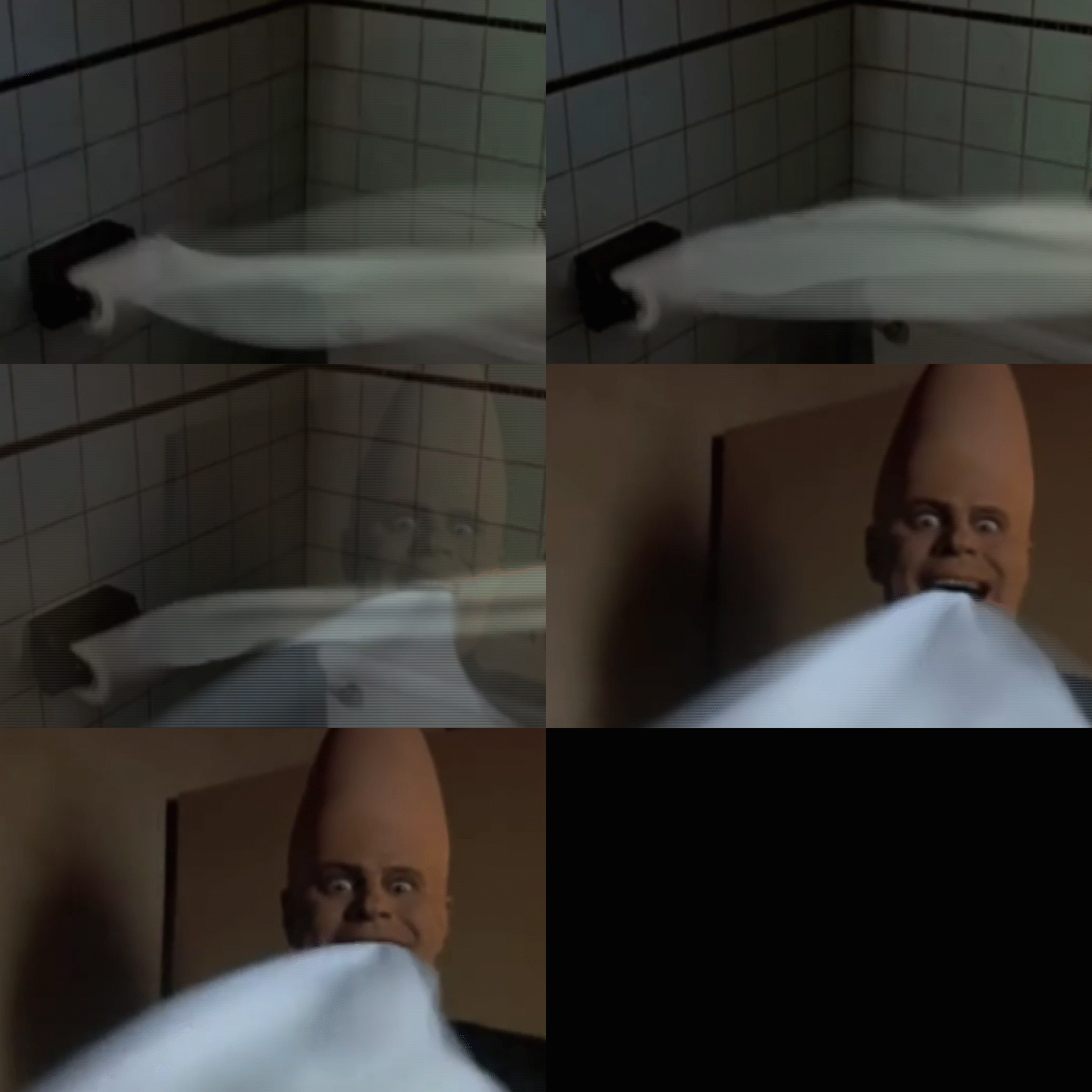
That being said, I do admire the filmmakers for testing the boundaries of the MPAA rating system by smuggling grotesque body horror into a PG movie.
In one scene, Beldar goes to a dentist to file down his teeth and reveals several rows of hideous fangs behind his retracted mouth.
In another moment, a pregnant Prymaat floods an entire basement apartment when her water breaks, leading to a baby delivery scene where Beldar cuts the umbilical cord with his new teeth.
Even the climactic fight at the end has some pretty grizzly sights for a kids movie, since a couple Remulak jobbers get their head and limbs torn off by a stop-motion space troll.
While these gags barely elicited a chuckle out of me, I at least respect the writers’ willingness to make the audience uncomfortable and not settle for a completely sanitized experience.
Unfortunately, Coneheads is still meant to be a comedy and in that area the film mostly falls flat.
Outside of its overreliance on gross-out humour, the film’s remaining jokes become pretty predictable and fall into a familiar pattern, where misunderstandings about Earth culture are sandwiched between cracks about the Remulak’s unique physiology and speaking patterns.
That repetition may not be noticeable in an eight-minute sketch, but every subpar gag becomes magnified in a feature-length environment, and Coneheads doesn’t have enough standout lines or bits to even out this ratio.
And even though the actors do the best with the material they’re given (especially Curtain), one puzzling casting decision really threw me for a loop and torpedoed a romantic subplot that dominates the second half of the film.
This story thread revolves around Connie’s growing infatuation with Ronnie, an auto mechanic played by Chris Farley.
While Farley (rest in peace) was a man of many talents, he definitely looked his age and should have never been hired to play a character who is lusting after a teenager.
Even if Farley’s character is meant to be 18 or something, the scenes between him and Burke come off as extra weird and creepy, which is a major problem when so much of the story’s emotional weight is reliant on their relationship.
You could argue that this creepy dynamic is intentional, since the movie thrives on this kind of absurdist contrast, like how all the human characters never once remark on the Coneheads’ freakish appearance as being alien.
But Farley’s casting seems like it’s moreso a matter of convenience, since the rest of the cast is chock full of comedians who were already in SNL’s orbit during the early 90s.
So overall, I can’t really recommend Coneheads as a comedy, although I do admire some of the work being done at its core.
The writers at least had a solid foundational idea to play around with by using Beldar, Prymaat, and Connie to mirror the American immigrant experience. This framing gives the movie a sense of momentum as the plot moves forward and it never feels like the film is a series of random skits strung together with a loose plot.
This story about undocumented aliens becoming productive members of society is also especially relevant in today’s political climate, where the current U.S. government is so cartoonishly cruel and draconian in its treatment of these people that it makes the film’s main villain (an overzealous immigration agent played by Michael McKean) look like a choir boy by comparison.
Had the jokes been a little sharper, I believe that Coneheads would be on the same tier as beloved SNL features like Wayne World or The Blues Brothers (1980), rather than being relegated to the middle of the pack.
Thankfully, two of the movie’s writers (Bonnie and Terry Turner) would later find success creating 3rd Rock from the Sun, an NBC sitcom that used the same basic premise as Coneheads and even featured Curtain as a series regular.
Not only did 3rd Rock run for six seasons, but the show also picked up eight Primetime Emmys throughout its run, including multiple wins for series leads John Lithgow and Kristen Johnston.
So clearly this writing team had the talent to make this concept work; they just needed the right platform to give it room to breathe.
In that sense, the Coneheads movie could be seen as a (very expensive) learning experience, where the writers were given space to see what doesn’t work, refine their craft, and become better comedians down the line.
That opportunity to learn and grow is what draws so many up-and-coming comedians to SNL even in the 2020s, so Coneheads should at least be praised for staying true to that spirit of self-improvement.
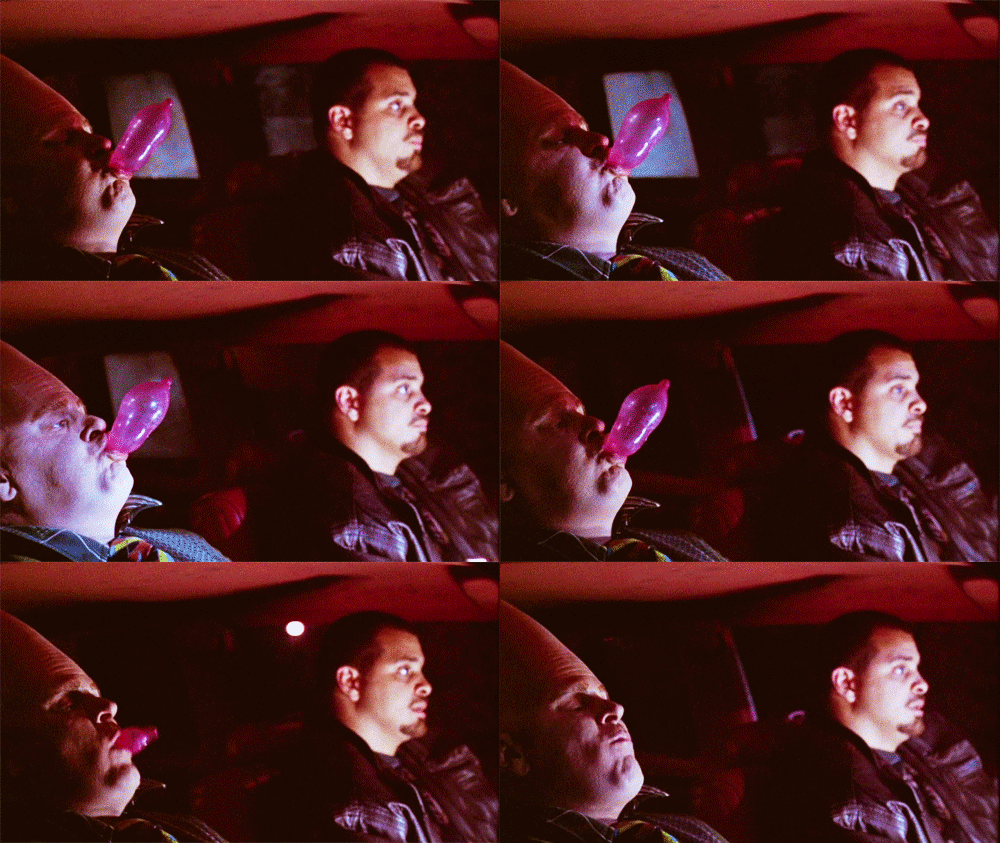
Then again, I had to sit through multiple scenes of actors chewing on condoms like bubble gum, so my positive feelings for this film can only go so far.
Verdict:
5/10
Corner store companion:
Toblerone (because it’s triangle shaped and meant to be consumed in mass quantities)

Fun facts:
Release date: July 23, 1993
Budget: $30 million
Box office: $21 million
-The Coneheads made a total of 11 appearances on SNL between January 1977 and February 1979.
-The Coneheads movie features a smorgasbord of cameos from established comedians and up-and-comers who would go on to be majors players in the industry. This list of cameos includes: Adam Sandler, Drew Carey (in his film debut), Ellen DeGeneres, Sinbad, Eddie Griffin, Jon Lovitz (uncredited), Kevin Nealon, Phil Hartman, Tom Arnold, Parker Posey, Dave Thomas, Tim Meadows, and Michael Richards.
-Aykroyd and Curtain perform the original song “Conehead Love” over the credits in character as Beldar and Prymaat. This song would receive the full music video treatment to help promote the film.
-Prior to this film, SNL tried to turn the Coneheads into an ongoing cartoon series in 1983 via animation giant Rankin/Bass. The 22-minute special, which was never picked up for a full series, follows a lot of the same plot beats as the 1993 film, with Beldar and Prymaat crashing landing on Earth and adjusting to life amongst humans.
-Despite never scoring a sequel or returning to SNL as these characters, Aykroyd and Curtain reprised their roles as Beldar and Prymaat in a series of commercials for State Farm in 2015.
-Musical highlight: “Kodachrome” by Paul Simon (plays over a montage of Beldar and Prymaat raising their daughter in the suburbs)



 Corner Store Cinema