
While some could accuse Jackie Chan of playing the same kind of guy over and over, he’s at least tried to shed that skin in his later career.
Outside of portraying a Chinese revolutionary in the historic drama 1911 (2011), Chan channeled his inner Liam Neeson in The Foreigner (2017), showcasing his dramatic chops as a mourning father looking to avenge his daughter’s murder at the hands of IRA terrorists.
Even though critical reception for both projects was mixed, it showed that Chan was willing to use his cachet as an international superstar to stretch his acting range, rather than stick to his usual screen persona (a goofy, wholesome guy who loves martial arts).
One could argue that he chose these later roles out of necessity. After all, a 60-ish-year-old Chan simply couldn’t replicate the pure athleticism and intricate physical comedy that made him a household name in the first place.
But it should be noted that Chan has tried to mix things up before, with Wong Jin’s City Hunter (1993) being a noticeable mid-career experiment.
Instead of deploying his usual boyish charm, Chan is a considerably meaner in this film, playing a character who lustfully chases after women and dishes out violence in a very cavalier fashion.
Plus, the general tone of the film is a major departure from Chan’s previous work, where the comedy is much more Looney Tunes than his preferred Buster Keaton stylings.
Unfortunately, these changes don’t play to Chan’s strengths at all, and the general filmmaking on display isn’t strong enough to compensate for the movie’s many shortcomings.
As a result, all you’re left with is a really off-putting experience, where Chan and the filmmakers seem like they are actively trying to alienate the audience for 100 minutes straight.
In terms of plot, City Hunter follows the basic premise of the serialized manga of the same name (created by Tsukasa Hojo). Chan stars as a private detective who solves crimes alongside his assistant Kaori, who is the sister of his deceased partner.
After being hired to locate a media mogul’s missing daughter, the pair’s search leads them aboard a cruise ship that is quickly taken over by armed thugs. Wacky hijinks ensue from there, as a colourful cast of characters help Chan take back the ship from the gunmen.
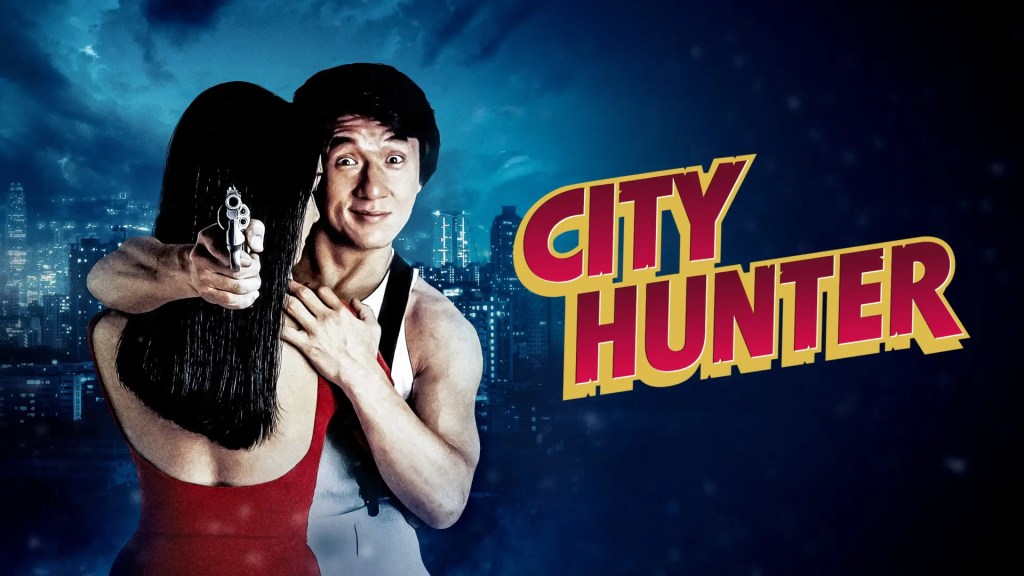
Despite its many flaws, City Hunter has the decency to show you what kind of movie it is right out of the gate.
Within the first three minutes or so, the audience is hit with garish mugging from the actors, cartoon sound effects deployed to heighten jokes, and a pungent pervy tone that wafts right through the screen.
It definitely sets the stage for a film that’s consistently obnoxious and even downright depraved at times.
The one element that really soured me before the movie even got out of its starting blocks was the relationship between Chan’s private detective and his young assistant.
During the opening scene, City Hunter promises to take care of his dying partner’s 10-year-old sister and swears that he will “never seduce her.” Cut to the next scene where Kaori transitions from being a child to a beautiful woman (played by Joey Wang) in a single, continuous shot, with Chan’s character loudly proclaiming to the camera that such a development is “not fair.”
It would be one thing if this grooming joke was a one off, but the will-they-won’t-they relationship between City Hunter and his adoptive daughter is a romantic thread that’s woven throughout the entire movie.
Basically, Kaori’s whole deal is she’s constantly vying for her adoptive brother/father’s affection, and gets extremely jealous whenever he chases after other women (which is every five minutes or so).
While this back-and-forth is largely played for laughs, the filmmakers never at any point acknowledge that the idea of these two getting together is gross, which is a dark cloud that hangs over the entire picture.
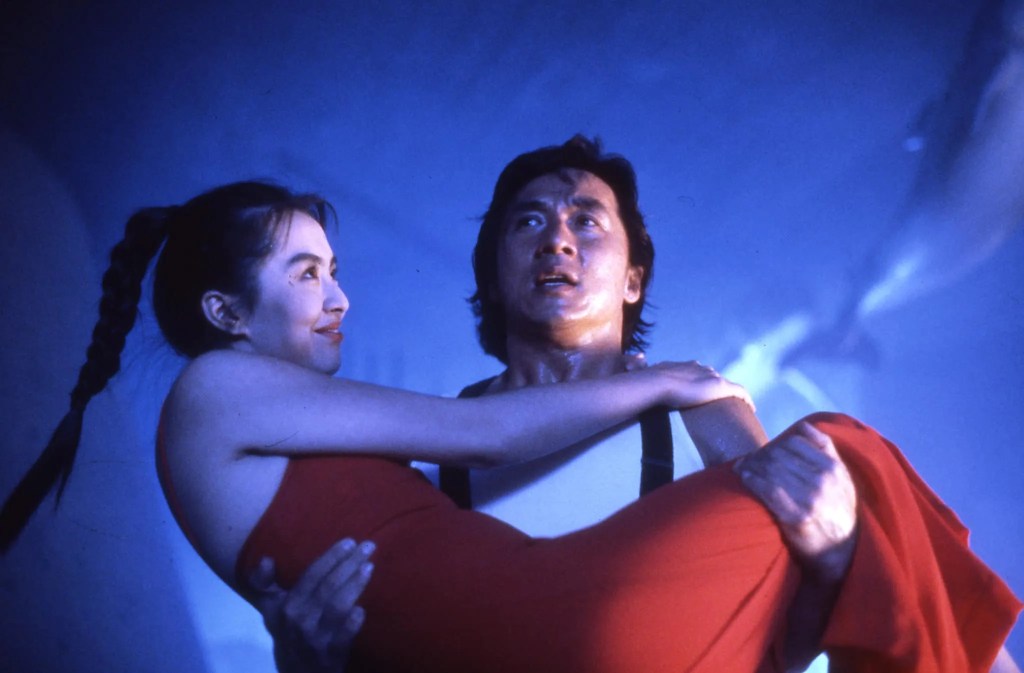
To make matters worse, City Hunter doesn’t really offer up enough exciting action set pieces to offset its busted moral compass.
For most of the movie, any fight scenes that break out are criminally short. Chan and his stunt team never get the chance to build up any momentum before the filmmakers seemingly get bored and switch back to some juvenile comedy skit.
And any fight scene that IS given enough room to breathe is pretty uninspired, where Chan is relying on editing tricks (rather than his raw physicality) to wow the viewer.
This includes a sequence where Chan is chased by a gang of skateboard punks, and it’s pretty obvious that his most impressive moves are being performed by a double. Apparently, stand-ins were used for this scene because Chan suffered a serious ankle injury, which should have been a sign from the Gods that this silly sequence should have been cut altogether.
What could be more galling than a Jackie Chan movie where he doesn’t do all his own stunts? How about a pointless musical number performed by actors who aren’t even in the main cast? Yeah, sure. Why not? Here’s three minutes of that.
Things looked like they were headed in the right direction with the introduction of Gary Daniels as the villain’s main henchman. On paper, Daniels is a great opponent for Chan, given his sharp look and athletic acumen as a competitive martial artist in real life. But when the two finally get together for a big brawl, it turns out to be a giant farce.
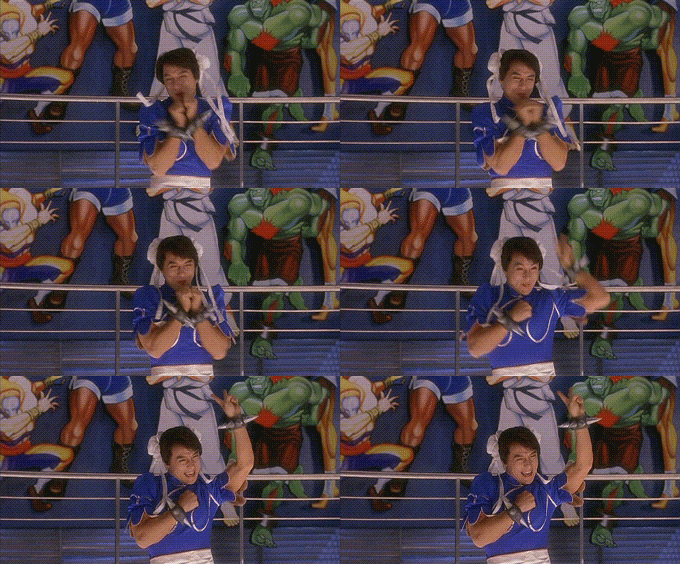
Instead of a traditional one-on-one bout, the scene morphs into a deranged video game pastiche, where Daniels and Chan (who is hallucinating) dress up like Street Fighter characters for some reason.
I will commend the filmmakers for committing to the bit, since they went to the effort of using the official music and sound effects from the game, alongside decent replications of the costumes and signature moves of each character. This moment is so surreal that it’s gone on to become more famous than the movie itself, with thousands watching it on YouTube not even knowing it’s connected to City Hunter.
But in the context of the full movie, this scene is staggeringly divorced from the ongoing plot, and it completely wastes a performer like Daniels on some self-indulgent cosplay (or a blatant paid advertisement courtesy of Capcom).
It isn’t until the movie’s final reel that City Hunter provides a decent showcase of Chan’s abilities without any annoying interruptions.
In this climactic clash with Richard Norton (another real-life martial artist turned actor), the action and comedy is woven together far more naturally, and it at least looks like Chan isn’t hiding behind a bunch of smoke and mirrors to trick the audience (even though a double was reportedly used for Chan here to help save time on production).
Regretfully, this fun action sequence comes far too late in the film to salvage all the bullshit that came before it.
Said bullshit includes an earsplitting soundtrack, which sounds like it was composed by a cat operating a single Casio keyboard with faulty wiring. When this movie doesn’t sound like a cheap carnival act, the filmmakers pipe in some cheesy guitar licks to try and make Chan’s character into some kind of discount James Bond. It’s all very obnoxious.
The supporting cast (which can often be the saving grace of an overwise middling film) is also severely underutilized, with most of these side players not getting nearly enough screen time to make a good impression.
Besides the one-note villains, the best example of this phenomenon is when actor Leon Lai is introduced as a gambler on the cruise ship who throws playing cards like ninja shuriken. After that stellar introduction, Lai is featured in maybe two other scenes before he’s completely forgotten about, exiting the movie having never interacted with Chan in any capacity.
The only actor who escapes this project with any kind of dignity is 90s Hong Kong bombshell Chingmy Yau, who plays an undercover cop tasked with taking down the bad guys alongside Chan. Unlike all the other women in the film, Yau’s character is treated with some respect by the writers, since she’s allowed to be sexy, funny, and a competent ass kicker all at the same time. This comes to a head in the film’s finale, when Yau and Chan take out a legion of goons by engaging in a dance that combines impressive acrobatics with deadeye marksmanship.
However, these quality nuggets can’t distract from the crushing reality that Chan (the star of the film) is just not cut out for this kind of material.
While he is normally a master of combining action and comedy, his appeal as a performer has always involved stringing together daredevil stunts and action sequences where it seems like he’s seconds away from grievous injury or death.
Hardy any of that tactile quality is present in City Hunter, where any trace of a human element is usually hidden behind broad gags that wouldn’t be out of place in a Three Stooges short or Wile E. Coyote cartoon.
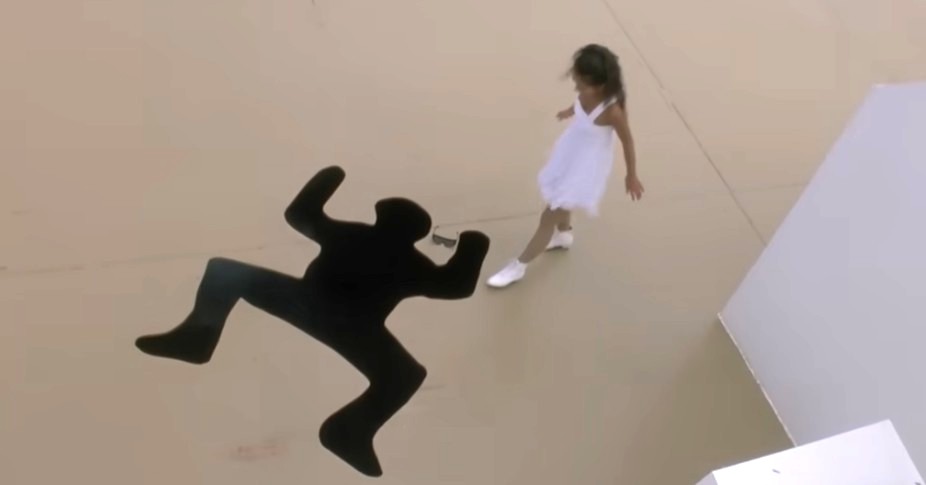
Plus, try as he might, Chan struggles to thread the needle playing a character who is an outright scoundrel and deviant.
His natural boyish charisma just doesn’t mesh well with scenes involving him drooling over attractive women and gleefully gunning down henchmen.
Maybe his performance was poisoned by my familiarity with his broader filmography, where he usually plays a morally upstanding hero who is sexually non-threatening.
But this role in City Hunter really called for a performer with more of an edge, backed by some writing that doesn’t solely trade in broad stereotypes.
Some may defend Chan’s exaggerated performance as being closer to the source material, but I don’t think that’s even true. Based on what I’ve seen from the broader City Hunter franchise (which is mostly the 1989 animated film subtitled .357 Magnum), the general tone is more of an even mix of comedy and serious drama. While City Hunter may act like a horny dufus a lot of the time, he’s at least shown to be intelligent and well-mannered when the situation calls for it.
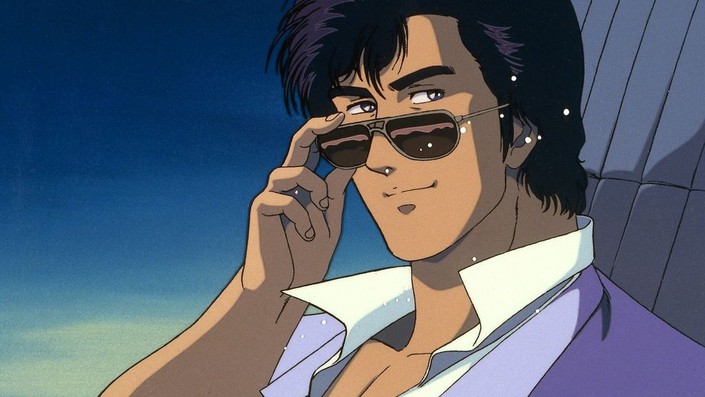
In the 1993 live action film, meanwhile, Chan’s version of the character is a total boob 100 per cent of the time, which is more of a creation of writer/director Wong Jing. And unfortunately, Chan wasn’t able to surpass such a bad creative vision, which is probably why he reverted back to his usual uncomplicated screen persona for the rest of the 1990s and 2000s.
Despite this career trajectory, his brief detour into moral depravity for 1993’s City Hunter remains a fascinating oddity in his career, since I don’t recall him playing a character like this ever again.
And hey, we should always celebrate actors (or artistic people of any stripe) when they decide to venture outside of their comfort zone, since it usually breeds creativity and gives the audience something new to chew on.
But here, Chan’s big creative swing just doesn’t really work on any level, unless you’re in that rare subset of people who always wanted to see him dress up like Chun-Li for some reason.
If you’re a member of that hyper-specific group, then this movie might just be a home run.
Verdict:
4/10
Corner store companion:
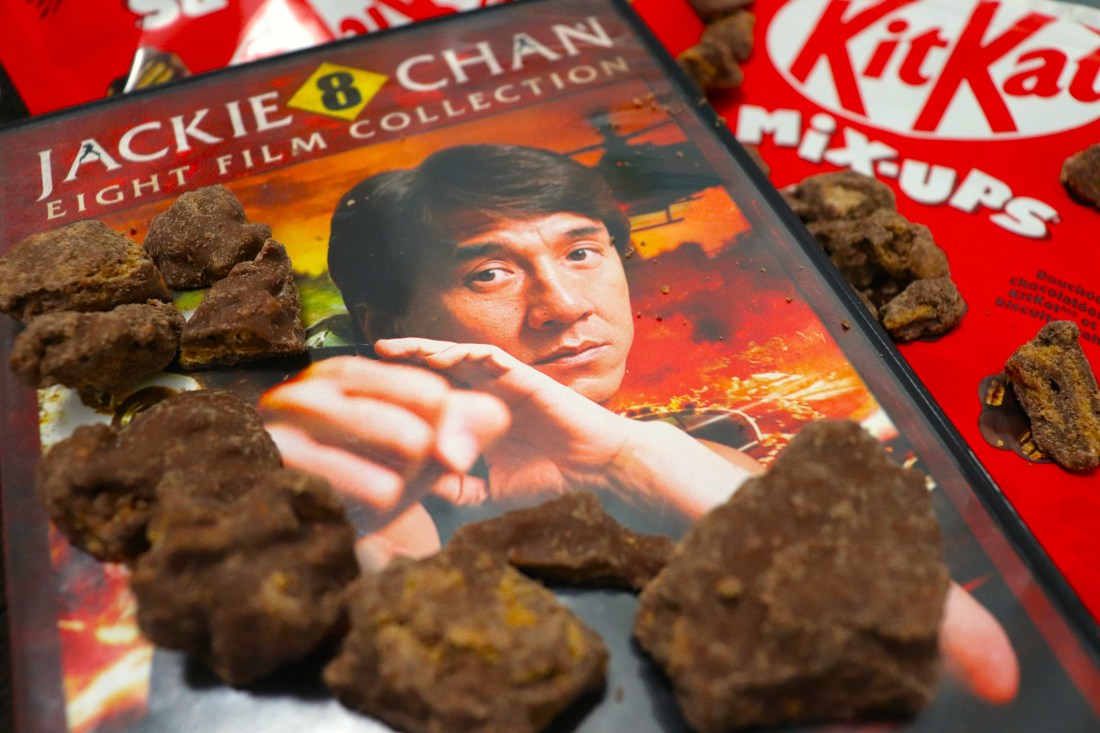
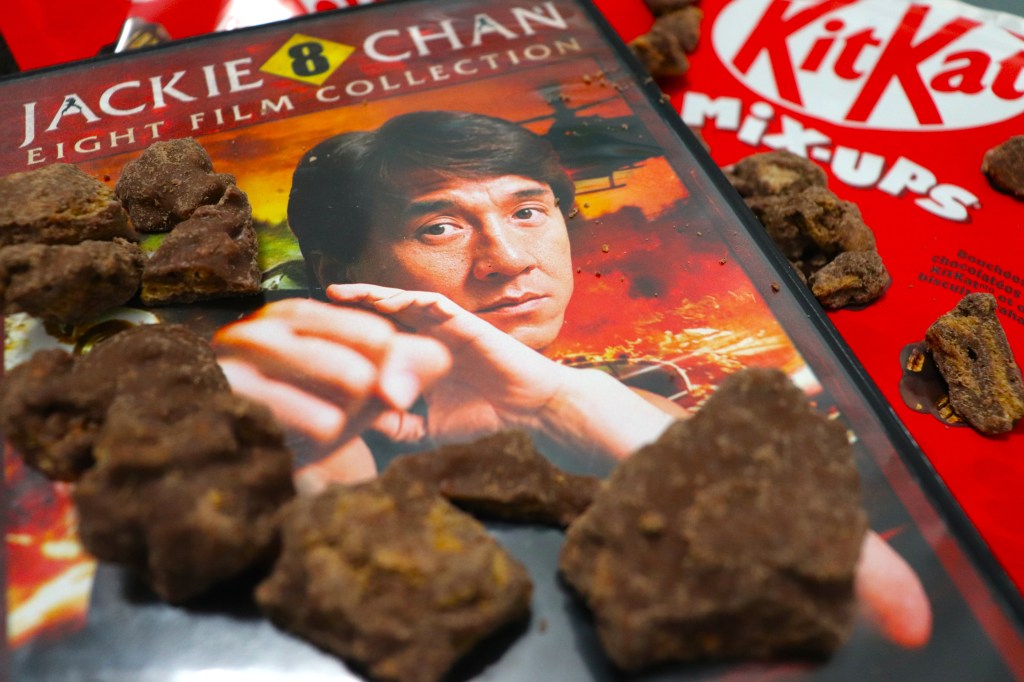
Kit Kat Mix-Ups (because this snack mixes chocolate and Graham Crackers far better than this film combines action and comedy)
Fun facts:
-Release date(s): January 14, 1993 (Hong Kong), March 20, 1993 (Japan)
-Box office: $14.6 million
– Tsukasa Hojo’s City Hunter manga was serialized in the pages of Weekly Shōnen Jump magazine between 1985 and 1991. The manga was quickly adapted into an anime series that produced 140 episodes (and several standalone animated movies) from 1987 to 1991.
-Outside of this 1993 film, the City Hunter manga has been adapted numerous times in live action, including Hong Kong’s Saviour of the Soul (1991), France’s Nicky Larson et le parfum de Cupidon (2018), and Netflix’s City Hunter (2022).
-Internet film critic Movie Bob theorizes that actor Stephen Chow (Shaolin Soccer, Kung Fu Hustle) was originally slated to star in this adaptation of City Hunter given his close relationship with director Wong Jin at the time. However, I couldn’t find any other independent source to verify this claim.
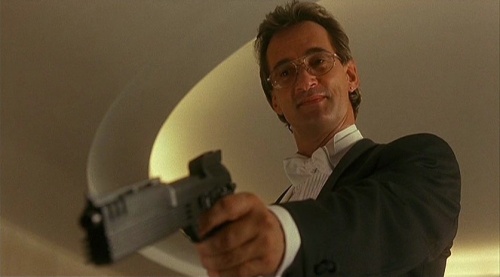
-Richard Norton’s firearm of choice in this film is the Auto 9, the same modified Beretta 93R wielded by Peter Weller in the Robocop series.
-A English dubbed version of this movie can be watched in its entirety on the Shout! Studios YouTube channel.