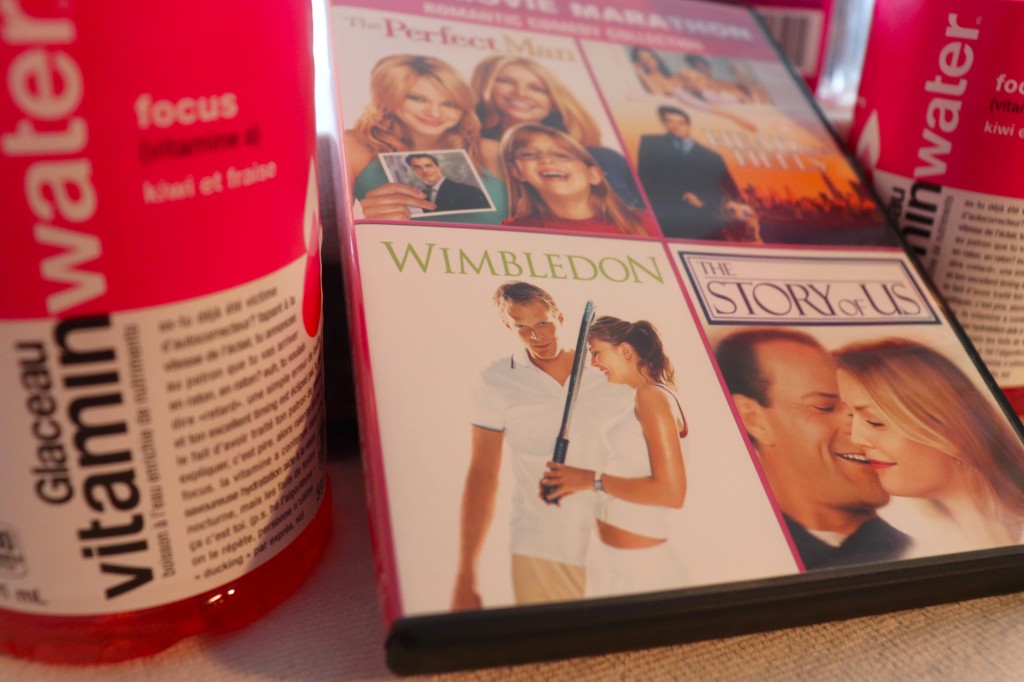
Wimbledon (2004) review-getting me to care about tennis is a feat

Film critic Roger Ebert famously described cinema as a “machine that generates empathy” and to me that machinery is running at peak efficiency when it comes to sports dramas and romantic comedies.

As someone who doesn’t follow professional sports in real life, I’m constantly wowed by films like Moneyball (2011), Rocky (1976) and Remember the Titans (2000) that sucked me into the world of professional baseball, boxing, and high school football, respectively.  

The same kind of amazement is at play when I watch a good rom com, since I generally don’t dwell on the interpersonal lives of those outside of my friends and family.

Richard Loncraine’s Wimbledon (2004) was largely able to bridge that divide on both fronts.

Not only did Loncraine and his team create a couple I actively rooted for, but they also managed to hook me in with the competitive aspect of a sport that I couldn’t care less about (tennis).

Plus, the writing team should be commended for the way they turned this genre mash-up into a core part of the plot, since the protagonist is caught between his athletic legacy and his desire to pursue a new relationship.   

While there are some annoying remnants of 2000s filmmaking at play, Wimbledon is still an immensely charming affair that should unify fans of sports movies and romantic comedies, as long as both parties come in with an open mind.  

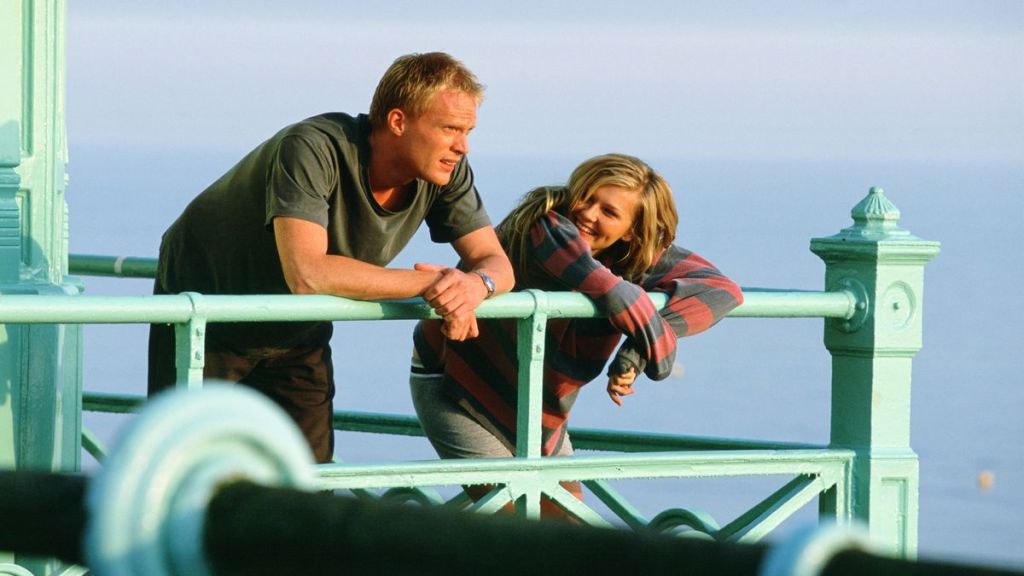
The plot of Wimbledon follows Peter Colt (Paul Bettany), a journeyman tennis pro who is at the end of his career and decides to enter the renowned UK tournament for the final time.

Despite going into the competition with limited expectations, Peter quickly finds that his fortune has changed once he meets and begins a relationship with up-and-coming American tennis star Lizzie Bradbury (Kirsten Dunst).

Not only is he playing better on the court, but Peter’s growing feelings for Lizzie allow him to envision a happy life beyond tennis for the very first time.

Unfortunately, the high-pressure environment of Wimbledon, and the media circus surrounding it, threatens to tear these two apart as the tournament reaches its conclusion.

Of course, the first inevitable hurdle that most romantic comedies must clear has to do with the leads and whether or not they are a believable on-screen couple.

Luckily, Bettany and Dunst sell you on this idea as soon as they first lock eyes in Wimbledon.

Their mutual attraction and chemistry is palpable, so much so that you don’t question the pair hooking up less than 20 minutes into the movie (a development that other filmmakers would have saved for the, er, climax of the story).

Bettany’s performance is particularly impressive given that Wimbledon marked his first major role in a romantic comedy.

During a 2018 interview with GQ, Bettany revealed this part proved extremely difficult, as he wasn’t prepared to take on a character who is required to be “relentlessly charming” in every scene.

But whatever difficulties Bettany was experiencing behind the scenes didn’t follow him in front of the camera, as his underdog tennis pro remains a consistently engaging presence who is easy to get behind.   

Dunst is even better equipped to handle this material, having recently cut her teeth on a range of comedies and romantic dramas like Drop Dead Gorgeous (1999), Bring It On (2000), and Crazy/Beautiful (2001).

Because of this, she effortlessly slips into the role of a firecracker love interest, while also maintaining a strong sense of agency that makes her an interesting character in her own right.

Much of the pair’s likability should also be credited to Wimbledon’s trio of screenwriters (Adam Brooks, Jennifer Flackett, and Mark Levin), who managed to craft a whole cast of characters that remain grounded despite engaging in some heightened romantic comedy hijinks.

Peter Colt (Bettany) is a prime example of this, since a lesser film would have taken the easy route and presented audiences with a complete screw-up to garner more sympathy right off the bat.

Instead of being saddled with a drinking problem or some inherent klutziness, Peter’s inner conflict is rooted in his fear of becoming irrelevant in a sporting world that is leaving him behind.

And despite his oblivious foibles, Bettany remains a cool operator when it comes time to chat with reporters or literally fight for his lady’s honour at a party, presenting a character who is aspirational without being unrealistic.  

I know this sounds like basic screenwriting, but a surprising number of romantic comedies screw up this formula, where the characters are presented as one note or cartoonishly flawed in order to generate cheap laughs.  

One such famously underwritten rom com archetype is the love interest’s disapproving father, whose dislike of the protagonist often borders on psychotic.

However, Sam Neill injects some much needed subtly into this kind of character in Wimbledon.

While he definitely serves as an obstacle that Bettany must overcome to court Dunst, Neill remains soft-spoken and completely reasonable from the get-go, explaining that his daughter’s full attention should be on the tournament if she wants to succeed as a tennis star.

This concern mirrors Bettany’s lingering anxiety about his own legacy in the sport, creating a shred of understanding between the two opposing characters that was a nice touch.

That being said, the film’s main antagonist is the one character in the cast who remains completely underwritten.

As Bettany’s American tennis rival, Jake Hammond isn’t given any opportunity to play anything other than an arrogant, sneering villain, who slut shames women off the court and (accidently) assaults small children while on it.

These antics do succeed in getting you to hate Hammond, but it doesn’t take away from the reality that his one-dimensional character sticks out like a sore thumb.

A similar lack of subtlety is on display during the early one-on-one tennis scenes, which feature some garish computer-generated trickery.

Instead of focusing on the athleticism of his actors, Loncraine uses these digital camera movements to follow the ball from one side of the court to the other, harking back to that dark period of the mid 2000s when most directors hadn’t quite mastered CGI as a story-telling tool just yet.  

Thankfully, Loncraine reels back his usage of this virtual reality hell as the film goes on, letting Bettany and Hammond take centre stage for the grand finale.

And by that point, the writers had already laid the groundwork necessary to get me invested in this big showdown, tying Bettany’s success in the tournament to many of the supporting characters in the cast.

Not only does his relationship with Dunst ebb and flow in tandem with each successive match, but so do the financial endeavors of his brother (James McAvoy), his agent (Jon Favreau), and the emotional reconciliation of his parents (Bernard Hill, Augusta Colt).

And by having all these characters show up to cheer him on in the finals, alongside the rest of England watching on TV, Loncraine creates an organic underdog story that doesn’t seem phony or forced.

Because of this, I can look past a lot of the film’s shortcomings, like its bland villain, sporadic use of bad CGI, and dated soundtrack that features the kind of radio-friendly soft pop that’s best left in the 2000s.

All that noise fades into the background for what ends up being a solid sports-romantic comedy hybrid that focuses on the human element first and athletic spectacle second.

If you feel like the filmmakers’ priorities are backwards when it comes to this material, then Wimbledon might not be for you.

But for someone like myself who gravitates towards the theatrical elements of professional sports, but not the games themselves, this movie hits the right notes and is an easy recommendation.

Unfortunately, Wimbledon wasn’t compelling enough to convince me to watch the actual tournament this coming July.

That being said, I might change my mind if this year’s event features another relentlessly drunk Woody Harrelson cheering from the sidelines.

That’ll be must-see TV.

Verdict:

7/10

Corner store companion:

Kiwi Strawberry Vitamin Water (because it’s a refreshing treat, as long as you’re prepared to deal with the sugar rush)

Fun facts:

-Release date: Sept. 17, 2004

-Budget: $31 million

-Box office: $17,001,133 (US and Canada), $41,682,237 (international)

-Scenes from this film were shot during the actual 2003 Wimbledon tournament, with real-life spectators and officials featured in the background. This is the only time this kind of filming has been allowed in the tournament’s history.

Wimbledon features several actors who have played famous Marvel Comics characters on the big screen. This includes Dunst (Mary Jane, Spider-Man), McAvoy (Professor X, X-Men), Favreau (Happy Hogan, Iron Man), and Bettany (Jarvis/Vision, various). In fact, Bettany claims that Favreau cast him as Jarvis in the first Iron Man film because of their time shooting Wimbledon together.

-Bettany spent eight months training to prepare for his role as a tennis pro, having never picked up a tennis racket beforehand. He credits Wimbledon champion Pat Cash with teaching him how to play.

-The career trajectory of Bettany’s Peter Colt parallels real-life Croatian tennis pro Goran Ivanišević, who remains the only wild card singles player to win a Wimbledon title (having done so in 2001 while being ranked 125th in the world).

-Surprise cameo(s): Renowned tennis pros John McEnroe and Chris Evert (playing themselves) provide play-by-play and colour commentary throughout the film.

Back to Bataan (1945) review- military retribution through cinema

The American public was riding a collective high in the spring of 1945, with the Third Reich having officially surrendered to the Allies in early May of that year.

With the fighting in Europe now wrapping up, the United States military turned its full attention to the Pacific theatre of World War II, with the hope of bringing this destructive conflict to a swift end.

Several weeks after Germany’s surrender, American cinemas were able to capitalize off this massive change in fortune through the release of Edward Dmytryk’s Back to Bataan, a film that chronicles the US’ attempt to liberate the Philippines from Japanese control.

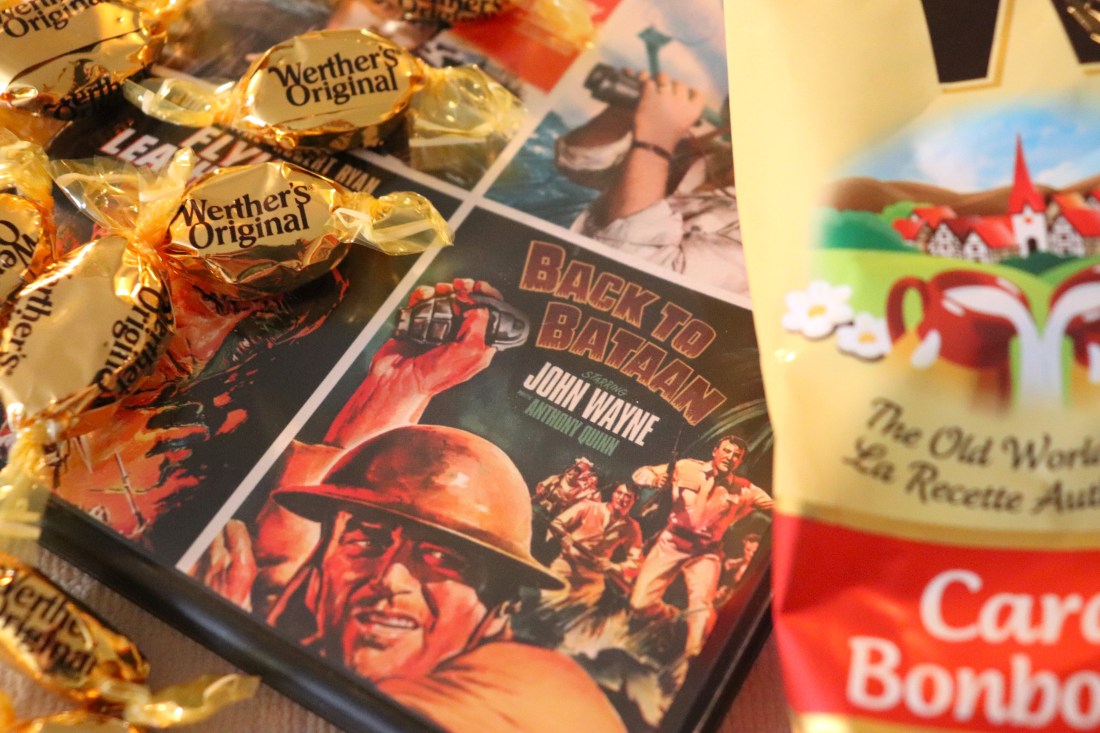
Now, I’ve sampled a decent number of WWII-era propaganda for this blog, including another war film starring John Wayne called Operation Pacific (1951).

While that movie was a lot more easy-going in its tone, Back to Bataan features a much more palpable sense of urgency, probably due to the fact that it was shot and released while the Philippines campaign was still underway.  

In fact, Dmytryk’s film could be seen as a form of cinematic retribution on behalf of the US military, who had been handed a monumental defeat when Japan successfully invaded and conquered the Philippine islands several years earlier.

Even though the war would eventually come to an end in summer of 1945, Back to Bataan was probably viewed as a way to keep American morale high in the interim, with a fictionalized recount of the hardship US soldiers and local resistance fighters endured to take back the commonwealth territory.

Admittedly, this “ripped-from-the-headlines” kind of story doesn’t hold nearly the same weight as it did 78 years ago, especially with world-shaking conflicts in Europe and the Middle East holding everyone’s attention in the final months of 2023.

So while Back to Bataan is pretty dated, it at least serves as a time capsule of a lesser known chapter of WWII, with some well-produced action sequences that hammer home the desperation and brutality that characterized the Pacific theatre of that war.

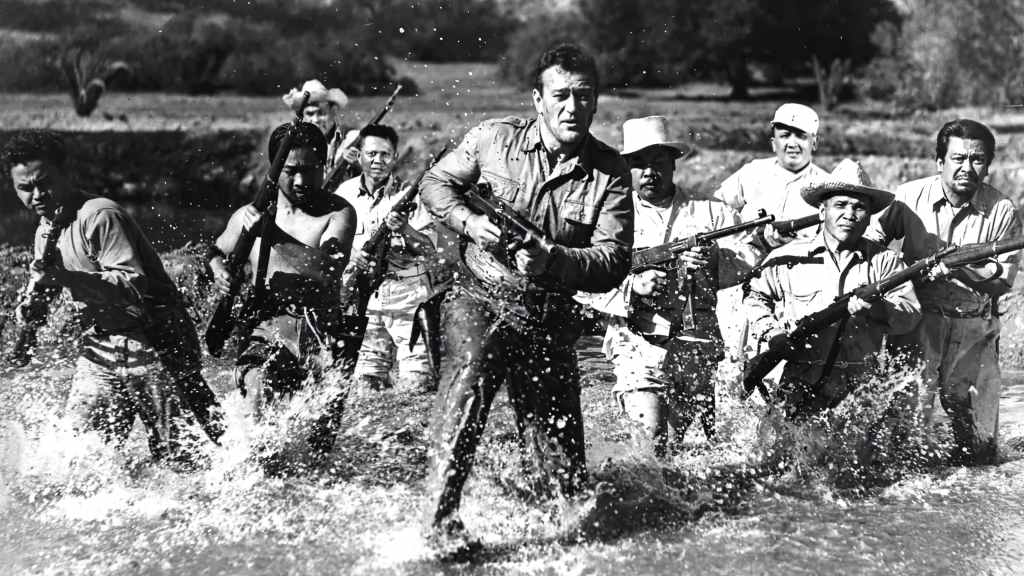
Instead of sailing the high seas like he did in Operation Pacific, John Wayne mostly sticks to dry land this time around as Joseph Madden, an army colonel who is tasked with mobilizing Filipino guerilla fighters to drive Japanese troops out of their homeland.

After making contact with some eager recruits, Madden and his men find themselves in a hopeless situation after US forces are decimated following the Battle of Bataan in early 1942.

Despite being outnumbered and outgunned, this small resistance group is determined to liberate the islands from this invading force, especially with the grandson of Filipino revolutionary Andrés Bonifacio (played by Anthony Quinn) on their side.

Some may bristle at my use of the word “propaganda” to describe Back to Bataan, but I think it’s pretty apt.

Not only does the film begin with a title card thanking the US armed forces for their aid in the production of this film, but it’s followed up by a parade of supposedly real-life American POWs rescued from Japanese prison camps in the Philippines.   

While you could brush this off as just patriotic window dressing, Dmytryk and his screenwriters actively bake these themes and images into key points of the film, usually to its detriment.

For example, the film opens with a puzzling flash forward, where US Army Rangers raid a Japanese prisoner camp near Cabanatuan City in 1945.

This scene is only included because the real-life Raid at Cabanatuan (also known as “The Great Raid”) took place in January of that year and the filmmakers wanted to include it even if they couldn’t organically work it into their story that’s set three years earlier.

By introducing the movie with such a momentous military victory, Dmytryk and his team immediately deflate the ongoing tension in favour presenting the audience with a comforting narrative right off the bat.

American movie-goers are presented with further nationalistic navel gazing once the actual plot gets underway.

This includes a moment when some Filipino school children take turns listing all the great things the US has done during its occupation of their country (like importing soda pop, baseball, and Hollywood movies).

The school’s principal then adds his two cents by proclaiming that America taught the Filipino people that “men are free or they are nothing,” underplaying the fact that the US took control of these islands through shedding lots of blood in the Philippine–American War (1899-1902).

However, the principal’s martyr status is solidified once he is executed by the Japanese several minutes later, firmly establishing the Americans as the benevolent colonizers in this scenario.  

Revisionist history aside, the scenes are pretty blunt and heavy-handed in their presentation, focusing on political talking points rather than the humanity of the people caught up in this conflict.

Thankfully, all this patriotic cheerleading is largely balanced out by the filmmakers’ sound technical expertise, particularly when it comes time to blow shit up.    

Rather than pushing the complicated action off screen, or hiding it behind convenient edits, Dmytryk’s team relies on long takes that keep a lot of the explosions in-camera.

Special credit should be also given to the stunt team on this project, who were willing to stand uncomfortably close to these pyrotechnics to create a tangible sense of danger.

This praise must be extended to Wayne himself, who noticeably performed a lot of his own stunts for this project, including a scene where he was tied to a leather harness to simulate being blown away by a mortar shell.

For the time, Back to Bataan also features some particularly grizzly kills that highlight the nasty jungle fighting that the Pacific front of WWII was known for.

Midway through the film a Filipino resistance fighter takes out a Japanese soldier with a throwing knife and the director is not shy about showing the bloody blade visibly sticking out of both sides of the sentry’s neck.

And despite not being shot in the Philippines, for obvious reasons, the filmmakers do a decent job of replicating the look and feel of a south-pacific battlefield with some interior sets and scenic exterior locations in southern California.

I understand that this visceral action aesthetic is meant to reinforce the movie’s propagandistic aims, but the caveman part of my brain can’t help but admire the high level of craftsmanship on display.

And while Wayne puts in the kind of stilted, stoic performance you would expect from this kind of film, the rest of the cast is filled out by some decent supporting performances that give the dry military proceedings some life.

Outside of veteran character actors like Beulah Bondi and Paul Fix, Anthony Quinn puts in some good work as the film’s co-lead, whose Aragorn-like reluctance to accept his destiny as a leader injects the story with some much-needed humanity.

Still, your enjoyment of this project is entirely dependent on whether or not you can disassociate it from the politics of the time.

While the US’ entry into WWII was undoubtedly a just course of action, some of the government’s domestic policies during this period were decidedly not, like the internment of Japanese citizens from 1942 to 1946.

Despite not being explicitly stated in the film itself, I can’t shake the feeling that movies like Back to Bataan were made to reassure American audiences that their xenophobic paranoia towards certain groups is justified during wartime.

But with all those caveats out of the way, I still think Dmytryk and his team put together a slickly produced piece of entertainment that works as an action movie and an interesting window into the past.

And if you’re still concerned about the film’s propagandistic aims, just know that the negative impact of one war movie from 1945 pales in comparison to all the social media misinformation currently being spread about conflicts in Israel and Ukraine.

That may seem like cold comfort, but in today’s incendiary political landscape old movies like Back to Bataan seem quaint and harmless by comparison.

That’s not a ringing endorsement, by any stretch, but these days I’ll take some dumb escapism where I can find it.

Verdict:

6/10

Corner store companion:

Werther’s Original Caramel Hard Candies (because it’s something your grandpa would enjoy)

Fun facts:

-Release date: May 31, 1945

-Box office: $2,490,000

-Despite the strong nationalistic themes present in Back to Bataan, director Edward Dmytryk was actually a member of the Communist Party in 1945 and was later called to testify before the House Committee on Un-American Activities. Alongside nine other directors, screenwriters, and producers —collectively known as the “Hollywood 10” — Dmytryk refused to testify before the committee and was blacklisted from the American film business as a result. However, Dmytryk managed to worm his way back into Hollywood after telling the committee about his former communist associations in 1951. He would go on to work steadily throughout the next three decades, including high-profile gigs like The Caine Mutiny in 1954 (which earned him seven Oscar nominations including Best Picture).

-The Axis occupation of the Philippines officially ended on Aug. 15, 1945 following the atomic bombing of Hiroshima and Nagasaki earlier that month. Japanese forces in the Philippines were ordered to surrender by the mainland government, who officially capitulated on Sept. 2 aboard the USS Missouri in Tokyo Bay.

-The Philippines finally received its independence on July 4, 1946 through the Treaty of Manila, which relinquished US sovereignty over the land.

Cattle Queen of Montana (1954) review-both of and ahead of its time

While Ronald Reagan’s transition from Hollywood to the White House has been extremely well documented, I always believed the early acting career of the 40th president of the United States was some sort of elaborate hoax.

For someone who was so influential in the realm of politics (for good or for ill), Reagan left virtually no lasting impact on the pop culture zeitgeist past the Baby Boomer generation, unlike some of his tough-guy contemporaries like John Wayne or Gary Cooper.

Up until recently, my only reference for Reagan’s filmography was a single photo of him cradling a chimpanzee in the comedy Bedtime for Bonzo (1951), which could be easily mistaken as a doctored piece of Democratic Party propaganda.

But this past Christmas, my parents provided me with irrefutable proof that Reagan’s acting career was, in fact, real by stuffing a DVD copy of Allan Dwan’s Cattle Queen of Montana (1954) into my stocking.

And after watching this western, it’s easy to see why Reagan’s run as an actor is mostly overshadowed by his political career, since he comes across as a generic leading man who relies on the same three facial expressions over and over.

Luckily, this film is largely saved by the titular “Cattle Queen” Barbara Stanwyck, who is far more compelling than her male co-star and manages to craft a likable protagonist who elevates this fairly boilerplate material.

In fact, Stanwyck is so good that it makes you (temporarily) overlook some of the film’s glaring weaknesses, like its odd production shortcuts and prevalent use of brownface for all the Indigenous characters who have speaking roles.

The plot of Cattle Queen revolves around Sierra Nevada Jones (Stanwyck), who travels from her home in Texas to Montana after her father inherits a large piece of land.

As soon as the family arrives at their destination, they are set upon by Blackfoot tribesmen, who steal their cattle herd, kill the patriarch, and take Sierra hostage, all at the behest of a corrupt local rancher.

Once she is released from captivity, Sierra vows to reclaim what’s rightfully hers and teams up with mysterious ranch hand Farrell (Reagan) to get the job done.   

Even though Cattle Queen of Montana is very much a project of its time in many respects, it does set itself apart from a lot of other Golden Age westerns through Stanwyck’s protagonist.

Rather than be relegated to the role of a love interest or a damsel in distress, Sierra Jones is a surprisingly very active character who drives most of the plot, constantly hatching schemes to outwit the bad guys and using emotional intelligence to recruit allies to her cause.

She also doesn’t hold back during the action scenes, standing toe-to-toe with Reagan and her other male co-stars once the shooting starts.

I know this sounds like very basic character writing, but these kinds of acting roles were few and far between for women in 1950s Hollywood, especially for someone like Stanwyck who was in her late 40s by this point.

But for whatever reason, Stanwyck was able to use the goodwill she built up in the industry to secure herself some meaty roles in this film and several other hard-hitting westerns like The Furies (1950) and The Maverick Queen (1956).

Judging by her performance in Cattle Queen alone, it’s easy to see why so many directors opted to give Stanwyck top billing in a traditionally male-dominated genre, since she oozes that same calm, confident charisma that defines most classic western hero archetypes.

It also doesn’t hurt that Stanwyck is surrounded by so much lovely scenery during her time on screen, with Dwan’s team opting to shoot part of this film on location at Montana’s Glacier National Park in vivid Technicolor.   

This adds a considerable amount of spectacle to what’s admittedly a pretty basic revenge story, since it gives the cast free reign to run around in real meadows and rocky outcrops instead of being stuck on an artificial studio sound stage.

Unfortunately, the use of these gorgeous landscapes is slightly undercut by some head-scratching production decisions, where the filmmakers will occasionally cut from a gorgeous wide shot of a mountain range to two actors standing in front of what’s obviously a rear projection.

Not only is this technique extremely jarring, but it’s employed inconsistently throughout the movie’s 88-minute runtime, with most other outdoor medium shots and close-ups being captured on location in either Montana or rural California.

My guess is that some footage originally shot in Montana was either lost or unusable by the time Dwan and his crew got back to Hollywood, forcing them to cobble together some insert shots on a studio backlot.

These cheap-looking transitions are made even worse by the filmmaker’s prominent use of day-for-night shooting, which makes some of the early action incredibly hard to keep track of on modern TV sets.

I understand that this technique was a necessary evil used to keep movie budgets in the black, but the end result is far from ideal, especially when you can still see puffy white clouds in scenes that are supposed to take place at night.

However, the biggest thing dragging Cattle Queen down, beyond those technical snafus, is the fact that all the Indigenous characters are quite obviously played by Italian actors.

Now, this isn’t a matter of my “liberal” sensibilities getting wounded by a practice that was much more prevalent in old Hollywood.

And in the movie’s defense, Dwan and his screenwriters at least go out of their way to portray the Blackfoot tribe in a nuanced light, casting a great many Indigenous characters as sympathetic and heroic rather than as a uniformly evil force (like in so many other western films of that era).  

Unfortunately, a lot of that hard work goes out the window as soon as actors with names like Lance Fuller and Anthony Caruso show up caked in what looks like dried mud, speaking in broken English like they’ve been clubbed in the head a couple times.

Those distracting sights and sounds are made even worse when the movie tries to posture itself as being anti-racist, with Sierra going out of her way to admonish some of her fellow White settlers for harboring prejudices towards Native Americans.

Again, it’s a nice sentiment, especially in a pre-civil rights America, but it rings very hollow when the very people you’re defending aren’t even allowed to play themselves on screen.

Despite these significant shortcomings, I still had a decent time watching Cattle Queen of Montana, especially since it served as my official introduction to Stanwyck and her filmography, which I’m very interested in exploring further.

The same can’t really be said for Reagan, since his stoic line delivery in this film is definitely better suited for the kind of rabble-rousing stump speeches that he became famous for in his political career.

But at the very least, I can now say with confidence that I’ve seen at least one Ronald Reagan film, which gives me the proper context to fully enjoy this gag from Robert Zemeckis’ Back to the Future.

Verdict:

6/10

Corner store companion:

Simple Pleasures oatmeal cookies (because this movie will remind you of a “simpler” time when you could get away with utilizing brownface to this degree)

Fun facts:

-Release date: Nov. 18, 1954

-Outside of referencing Ronald Reagan’s acting career in Back to the Future (1985), a poster for Cattle Queen of Montana is also featured in a scene immediately after Michael J. Fox arrives in 1955 Hill Valley.  

-Reagan reportedly watched this film at Camp David on Jan. 14, 1989, six days before the end of his two-term presidency.

-Reagan’s career as a screen actor lasted from 1937 to 1965 before he transitioned into politics, first becoming the Governor of California in 1966 before moving on to the White House in 1981.

– Barbara Stanwyck was nominated for four Academy Awards throughout her acting career, eventually winning an honourary Oscar statue in 1982. She also won a Primetime Emmy and a Golden Globe for her role in The Thorn Birds TV miniseries from 1983.  

– Stanwyck performed most of her own stunts in Cattle Queen of Montana, including a scene where her character goes for a swim in an icy lake.

Death of a Prophet (1981) review- an appetizer before a full course meal

Sometimes a filmmaker puts such a definitive stamp on a historical event or figure that it can outright delete previous cinematic depictions from the public consciousness.

James Cameron’s Titanic (1997), for example, was a cultural and financial juggernaut when it was first released, so much so that it became the go-to rendering of this 1912 oceanic disaster for an entire generation of movie goers.

As a result, a lot of people my age don’t even know that half-a-dozen or so Titanic-centric feature films and TV movies came out before 1997, although a lot of these generational blind spots could be blamed on modern streaming services failing to stock up on older media.

A similar phenomenon is at work with the first 20 minutes of Steven Spielberg’s Saving Private Ryan (1998), since this brutal, unflinching portrayal of the 1944 D-Day invasion turned into an aesthetic template that was adopted by countless future films, TV series, and even video games set during World War Two.

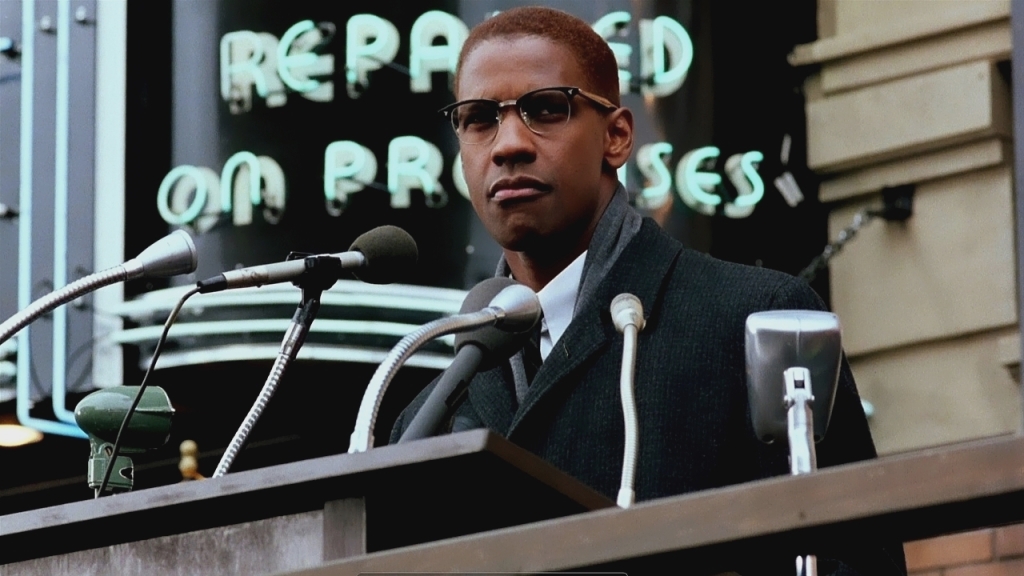
But in terms of biopics, few films are as comprehensive as Spike Lee’s Malcolm X (1992), a three-and-a-half-hour epic that tracks the controversial civil rights leader’s life from his younger years all the way to his assassination in 1965.

Even though these birth-to-death biopics are usually exhausting experiences, Lee’s ferocious directing combined with Denzel Washington’s Oscar-caliber lead performance proved to having staying power with generations of movie-goers, so much so that this motion picture (like the previous two examples) was entered the U.S. National Film Registry decades later.

Lee’s Malcolm X is so influential that it’s easy to forget all the other times the Black empowerment icon showed up on the big and small screen prior to 1992, even with a big-time actor like Morgan Freeman taking on the role in Woodie King Jr.’s Death of a Prophet (1981).

But while this low-budget TV movie definitely has its merits, it’s easy to see how it got lost in the pop culture shuffle and eclipsed by future projects like Malcolm X.

Not only is Death of a Prophet plagued with head-scratching filmmaking decisions, but King Jr. also does a poor job of putting the events on screen in the proper context, which does a real disservice to such an important historical figure.

Instead of covering Malcolm X’s entire life, Death of a Prophet focuses on the 24 hours leading up to his demise, attempting to provide a small-scale portrait of a larger-than-life figure who knew his days were numbered.

Even though this premise is loaded with potential, the end product isn’t very compelling and comes across as an unfinished documentary that needed some additional footage.

Freeman spends a lot of his screen time wandering through the streets of New York City, where he bumps into some hippies, chats with a local bookstore owner, and is confronted by members of the FBI.

Throughout these encounters, the audience is rarely provided any real insight into Malcolm’s state of mind, with Freeman never getting the chance to flex any emotional range beyond some stern stoicism.   

Meanwhile, the film also spends a distracting amount of time following Malcolm X’s assassins as they prepare for his eventual killing at Manhattan’s Audubon Ballroom.

These scenes similarly fall flat, since King Jr. is only interested in having these characters discuss the logistics of the hit and bizarrely showcase the strength of their abdominal muscles at a karate dojo.

In both parallel storylines, the director is reluctant to fill audiences in on the historical events and political intrigue that led up to this point, namely Malcolm X’s split from and growing hostility towards the Nation of Islam.

Maybe this was done to avoid ruffling any feathers in the Black community, since the true identity of Malcolm X’s killers remains a contentious topic of debate even to this day.

But whatever the reason, the choice to deprive Death of a Prophet of all these critical background details robs the story of any real weight, especially for someone who isn’t familiar with Malcolm X’s legacy ahead of time.

The film’s low production values also don’t do a great job of selling the serious story that King Jr. is trying to tell.

Not only is the audio recording of the character dialogue pretty spotty, but the prominent hand-held camera work and dingy lighting can sometimes give off the impression that you are watching a series of home movies rather than a civil rights drama.

However, this biggest production shortcoming in Death of a Prophet can be found in the make-up and hairdressing departments, since they didn’t even try to make Freeman look like his historical counterpart.

I mean, would it have been that expensive to give the star of your movie a haircut?

On the other hand, this amateurish feel does imbue the film with a kind of rough-around-the-edges charm that occasionally manifests on screen.

While the recording of character dialogue is rough, King Jr. and his team inject the project with some naturalistic sound that does a decent job of setting the mood.

This heavy ambiance is most prevalent in the middle of the film, where Freeman is accompanied by a cacophony of honking cars and chattering bystanders as he makes his way through the streets of Manhattan, his paranoia of an impending assassination growing by the second.

When it comes to non-diegetic sound, Death of a Prophet features an energetic jazz score full of woodwind, brass, and percussion instruments that similarly manage to crank up the tension.

In fact, portions of the film even reminded me of Alejandro Iñárritu’s Birdman (2014), which also used an aggressive, drum-heavy score to foreshadow the main character’s impending demise.

And while King Jr.’s hand-held shooting style is a little clumsy at times, this technique gives the film a gritty, documentary-like feel that calls back to the vibrant Blaxploitation cinema of the previous decade.

This documentary-like quality extends to the film’s opening six minutes, which features interviews with people who knew Malcolm X in real life, like activist Yuri Kochiyama, poet Amiri Baraka, and actor Ossie Davis.

So even though King Jr.’s filmmaking craft and presentation of history is seriously flawed, it’s difficult to deny his passion for the main subject matter.

In retrospect, Death of a Prophet comes across as the director’s attempt to keep Malcolm X’s legacy alive 16 years following his death.

After all, his depictions in film and television up until that point (excluding an Oscar-nominated documentary from 1972) were relegated to supporting roles in bio pics featuring more mainstream civil rights heroes, like Muhammed Ali and Martin Luther King Jr.

By placing Malcolm X at the centre of his own story, one could argue that Death of a Prophet sets the stage for more comprehensive biopics down the line, with Spike Lee’s epic hitting theatres just over a decade later.

But even with the benefit of historical hindsight, Death of a Prophet still comes across as a half-baked appetizer that’s meant to tide you over for a full course meal.

Sure, you can appreciate it in the moment, but only because you know something way better will be served up shortly.

Verdict:

4/10

Corner store companion:

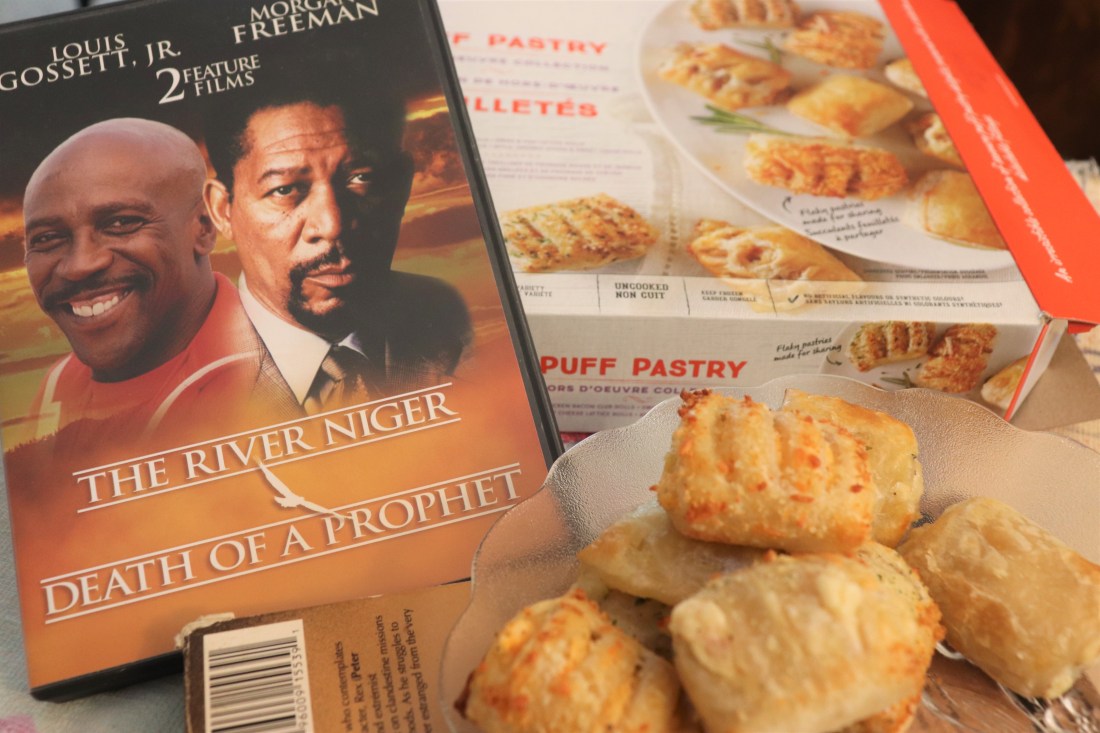
President’s Choice Puff Pastry Hors D’Oeuvres Collection (because they’re tasty enough, but can’t serve as a substitute for an actual meal)

Fun facts:

-Woodie King Jr.’s film and television projects pale in comparison to his work on stage, since he founded the New Federal Theatre in 1970 to better showcase African American playwrights. King Jr. wrote, directed, and produced dozens of plays throughout his multi-decade career, which netted him plenty of accolades (like the NAACP Image Award in 1988).

-Outside Morgan Freeman and Denzel Washington, Malcolm X has been portrayed by a variety of notable actors on film, television, and the stage. This list includes: James Earl Jones (The Greatest, 1977), Al Freeman Jr. (Roots: The Next Generations, 1979), Mario Van Peebles (Ali, 2000), Nigél Thatch (Selma, 2014), and Kingsley Ben-Adir (One Night in Miami, 2020).

-The percussion-heavy score featured in Death of a Prophet was composed by drummer Max Roach, who is known for being a pioneer in the bebop style of jazz.

Death of a Prophet can currently be watched in its entirety on YouTube:

She Demons (1958) review – micro-budgeted monotony

While independent filmmakers are often lauded for their ability to work outside the system and complete a project using a modest amount of money, they don’t always arrive at the same destination career-wise.

For example, directors like Quentin Tarantino and Paul Thomas Anderson have become critical darlings despite their humble beginnings; debuting with simple crime features that lead to increasingly complex projects.

Meanwhile, people like Robert Rodriguez and John Carpenter have largely stuck with their lurid genre roots and developed more of a cult following as a result.

Then you have luminaries like Roger Corman, who is remembered more as a genius businessman because of his ability to turn a profit by shooting fast and cheap.

Some renegade directors have even cemented a legacy through their sheer lack of talent and business sense, which is largely the case with B-movie king Ed Wood.

But for every Ed Wood there are probably a thousand independent filmmakers like Richard E. Cunha, whose name has been cast into the dustbin of history while his similarly schlocky work lives on in the realm of public domain.

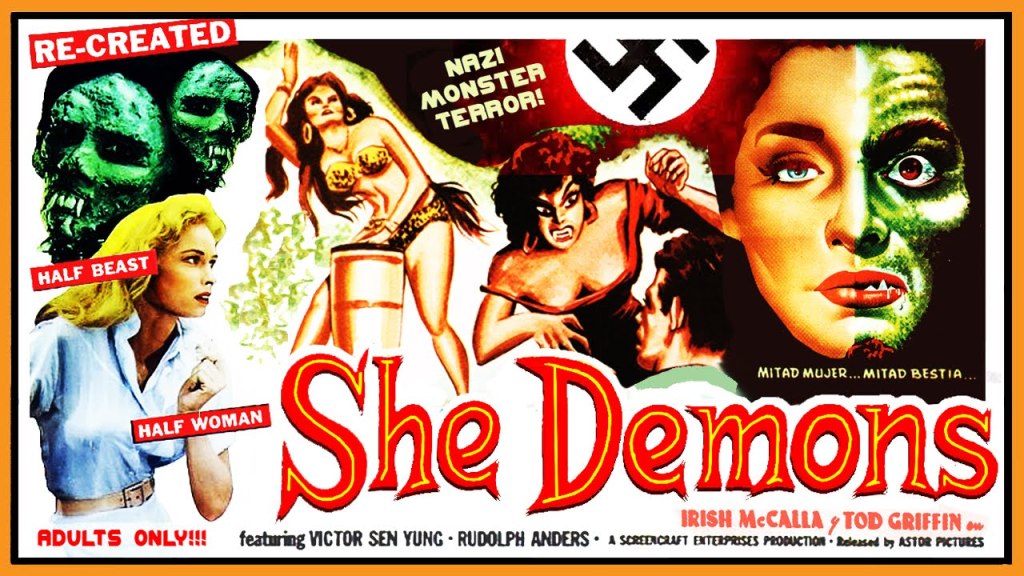
One of these projects is She Demons (1958), a sleazy science-fiction horror film whose production values are about on par with an elementary school play.

But to be fair, most elementary school plays at least go to some lengths to maintain some sense of stylistic consistency, whereas Cunha’s film feels like it consists of assets leftover from eight different movies.

And while part of me always admires the entrepreneurial spirit it takes to get any film project off the ground, especially on a micro budget, I can’t ignore the reality that She Demons feels like it is held together with chewing gum and masking tape.

For as disjointed as this movie gets, the plot is mercifully simple from the outset, where a spoiled heiress (Irish McCalla) and her entourage get shipwrecked on an uncharted island following a hurricane.

As the group gradually explores the island they stumble upon a menagerie of horrors, including Nazi soldiers, a mad scientist, and the titular female monstrosities, which turn out to be some conventionally attractive women wearing cheap Halloween masks.

After a bunch of corny fist fights and lengthy expositions dumps, the mad scientist eventually turns his attention towards McCalla, wanting to use her youth and vitality to restore the beauty of his horribly maimed wife.

Watching She Demons I was constantly reminded of a couple old episodes of Star Trek, the ones where the Enterprise crew would visit an alien planet that looked suspiciously like Earth during World War II or the Prohibition Era.

Of course, this sense of familiarity turned out to be a cost-saving measure, since it allowed the producers to re-use old sets, props, and costumes from other Paramount properties rather than shell out a bunch of money to create new ones.

It seems like Cunha’s team operated under the same penny-pinching philosophy, except they didn’t have access to the same caliber of writers that made those original Star Trek adventures so compelling.

Here, it seems like the story of She Demons was totally dependent on whatever sets, props, and costumes the filmmakers could get their hands on, leading to a weird sense of disconnect throughout the entire 77-minute runtime.

Admittedly, some of the exterior scenes look alright, since Cunha and his team at least had the good sense to shoot on an actual beach and public park in California to maintain the illusion that his characters are stuck on a tropical island.

But that illusion completely shatters whenever the actors venture indoors and are forced to interact with these cheap sets that were either quickly made or taken from other movies.

The patchwork nature of this production is present in a lot of other places as well, with the overuse of stock footage being a repeat offender.

The filmmakers didn’t even bother to set up important establishing shots in some cases, outright omitting any depiction of the giant shipwreck that’s supposed to set the entire plot in motion.

Now, you could excuse a lot of these shortcomings as being a byproduct of the film’s reported $65,000 budget, since that kind of money doesn’t leave a lot of creative wiggle room for a sci-fi, horror mashup, even by 1958 standards.

But what isn’t excusable is the movie’s script, which is simultaneously sloppy, nonsensical, and extremely long-winded.

For whatever reason, Cunha decided to take a simple premise (people getting stuck on an island populated with monsters) and weigh it down with a bunch of extraneous nonsense.

Instead of focusing on the characters’ struggle to survive, the film keeps introducing new outlandish concepts that come out of nowhere, like long-lost Nazis, experimental gene therapy, and using lava as a renewable energy source.

Cunha gets so carried away with these ideas that the titular “She Demons” barely factor into the plot and are only used as set dressing past a certain point.

It also doesn’t help that the movie’s complicated fake science is explained during a 10-minute-long speech from the main villain that only succeeds in bringing the film to a grinding halt.

The characters themselves aren’t much to write home about either, although you can at least tell that certain members of the case are trying to squeeze something meaningful out of this bonkers script.

The only person who comes close to making a lasting impression is Rudolph Anders as the main villain, since this German actor made a career out of playing doctors and Nazis and knows how to fuse those two archetypes together.

Irish McCalla also makes an impression as the leading lady, but that probably has more to do with her measurements than her acting ability.

Tod Griffin isn’t even worth bringing up as the main love interest, since his monotone delivery constantly sounds like he’s reading his dialogue off of cue cards.

While Victor Sen Yung is saddled with the hapless role of the wisecracking sidekick, the filmmakers at least had the decency to not force him to adopt a stereotypical Asian accent (as was the style at the time).

However, that didn’t stop Cunha and his co-writer from inserting some eye-rolling Oriental-flavoured expressions into the script, getting Yung to yell “jumpin’ wanton!” and “Great Confucius’ ghost!” at various points in the movie.

And despite the overall zaniness of the plot, She Demons’ biggest sin is it is a boring watch most of the time, with a punishingly sluggish pace that only picks up in the final five minutes.

So if you’re planning a Halloween-themed bad movie night, it’s best to avoid this film even in that context, since including it in your lineup will only succeed in killing the vibe.

The only real value you can glean from watching She Demons is purely academic, since it might give you some insight on what to avoid if you plan on shooting a movie for $65,000.

Now, I know that sounds harsh, especially since scrappy movie makers like Cunha still serve as inspiration to aspiring artists looking to break into the industry today.

But as much as cinephiles like to celebrate independent filmmaking as a whole, it’s always important to acknowledge the trash alongside celebrating the treasure, with She Demons being a prime example of the former.

Verdict:

2/10

Corner store companion:

OMG! Milk Chocolately Clusters (because you deserve to enjoy a delicious snack while watching this dreck)

Fun facts:

-Release date: Jan. 3, 1958 (U.S.)

She Demons was originally released in theatres as a double feature with Giant from the Unknown (1958), another cheaply made sci-fi, horror mashup directed by Cunha and released by Astor Pictures.

-Richard Cunha got his start in show business during World War II, where he served as an aerial photographer for the military. From there, he was transferred to Hal Roach Studios in Los Angeles to make training films, newsreels, and documentaries. After the war, Cunha worked his way up to becoming a cinematographer on television and eventually started directing his own feature films.  

She Demons marked the only time actress Irish McCalla received top billing in a feature film. She was also known for her starring role in the cult TV show Sheena: Queen of the Jungle (1955-56). McCalla retired from acting in the early 1960s and would go on to establish herself as a respected oil painter.  

She Demons can be viewed in its entirety on YouTube (the picture quality here is actually an improvement over my DVD copy from Echo Bridge Entertainment).

Head Over Heels (2001) review-who thought this was a good idea?

One of my favourite aspects of writing for this blog is it gives me an opportunity to go into a movie blind, where I haven’t watched any trailers or read a lengthy plot synopsis before pressing “play.”

This represents a nice alternative to our modern media landscape, where you’re inundated with clips and previews for every major upcoming release that leaves very little room for surprises once you enter the theatre.

By contrast, the randomized selection process that is a self-imposed signature of Corner Store Cinema™ has led me to discover some real hidden gems that I wouldn’t have stumbled upon otherwise, like the sublime slice-of-life dramedy Moscow on the Hudson (1984).

Other times I’ve been bamboozled by a truly bizarre creation like If Lucy Fell … (1996), which is so bad that I thought the filmmakers were playing an elaborate prank on the audience.

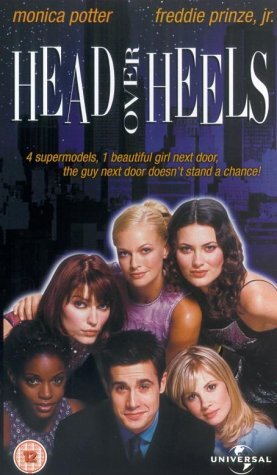
Mark Waters’ Head Over Heels (2001) definitely falls into the latter category, since it switches genres so often that it borders on being an experimental art film or a scathing satire of shallow American movie making.

But if you take a step back and look at this film from a distance, it becomes pretty obvious that Waters and his team of writers were just throwing spaghetti at the wall to see what would stick, without taking things like logic, consistency, or taste into account.

And while this approach caught me completely off guard and resulted in a memorable viewing experience, I’m under no illusion that Head Over Heels is anything more than a carnival freak show dressed up as a standard romantic comedy.

As you might have gleaned from the trailer, this film kicks off like alot of chick flicks from that era, where hard-working city gal Amanda (Monica Potter) falls for a good-looking fashion executive Jim (Freddie Prinze Jr.) despite their differences in lifestyle.

In order to capture Jim’s affection, Amanda enlists the help of her four roommates, who are all runway models and know a thing or two about attracting the opposite sex.

However, the plot takes a major turn when Amanda thinks she witnesses Jim commit a cold-blooded murder, and vows to get to the bottom of this mystery with her model roommates in tow.

It’s hard to describe in words how jarring this story pivot is, since the first 30 minutes of this movie contain nothing that foreshadows this sudden transition from Sex in the City-flavoured kookiness to Rear Window-style horror.

In fact, up until that half-hour mark, it seemed like the filmmakers were actively running through a checklist of rom-com clichés that were worn-out even by early 2000s standards.

Most of these tired tropes revolve around the main character played by Potter, who:

– uses a voiceover to highlight her romantic woes to the audience.

– has a gay best friend who only exists to be a sympathetic sounding board.   

– holds down a job that is professionally fulfilling but socially isolating.

– is conventionally very attractive even though the screenwriters pretend like she is plain.

– possesses superhuman clumsiness that is constantly used for cheap physical comedy.

It also doesn’t help that the movie’s initial set-up, where the main character moves in with four high-fashion models, seems like a failed sit-com pilot that got smuggled into a feature film.

Outside of the stagy set decor, with a bright, open-concept apartment that’s right at home with ABC’s TGIF programming block, many of the jokes feel like they were written with a live studio audience in mind.

But without the presence of any canned laughter, there’s nothing to distract from the reality that a lot of these gags are lazy and being delivered by paper-thin characters.

One of the roommates played by real-life model Sarah Murdoch is probably the most obvious example of this pedestrian writing style, since she introduces herself to the main character by talking about her pet dingo, as if her thick Australian accent wasn’t a big enough clue to her nationality.

With that set-up in mind, the movie’s transition into a murder mystery after 30 minutes is a hard pill to swallow, since the filmmakers hardly deviate from the cookie-cutter cinematic style that has already been established.

This problem is further compounded in the final third of the movie when the plot turns into a spy thriller of sorts, which just left me feeling discombobulated.

Now, one may argue that Waters is using this structure to be intentionally subversive, especially since his follow-up projects Freaky Friday (2003) and Mean Girls (2004) were all about deconstructing well-established film archetypes.

But while those movies tried to mine their shallow premises for a deeper meaning, Head Over Heels doesn’t have much on its mind beyond an overriding scorn and hatred for the fashion industry.

Plus, producer Robert Simonds outright stated in a behind-the-scenes featurette that his intention was to make more of a “throwback” romantic comedy, so any theories about Head Over Heels being a stealth critique of the genre can be thrown right out the window.

Because of this, all you’re left with is the movie’s cavalcade of dumb jokes and visual gags, which constantly flip flop between being family-friendly and adult-oriented.

One minute the characters are taking part in a cutesy make-over montage that is straight of a Disney Channel original TV show. The next they’re secretly ogling Freddie Prinze Jr. with binoculars, wondering out loud whether or not he’s had sex with the underage school girls who recently visited his apartment.

And if that tonal whiplash isn’t bad enough, the writing also suffers from an over-reliance on Three Stooges-esque physical comedy, something that is randomly deployed every time the filmmakers don’t know how to make a scene interesting.

With that being said, there are a few key moments where the filmmakers hit a home run in the comedy department, with some gross-out gags that completely blindsided me in a good way.

One of these scenes involves Freddie Prinze Jr. loudly pooping out some perogies in his bathroom as some of the investigating models hide in a nearby shower stall.

Later on in the movie, these same characters get covered in shit after they are caught in a public bathroom plumbing accident.

While the main appeal of these gags is the pure spectacle of watching pretty actors willingly subjecting themselves to such low-brow toilet humour, the film’s editor still nails the timing and does a great job of making these jokes land.

Unfortunately, these few genuinely funny moments (alongside some charming performances from members of the cast) can’t make up for the rest of Head Over Heels , which is a complete mess in terms of its writing and structure.

Even though part of me wants to admire Waters’ attempt at combining a rom com, a murder mystery, and a spy thriller into one 86-minute movie, the reality is that these disparate elements mix about as well as oil and water.

But even if this film is not destined for a Criterion Collection release, it still remains a fascinating cultural artifact that should be poked and prodded at, like some kind of grotesque laboratory specimen.  

While genre mash-ups are interesting and can be done well, the crew behind Head Over Heels approach this concept with all the skill and subtlety of a drunk lumberjack performing open heart surgery.  

Verdict:

4/10

Corner store companion:

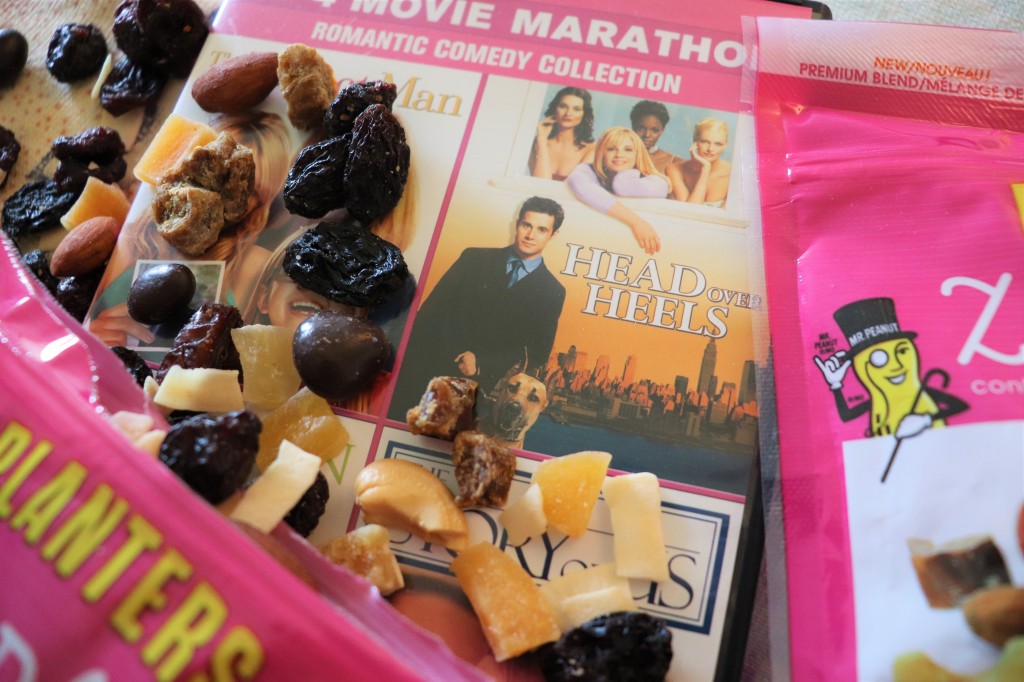
Planters Zen Blenz (because it contains a bunch of stuff that doesn’t belong together)

Fun facts:

-Release date: Feb. 2, 2001

-Budget: $14 million (estimated)

-Box office: $10,424,470 (gross in US and Canada), $13,127,022 (total gross including worldwide markets)

-There are at least three other feature films with the title “Head Over Heels,” according to IMDB. This includes a 1922 silent comedy, a 1937 British musical and a 1979 romantic comedy. A pair of short-lived comedy TV series from Britain and the United States, airing in 1993 and 1997 respectively, also bear the name “Head Over Heels.”

-The lead role of Head of Over Heels was originally supposed to go to Claire Danes, who dropped out of this project at the last minute.

Surprise cameo: Timothy Olyphant briefly shows up to play Amanda’s cheating ex-boyfriend, whose infidelity sets the whole plot in motion.

Musical highlight: “Head Over Heels” by The Go-Go’s (plays over a montage of the main characters stalking Freddy Prinze Jr. to see if he is really a serial killer)

Smokey and the Bandit Part 3 (1983) review-when a franchise runs out of gas

People often say that “good things come in threes,” but those folks obviously never watched the Smokey and the Bandit trilogy.

Sure, the series started off on the right foot in 1977 with an easy-going sleeper hit that defined “cool” for an entire generation of moviegoers.

Unfortunately, the Smokey name quickly nose-dived into sellout territory with a 1980 sequel that was in short supply of laughs, charm, and impressive stunt work.

That film was so bad that director Hal Needham declined to take part in Smokey and the Bandit Part 3 (1983), with star Burt Reynolds only agreeing to make a brief cameo.

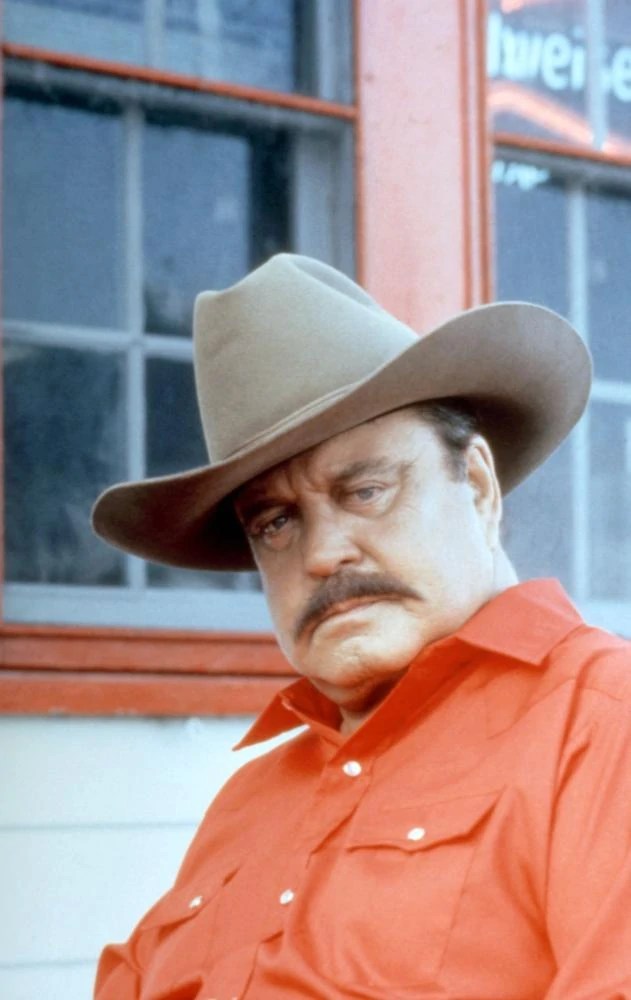
As such, the focus of this movie shifted to Jackie Gleason’s bumbling sheriff Buford T. Justice, who (mostly) serves as the protagonist this time around even though the first two films in this series were bristling with anti-authoritarian energy.

To make matters worse, Part 3 was plagued with conflicting creative visions during production, resulting in a bunch of expensive reshoots that forced the filmmakers to cobble all these disparate pieces together in the editing room.

Because of this, the theatrical Smokey and the Bandit trilogy ends on a pretty sour note, with a lazy, unfocused final entry that’s totally content with coasting on cruise control.

While the absence of Burt Reynolds is already a tough pill to swallow, the plot of Part 3 doesn’t help matters by being completely inane.

Even though Buford T. Justice serves as the protagonist here, the writers basically recycle the same story from the last two films, where a pair of wealthy Texans task the recently retired police officer with transporting some precious cargo across the American south for $250,000.

This kind of premise might have worked for an outlaw character like the Bandit, but Gleason’s cop seems like a square peg that the filmmakers are trying to stuff into a round hole.

After all, Justice never seemed preoccupied with material concerns like money throughout his first two big-screen appearances, with his motivation to catch and arrest Reynolds’ charming rogue being primarily ego-driven.

I guess the logic behind Part 3 is that Justice is bored after retiring from the force and is looking for some kind of action to relive the glory days.

But that element never gets addressed in any meaningful way, with the filmmakers being far more preoccupied with staging zany car chases and bad comedy skits.

The plot gets muddied even further with the re-introduction of Bandit’s sidekick Cledus Snow (Jerry Reed), who is hired to disguise himself as the famous outlaw and distract Justice on the road so that he doesn’t arrive at his destination in time.

It’s at this point that the movie goes from being lazy to outright shameless in terms of its attempt to hoodwink the audience into thinking they’re watching the first film.

Not only do the filmmakers dress Reed up in Reynolds’ iconic red shirt and cowboy hat, but they also give him the keys to the Pontiac Trans Am and have him pick-up another runaway woman who isn’t Sally Field.

Even though Reed tries to put his own spin on the Bandit character, he comes across as a cheap imitation of Reynolds and not even an amusingly absurd one like Norm MacDonald’s work on SNL.

This element of the movie also highlights the behind-the-scenes production woes that plagued Smokey and the Bandit Part 3.

According to multiple sources, Reed wasn’t even supposed to be involved, with the original plan being that Gleason would tackle a dual role as both Sheriff Justice and the Bandit.

However, this version of the film, titled “Smokey is the Bandit,” was disliked by test audiences, which encouraged Universal Pictures to order re-shoots with Reed’s participation.

While the severity of these re-shoots is still a matter of debate, it’s clear that these last-minute production changes had a significant impact on the final product, given how disjointed everything feels.

Since the filmmakers don’t fully commit to Justice or Reed as the main character, there’s no emotional throughline to lead the audience through this razor-thin story that mostly consists of throwaway car stunts, janky editing and bad ADR.

In fact, if one were to take out the end credits and the two-and-a-half minute introductory recap that consists of archive footage, this movie is barely feature length, which is undoubtedly a consequence of all the “Smokey is the Bandit” footage being scrapped.

But with that being said, Part 3 isn’t a total bust and actually does improve on its predecessor in one key area.

While the team behind Smokey and the Bandit II (1980) were surprisingly reluctant to stage any car chases until the very end of that film, director Dick Lowry and his crew do a much better job of pacing the action this time around.

Admittedly, a lot of the stunt work here is pretty basic and way too reliant on slow motion to artificially crank up the excitement of every chase.

But at least the automotive destruction is in good supply here and should satisfy anyone who just wants to see a police cruiser plow through a milk tanker.

Part 3’s soundtrack is also surprisingly strong, offering a variety of original tracks from country music heavyweights like Lee Greenwood and Ed Bruce.

So on a purely surface level, this film provides all the sights and sounds one would expect of a road comedy from this era, although there’s not a lot to praise beyond that.

Overall, the project feels like a lot of the cynical sequels and remakes that get made these days, where the audience is constantly bombarded with winks and nods to the original property they like, without anything fresh or original being offered in return.

But whereas these soulless cash-grabs keep racking in major box office returns today, moviegoers in 1983 at least had the good sense to stay away from Smokey and the Bandit Part 3 in droves.

In stark contrast to the $120 million that the first Smokey film generated, Part 3 couldn’t break even on a $9 million budget, meaning the franchise had officially run out of gas.

Of course, the Bandit name didn’t completely die out after this bomb, with Hal Needham eventually bringing the character back just over a decade later, this time on the small screen.

But that’s a story for another time.

For now, I just hope the lost “Smokey is the Bandit” footage eventually sees the light of day, since the surviving promotional image of Gleason dressed up like Reynolds is way funnier than most of the jokes in Part 3.

Verdict:

4/10

Corner store companion:

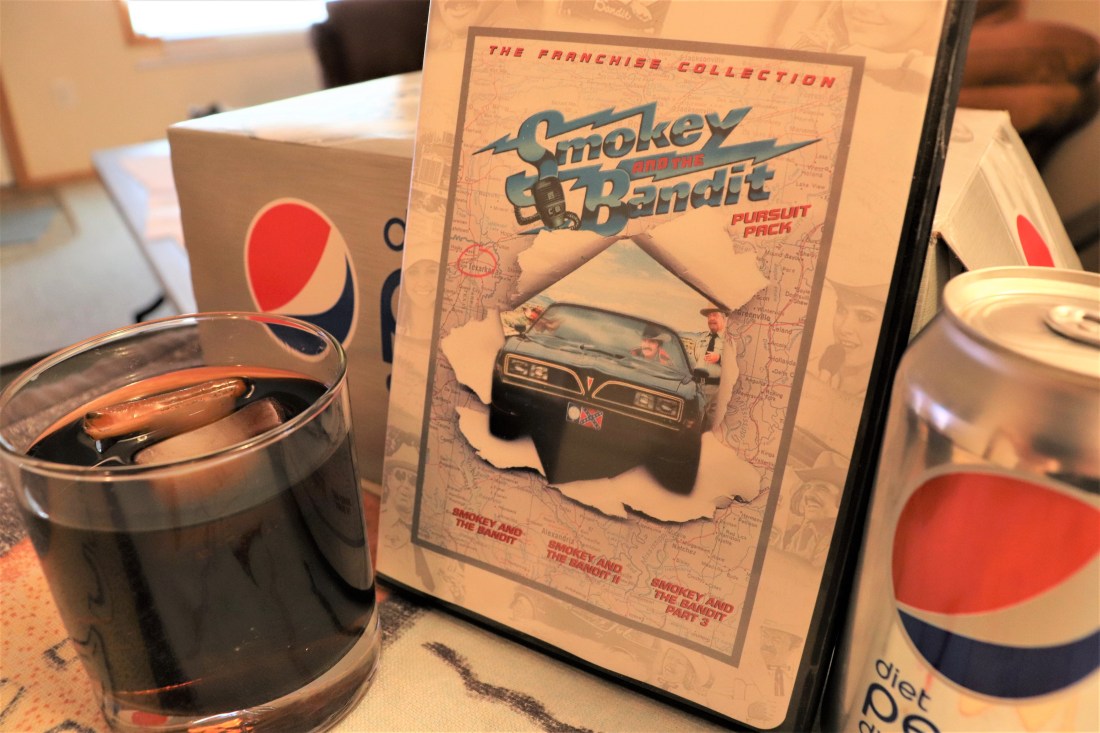
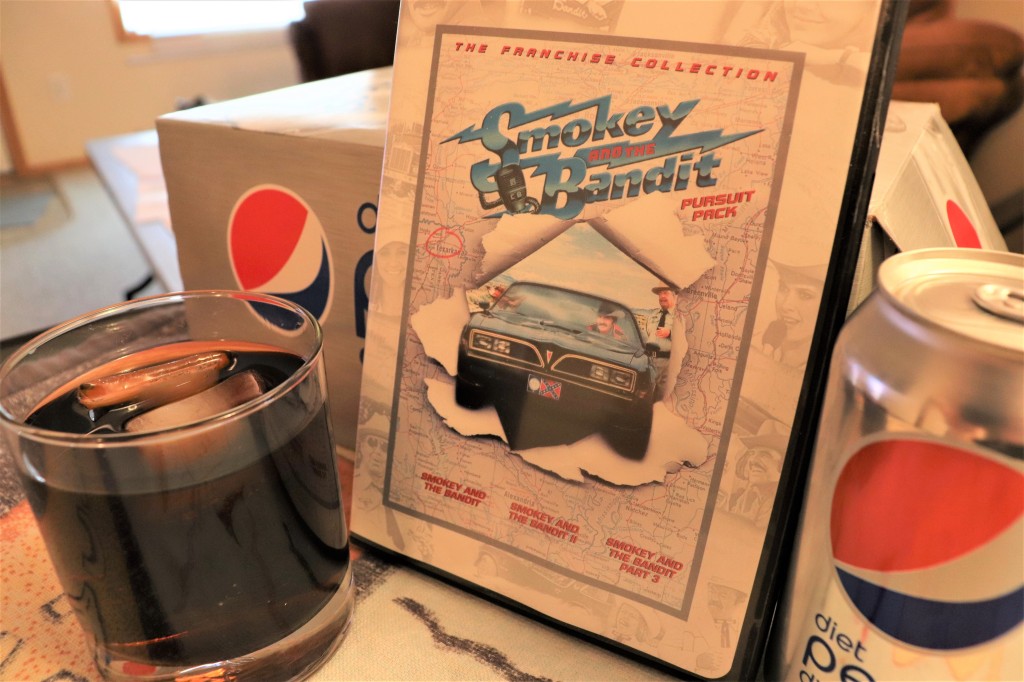
Diet Pepsi (because it’s that thing you like, without some of the key ingredients that make it cool)

Fun facts:

-Release date: Aug. 12, 1983

-Box office: $5,678,950

-Budget: $9 million

-Roger Ebert named Smokey and the Bandit Part 3 one of the worst movies of 1983, calling it an “annuity in action” for how blatantly it was trying to capitalize off of the box office success of the first two films.

-In 1983 Jackie Gleason also starred in The Sting II, another maligned sequel to a beloved film that retained none of the original leads.

Smokey and the Bandit Part 3 marks director Dick Lowry’s only theatrical release. Lowry spent the rest of his career helming television projects.

-Remnants of the old “Smokey is the Bandit” footage can be glimpsed in certain sections of Part 3, since Reed’s stunt double is sometimes a heavy-set man who was obviously meant to be a stand-in for Gleason. 

-Musical highlight: “The Bandit Express” by Lee Greenwood (plays during one of the movie’s many car chases).

Sisters of Death (1976) review-too dumb to live

If I were to give any unsolicited advice to an aspiring screenwriter it would be this: start with a bang and end strong.

In my experience, a good beginning and conclusion can salvage a complete cinematic misfire, or at least help you forgive some of the glaring problems that dominate a movie’s middle section.

Outside of the newest entry in the James Bond franchise, my most recent encounter with this phenomenon took place during a viewing of Joe Mazzuca’s Sisters of Death (1976), a low-budget horror film that is rife with plot holes, cheap titillation, and bad production values.

However, I couldn’t bring myself to truly hate this film, since there were enough interesting elements at play to hold my attention for 97 minutes (including a really entertaining finale).

Still, I wouldn’t go as far to say that Sisters of Death is some kind of underrated horror masterpiece or anything, since the film often looks and feels like a porno with all the explicit sex scenes taken out.

The plot of Sisters of Death kicks off with a literal bang, where a secret college sorority initiation ceremony goes horribly wrong and results in one of the pledges being shot in the head.

Seven years later, the surviving members of the sorority meet up for a reunion at a secluded compound, although nothing is as it seems.

Once the women realize that they have been trapped by an electric fence, paranoia begins to set in once a mysterious killer starts picking them off one by one.

On paper, this sounds like a perfectly serviceable premise for an exploitation flick, especially with noted b-movie queen Claudia Jennings serving as the main lead.

And like I mentioned before, the opening couple minutes of this film serve as a great hook, where the filmmakers use an ethereal score and sudden burst of violence to set the stage for a movie that’s meant to be equal parts mystery and slasher.

Unfortunately, the script really starts to fall apart as soon as the plot gets rolling, since virtually all of the characters make one bone-headed decision after another, even by horror movie standards.

For one thing, the invitation to this college reunion was sent out by a mystery benefactor, which doesn’t set off any alarm bells for most of the women involved.

The majority of these ladies also find no problem with getting into a car with two strange men who were hired to drive them out into the middle of the desert.

And when they finally arrive at their destination, the sorority sisters are thrilled to find that this shadowy figure has supplied them with champagne and their own bathing suits to enjoy the compound’s luxurious pool area.

This serious lack of curiosity and self-preservation makes you resent these characters before they are even put in mortal damage, which robs the latter half of this movie of any real tension.

And that’s a real shame, since the entire cast are obviously doing their best to work with the material they were given.

Even though the sorority sisters are brainless idiots, the actresses playing them all have great chemistry and really sold me on the idea that they are old friends.

The movie’s screenwriters also do a decent job of imbuing the five main actresses with unique personalities, which helps you at least keep track of all the main characters once they start dropping like flies.

The people behind the camera should be given some credit as well, since they made the wise decision to utilize a lot of long takes to build suspense. 

Combine all these lingering shots with an eerie, atmospheric score and Sisters of Death occasionally resembles the better “Giallo” Italian horror movies that were coming out around the same time, albeit with a fraction of the same directorial skill that was wielded by filmmakers like Dario Argento.

Because as hard as he tries, Mazzuca’s cinematic ambitions are constantly at odds with the poor production values that plague most of this movie.

One of the most glaring examples of this dynamic is the “giant” electric fence that is meant to keep all the main characters from escaping the compound.

While I’m sure the original script for Sisters of Death specified that this fence needed to be 20-30 feet high, what ends up on the screen is a structure that is barely taller than an average man.

As pointed out by YouTuber Robin Bailes, the characters could have easily escaped this deadly scenario if they simply stacked some furniture next to this fence and hopped to the other side.

Instead, the sorority sisters and their two male companions simply wait around like sitting ducks and continue to go about their day and night almost like nothing had even happened, deciding to take hot showers and go to bed in their underwear.

This would have made sense if Sisters of Death was an outright porno, where the filmmakers were financially obligated to crowbar some inorganic sex scenes into the plot every five minutes or so.

But since that never happens, all I’m left with is the cinematic equivalent of blue balls and lingering thoughts like: “why didn’t they stay outside where the killer can’t sneak up on them?”

It also doesn’t help that the movie’s editor was seemingly asleep at the wheel, since I spotted the crew’s boom mic in at least five different shots.

But despite all those shortcomings, Sisters of Death actually manages to pull itself together for the final 10 minutes, where all the various plot threads wrap up in a pretty compelling fashion.

I won’t spoil what happens, but suffice it to say that Mazzuca and his screenwriters successfully threw some curveballs at me that I wasn’t expecting for a film of this caliber.

And while a strong ending isn’t enough to override the film’s many shortcomings, it at least made me feel like I hadn’t completely wasted my time.

Is this a back-handed compliment? Sure. But if the writers of Seinfeld have taught me anything, it’s that glaring character flaws can be forgiven if you leave the audience on a high note.

Verdict:

5/10

Corner store companion:

Wagon Wheels (because the middle is the worst part)

Fun facts:

-Release date: April 19, 1976 (IMDB), August 1977 (Wikipedia)

-According to IMDB, this movie was originally shot in 1972, but wasn’t released until several years later.

-Actress and Playboy Playmate Claudia Jennings, who plays the lead character in Sisters of Death, tragically died in an automobile accident on Oct. 3, 1979, only a few years after this movie was released. She was 29 years old.

Sisters of Death marks Joe Mazzuca’s last project as a live-action film director before switching over to being a production manager for several animated TV shows. His filmography includes work on programs like: Fat Albert and the Cosby Kids, He-Man and the Masters of the Universe, She-Ra: Princess of Power, Muppet Babies, and Dexter’s Laboratory.

Sisters of Death can be viewed in its entirety on YouTube.

A Walk to Remember (2002) review-Is it dusty in here or something?

My inaugural journey into the Nicholas Sparks cinematic universe got off to a shaky start last year, with Message in a Bottle (1999) providing lots of beautiful imagery but a fundamentally flawed love story at its core.

Because of this, I booted up A Walk to Remember (2002) with some serious reservations, expecting the same unbalanced experience that failed to show me why Sparks’ brand of romantic fiction has resonated with so many people.

However, this time around, the cast and crew behind the author’s second big-screen adaptation really went out of their way to sell you on the central relationship between the two leads, which is all you really need for this kind of movie to work.

The plot of A Walk to Remember revolves around rebellious high schooler Landon (Shane West), whose tendency to hang around with the wrong crowd eventually lands him in hot water with the law.

In order to avoid jail time and expulsion, this troubled young man signs up for a variety of community service programs, which puts him in close proximity with fellow student Jamie (Mandy Moore).

Even though they come from different backgrounds, the pair form an unlikely romantic bond that puzzles Landon’s friends and worries Jamie’s minister father. 

Now, if you read that synopsis (or watched the above trailer) and rolled your eyes I wouldn’t blame you.

This “star-crossed lovers” premise has been executed hundreds of times on film and A Walk to Remember does very little to mix up that formula.

In fact, it’s almost comedic how far director Adam Shankman goes to position West and Moore as an unlikely couple in the beginning.

Not only does the pair dress like they are inhabiting different centuries, but the film’s soundtrack even reinforces this disconnect by giving each character contrasting musical cues.

While Moore is usually surrounded by a choir or gentle, ambient music, West’s bad boy interloper is constantly backed by a punk or grunge band whenever he is on screen.

Even though this technique accomplishes its goal of distinguishing these two characters, the filmmakers lay it on way too thick, to the point where each scene transitions feels like you are jumping into a completely different movie.

This ham-fisted set-up also isn’t helped by some clunky dialogue early on, where screenwriter Karen Janszen decided to cram a lot of Jamie’s backstory into a single conversation.

But as the plot moves forward, a lot of those glaring weaknesses begin to fade away as the dynamic between Moore and West finally takes shape, which is hands down the best part of the movie.

Not only does the pair have crazy chemistry, but Janszen also maps out some pretty satisfying character development through their evolving relationship.

Like most great movie romances, Landon and Jamie bring the best out of each other as they become closer, helping to fill an emotional void that both characters have had to endure because of an absent parental figure.

Once this bond really takes hold, both characters demonstrate their ability to grow as people, with Jamie learning to come out of her shell while Landon finally showcases some empathy that he had been lacking up until this point.

And then, cruelly, Sparks pulls the rug out from under the audience with a third act revelation that has made this story a prolific tearjerker for an entire generation of readers and moviegoers.  

A WALK TO REMEMBER, Mandy Moore, Shane West, 2002 (c) Warner Brothers/courtesy Everett Collection.

Again, nothing about this framework is revolutionary, and A Walk to Remember got righteously raked over the coals by critics when it was originally released for being “boring,” “melodramatic,” “cliché-ridden” and even “simple-minded.”

However, I believe that this simplicity is why the movie works so well, since it is laser focused on the two appealing leads and doesn’t get bogged down in a bunch of unnecessary sub plots.

In fact, one of the film’s biggest missteps, in my eyes, are these brief digressions involving Landon’s estranged father, who doesn’t meaningfully add to the plot and should have been cut out of the story altogether.

Because, at the end of the day, all the audience really cares about is watching Moore and West interact on screen, and for very good reason.

 The back and forth between these two is very fun to watch, since they genuinely appear to enjoy each other’s company and don’t rely on the film’s soundtrack or cinematography to do the heavy lifting.  

Moore is particularly impressive inhabiting a role that requires her to act like a full-grown adult stuck in a teenager’s body, especially since she was only 17-18 at the time of filming. 

And when that tragic third act revelation finally rears its ugly head, her performance actually takes on a whole new layer of meaning, encouraging you to watch the whole movie again with this new information in mind.

Admittedly, these two strong lead performances aren’t backed up by any real impressive filmmaking, since Shankman’s direction is pretty bland and doesn’t hold a candle to the scenic vistas that were on display throughout Message in a Bottle.  

That being said, he does show some flourishes every now and again by utilizing the occasional long take, including a series of lengthy tracking shots that introduce a lot of the supporting cast in the opening minutes of the movie.   

Still, I’m not going to pretend like Shankman’s mise-en-scène in A Walk to Remember is particularly noteworthy or eye-catching.

In fact, it seems like most of those key visual elements—like composition, production design, lighting and costuming—are being used to service the two main leads as opposed to all the surrounding scenery.

But, in retrospect, that decision was probably for the best, since the relationship between Moore and West is the main selling point of the movie. And in that respect, I think most people left the theatre back in 2002 feeling like they got their money’s worth.

Overall, I think the main reason why A Walk to Remember succeeds where other romantic dramas fail is that the central love story is simple and earnest.

Even when the plot veers off into some heavy subject matter later on, the film doesn’t feel overly manipulative or like it is trying too hard to make the audience weep.

Instead, those tears flow from a very natural place, which is a testament to Janszen’s script and the original source material.

I don’t know if any of Sparks’ other screen adaptations contain similar levels of emotional potency, but I’m looking forward to seeing where this journey takes me.

After all, if I’m going to cry living under these lockdown conditions, I’d prefer my source of woe to be a piece of media rather than the crushing realization that I can’t see my friends and family right now.

Er …. anyway … Happy Valentine’s Day!!!

Verdict:

7/10

Corner store companion:

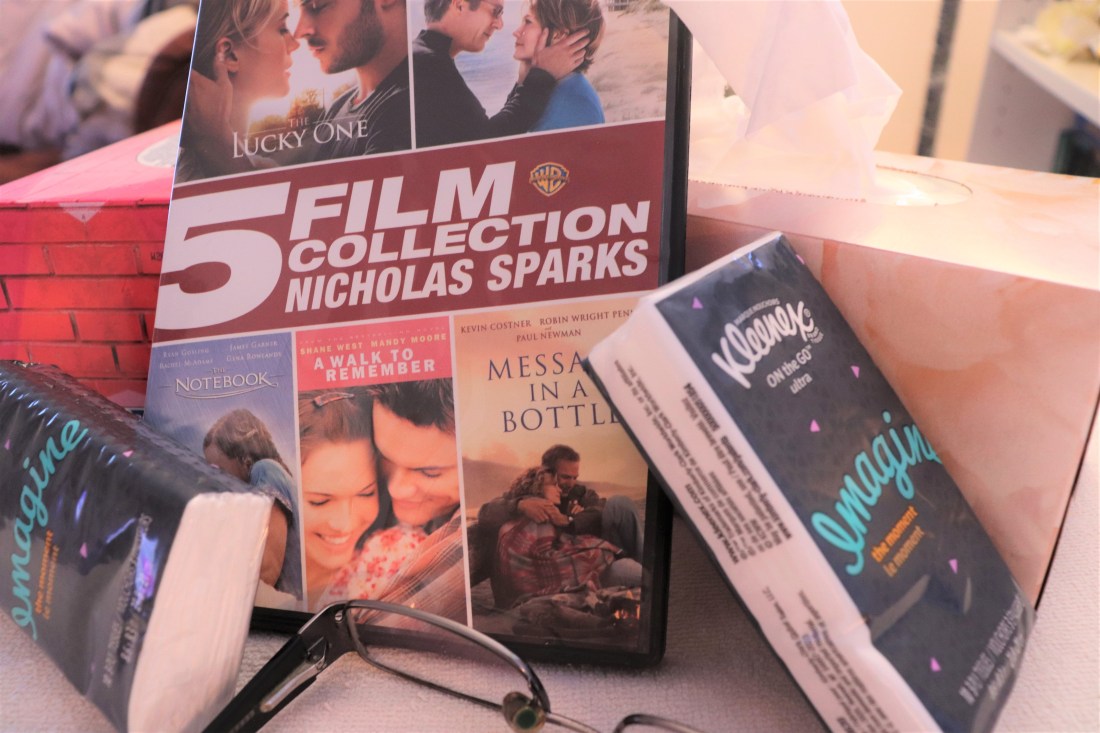
Scotties and Kleenex brand tissues (because you’ll really need them for the final reel of this film)

Fun facts:

-Release date: Jan. 25, 2002

-Budget: $ 11,800,000 (estimated)

-Box Office Gross: $ 41, 281,092 (domestic), $47,494,916 (worldwide)

A Walk to Remember serves as Mandy Moore’s first major movie role following her well-established career in music. Before this film, she mostly nabbed supporting roles in films like Dr. Dolittle 2 and The Princess Diaries.

-Many of the sets featured in A Walk to Remember were used by the cast and crew of Dawson’s Creek, a long-running teen drama that was also shot in Wilmington, North Carolina.  

-Even though Sparks’ original novel took place in the 1950s, he and the filmmakers decided to update the setting to the 1990s/2000s for the screen adaptation, believing that this change of scenery would resonate a lot more with modern audiences.

-In a 2015 interview with The Wrap, Shane West revealed that he was so enamored with the 1967 Chevrolet Camaro he drove in this film that he bought this classic muscle car following the first week of shooting.

-Like Moore, Shane West has an extensive background in music as well as acting, serving as the lead singer of the punk bands Johnny Was in the 1990s and Twilight Creeps in the 2010s.

-Musical highlight: “Cry” by Mandy Moore (this thematically appropriate song plays over the movie’s closing credits)

Deck the Halls (2006) review-just watch Christmas Vacation instead

One of my family’s more consistent holiday traditions is watching National Lampoon’s Christmas Vacation every December, although we’re far from the only people to do so.

Ever since that movie was released in 1989, it has gone on to become required viewing in a lot of households, due in large part to the film’s memorable cast and John Hughes’ crackerjack script.  

Even if you’ve never seen Christmas Vacation before, chances are you’ve already experienced a lot of its sights and sounds through cultural osmosis, like Chevy Chase’s epic meltdown during the movie’s climax.

In fact, Christmas Vacation was so influential that director John Whitesell decided to recycle a lot of the same story beats and plot elements for his own holiday-themed comedy Deck the Halls in 2006, although he neglected to capture the same wit and heart that made that original film so memorable in the first place.

For those of you who missed it, the plot Deck the Halls revolves around two rival neighbours played by Danny DeVito and Matthew Broderick, who start to butt heads due to their conflicting beliefs on how best to celebrate the holidays.

While Broderick’s Steve just wants to organize a quiet family Christmas, DeVito’s Buddy strives to make the biggest public spectacle possible, dressing his house up in hundreds of thousands of lights in the hopes that the dwelling can be seen from space.

As this war of attrition gradually escalates, both men’s families get caught in the crossfire, which threatens to tear them apart for good.

While it may not seem like a watered-down Christmas Vacation rip-off on the surface, Deck the Halls contains way too many similarities to the 1989 classic for it to be a coincidence.

Not only is a father’s infatuation with creating the perfect old-fashioned family Christmas the main narrative through line in both films, but a variety of jokes and plot points are also shared between the two. These parallels include:

-A character obsessing over decorating their house in as many lights as possible.

-A holiday advent calendar being used to chronicle the passage of time.

-A Christmas tree expedition going horribly awry.

-An extended gag where the main character loses control going down a snowy hill.

-Growing tension between neighbours resulting in lots of property damage.

I’m sure there’s other similarities I missed, but the point is that Deck the Halls’ three screenwriters (Matt Corman, Chris Ord and Don Rhymer) did their best to lift material from Hughes without attempting to replicate his ability to balance slapstick humor and relatable family drama.

Because of this, all the movie has to offer is a series of cartoony pratfalls and one-liners that occasionally entertain, but don’t stick with you on any meaningful level. 

Admittedly, Deck the Halls did make me laugh on a number of occasions, although most of those chuckles could be chalked up to the movie’s over reliance on physical comedy.

I’m an easy man to please when it comes to this style of humour, and the filmmakers at least knew how to stage a lot of these low brow gags in a satisfactory manner.

However, the same cannot be said for a lot of the movie’s verbal jokes, which usually land with a dull thud due to how they are put together in post.

It seems like the editors always leave a moment of silence at the end of every punchline to give the audience room to laugh, even though this technique spectacularly backfires more often than not due to awkward it is.

But the film’s biggest sin, by far, is its uneven tone that occasionally switches between wholesome family entertainment and raunchy sex comedy.

Even though Deck the Halls is rated “G” by the MPAA, the screenwriters somehow managed to get away with loading up their script with a bunch of suggestive jokes that are quite blunt and not clever in the slightest.

Normally, this sort of thing wouldn’t bother me, since studios like Disney, Pixar and DreamWorks always sneak some dirty joke into their children’s films.

But with Deck the Halls, it seems like these gags are clumsily crowbarred into the movie for no real rhyme or reason other than to alienate the movie’s target demographic.

One of the more mean-spirited recurring bits in the film involves the local police sheriff, whose propensity to wear lady’s underwear creeps Broderick out to the point where he doesn’t report any of DeVito’s various bylaw infractions.

Because, according to these writers, nothing gets people in the holiday spirit more than judging others for what they decide to wear underneath their work clothes.  

The absolute worst example of this approach to comedy comes later on in the film, when Broderick and DeVito unknowingly cat call their respective underaged daughters at a winter fair, with Broderick’s character even going so far as to yell “who’s your daddy?”

Not only is the act of inserting an incest joke into a family film a slight against human decency, but this scene doesn’t even make sense from a script-writing perspective, since neither character have displayed any outwardly pervy behaviour up until this point in the story.

Outside of testing my gag reflex, this one scene actually exemplifies why Christmas Vacation works and Deck the Halls doesn’t.

Sure, Hughes’ film featured a lot of off-colour jokes and some questionable decision-making from its protagonist, but that story was at least anchored in some recognizable holiday season struggles that most people can relate to.  

Deck the Halls, on the other hand, is an absolute farce, mostly due to the fact that its main characters are completely unlikable and have problems that no one can identify with.

For instance, DeVito’s goal to ensure that his house can be seen from space is treated like it is a noble endeavor instead of a rabid act of consumerism.  

Now, this element could have potentially worked if the screenwriters turned the story into a satire about Christmas commercialism gone amok. But I think that idea went right over the filmmakers’ heads and they decided to take such a shallow ambition at face value.

With all that being said, I don’t think Deck the Halls is as bad as a lot of other critics say it is, especially since sites like Vogue, Paste Magazine,  and Rotten Tomatoes currently rank it as one of the worst holiday movies of all time.

While the film is definitely vapid and soulless, it did manage to elicit a few laughs from me, which is more than welcome as this dumpster fire of a year finally comes to a close.

However, I will probably never get the impulse to watch Deck the Halls ever again, whereas the movie it was clearly trying to rip off (Christmas Vacation) still has a permanent place on my annual holiday watch-list.

Verdict:

4/10

Corner store companion:

Holiday M & M’s (because DeVito played the human version of an M & M in a Super Bowl commercial one time)

Fun facts:

-Release date: Nov. 22, 2006

-Budget: $51 million

-Box Office Gross: $35,093,569 (domestic), $47,232,776 (worldwide)

-Film critic Richard Roeper ranked Deck the Halls as the sixth worst movie of 2006 (alongside Unaccompanied Minors) during an episode of At the Movies with Ebert & Roeper

Deck the Halls picked up three nominations at the 2007 Golden Raspberry Awards, including Worst Supporting Actress (Kristin Chenoweth), Worst Supporting Actor (Danny DeVito) and Worst Excuse for Family Entertainment.

-Surprise cameo: Kal Penn (of Harold and Kumar fame) shows up briefly to play a software engineer whose program, My Earth, is being utilized to determine if DeVito’s Christmas decorations can be seen from space. The most notable thing about this performance is Penn decided to adopt a terrible British accent for some reason.