Shooter (2007) review-just off the mark

Lately, I’ve been getting this sinking feeling that certain genres of film are becoming completely irrelevant to modern audiences. This endangered species list includes any thriller or drama that touches on contemporary U.S. politics, given how chaotic, fractured, and patently absurd the real-life machinations of the current administration are. After all, how can a Hollywood screenwriter compete with the sheer ludicrousness of SignalGate or top the cartoonish villainy exhibited by a shifty interloper like Elon Musk?

In this context, Antoine Fuqua’s Shooter (2007) seems pretty tame by comparison. This is because the film’s U.S. government baddies are at least marginally intelligent and vaguely discreet when it comes to enacting their evil plans, not at all like their modern, real-world counterparts.

But regardless of the differences between Bush and Trump era politics, these conspiracy-themed thrillers can be a lot of fun, as long as they have a decent script, smooth pacing, and some tight direction.

Shooter definitely excels in a few of these areas, providing the perfect kind of disposable action movie fluff to watch on a lazy Sunday afternoon alongside your dad.

Unfortunately, the film is also weighed down by a weak lead performance and far too many genre cliches, making it hard to distinguish from the dozens of other “one man army” stories clogging up your local DVD bargain bin or drugstore book rack.

The eponymous “Shooter” in this film is Mark Wahlberg, who steps into the boots of elite Marine sniper Bob Lee Swagger. Despite being retired from the U.S. military for several years, Swagger is pulled back into service by Colonel Isaac Johnson (Danny Glover), who needs his help to thwart a presidential assassination attempt. However, the job quickly reveals itself to be a set-up, with Swagger being blamed for killing the Archbishop of Ethiopian (who was standing next to the American president during the shooting). Now on the run, Swagger must clear his name and get to the bottom of a vast conspiracy that reaches all the way to the U.S. Senate.

Like I mentioned at the top, the film’s major weak link is Wahlberg, who does very little to elevate this material above your standard action schlock.

Sure, Marky Mark pulls off the right rugged look and is convincing when he’s holding a gun. But there’s very little in his performance that helps engage the audience on an emotional level.

One moment that stuck out to me was when Swagger’s love interest (Kate Mara) tells him that the bad guys killed his dog. Rather than reacting with piercing sadness or explosive anger over the murder of his best friend, Wahlberg responds with mild annoyance, like someone just told him that he needs to replace his Brita filter.

Unfortunately, Wahlberg remains stuck in this subdued acting mode for most of the film’s runtime, offering only brief glimpses beneath his stoic persona.

I’m not suggesting he needed to break down crying every five minutes to be more relatable or whatever, but some psychological insight would have been welcome.

Maybe this could have been accomplished through casting an older actor, someone capable of bringing a genuine world-weary quality to the role.

According to IMDB, men like Clint Eastwood, Tommy Lee Jones, and Harrison Ford were all considered for the part, which sounds like a much better fit for the vibe the movie was trying to convey.

But to be fair to Wahlberg, the film’s script doesn’t do him any favours.

Despite being established as a conspiratorial shut-in (who lives in the mountains and reads the 9/11 Commission Report for fun), Swagger is surprisingly willing to trust this shadowy government figure (Glover) and fall for the most obvious frame up job of all time.

So when he’s betrayed and literally shot in the back, I was left wondering why Swagger didn’t have any contingency plans in place, since being a rigid individualist who doesn’t trust the government is one of his only defining character traits.

Plot nitpicking aside, Shooter at least delivers the goods once Wahlberg goes on the run.

While nothing approaches the tension director Andrew Davis created for The Fugitive (1993), Fuqua and his team make up for that by staging some impressive kinetic action.

This means juicy blood squibs, bright muzzle flashes, and big practical explosions, all tied together with crisp editing that makes the moment-to-moment carnage easy to follow.

The best example of this technical expertise is on display in the third act, when Wahlberg teams up with a sympathetic FBI agent (Michael Peña) to storm a rural compound full of cannon fodder enemies.

This flashy spectacle is also helped by the cast of great character actors assembled to play the bad guys.

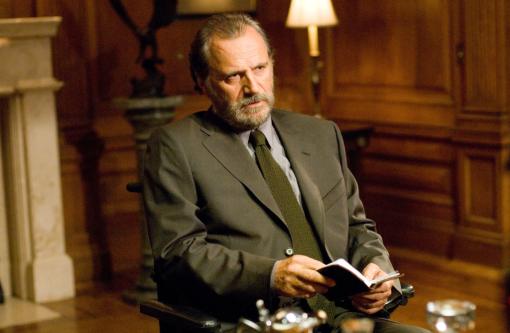
Outside of Glover, this rogue’s gallery includes the likes of Ned Beatty as a corrupt U.S. senator and Elias Koteas as a psychopathic henchman on Wahlberg’s trail.

While these three are suitably over-the-top, and serve as the perfect rivals for Wahlberg’s salt-of-the-earth veteran, the movie does at least carve out some depth for Rade Šerbedžija.

The well-known Croatian actor makes the most of his tiny role as a wheelchair-bound sniper who is working under the thumb of Glover’s corrupt army colonel.

Even though most of his lines are relegated to a single exposition dump, Šerbedžija conveys a lot of potent regret and melancholy through his delivery alone, making me wish the movie was about him instead.  
Unfortunately, familiar action movie tropes eventually pile up and dilute whatever unique sense of identity Shooter had going for it.  Some of these trappings I’m willing to forgive, like all the bad guys not being able to hit the broad side of a barn in a firefight. But other cliches are pretty egregious and took me out of the movie. These moments include:

  • Wahlberg’s soldier buddy pulling out a photo of his wife moments before getting ravaged by bullets
  • Mara delicately dressing the wounds of a naked Wahlberg despite barely knowing him
  • One of the bad guys delivering the “we’re not so different, you and I” speech to Wahlberg as he’s being held at gunpoint
  • Wahlberg being way too cool to look back at the explosion he just set off

Many of these moments were old hat in the 1990s, so the fact that they were smuggled into a 2007 film (without anyone in production batting an eye) is very concerning.

And while Shooter is fairly generic overall, I will at least give the filmmakers credit for grounding it in the specific real-world politics of the time.

Instead of taking the coward’s way out and giving the bad guys vague motivations (as to not offend anyone), the screenwriters zero in on U.S. foreign policy being a pervasive antagonistic force.

Not only is the Abu Ghraib torture scandal mentioned by name, but most of the plot revolves around [SPOILERS] the American military covering up an African village massacre to further Big Oil business interests.

After watching my fair share of military propaganda for this blog, it was refreshing to see U.S. imperialism portrayed in a critical light, even if it is packaged in a movie where the hero solves all his problems with brute force.

In that sense, Shooter may resonate with more people in 2025 than it did in 2007, given that the current American government is explicitly threatening to annex places like Greenland, Panama, and even my home country of Canada

I’m not suggesting that a dumb action movie like Shooter will wake people up to this growing American hegemony or shake them from the kind of political apathy that allows evil to flourish.

But if someone receives a shock to the system by noticing how these goofy movie villains are being eclipsed by the sinister actions of real-world politicians, then maybe this film is a worthwhile watch after all.

Plus, did you see that scene where Wahlberg sniped three guys while standing up in a boat? That was sick!

Verdict:

6/10

Corner store companion:

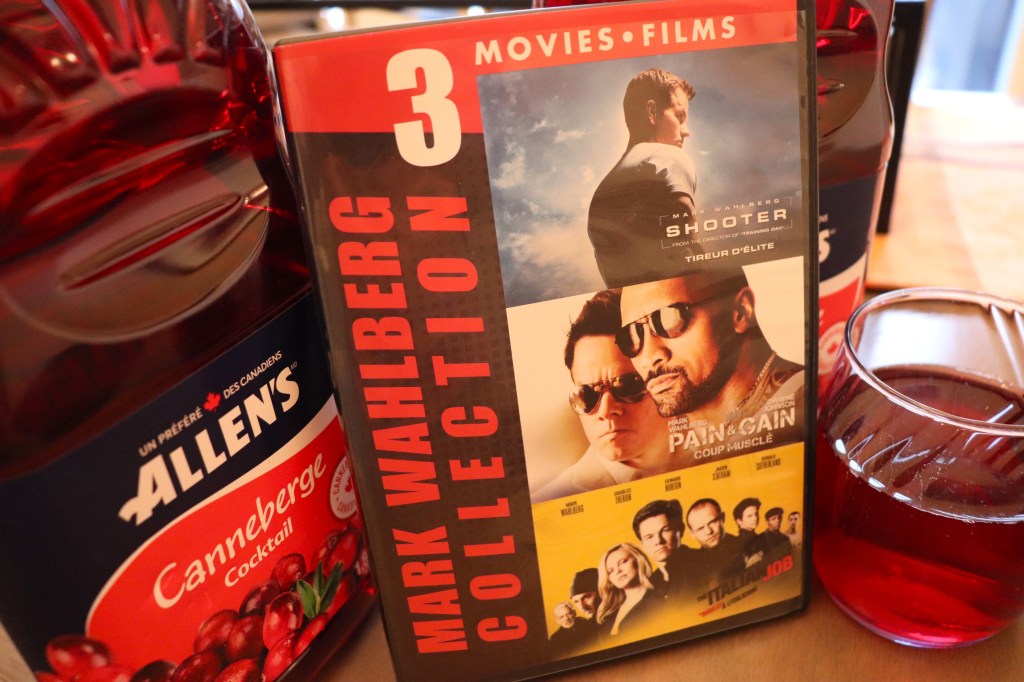
Allen’s Cranberry Juice (because when it comes to resisting U.S. imperialism, buying a Canadian food product is on the same level as watching a vaguely anti-American film from 18 years ago)
Fun facts:

Release date: March 23, 2007

Budget: $61 million

Box office: $95.7 million

-The character Bob Lee Swagger was originally created by author/film critic Stephen Hunter and first appeared in the 1993 novel Point of Impact. Hunter has written 12 books in the Bob Lee Swagger series, with the last story (Targeted) being published in 2022.

-The gun expert Wahlberg meets in the middle of the film is played by musician Levon Helm, who served as a drummer for The Band and was a 1994 inductee into the Rock and Roll Hall of Fame. Outside of his lengthy music career, Helm also appeared in films such as Coal Miner’s Daughter (1980) and The Right Stuff (1983).

-This film was later spun off into a TV series that ran for three seasons (2016-2018) on the USA Network. Ryan Phillippe took over the lead role from Wahlberg and the plot of the TV show revolved around the first three novels in the Bob Lee Swagger book series.

-Musical highlight: “Nasty Letter” by Otis Taylor (plays during the end credits)
In The Navy (1941) review-pratfall propaganda

Much has been written about the manufacturing might of the United States during times of conflict.

This is especially true during the Second World War, which sparked an industrial boom that single-handedly lifted America out of the Great Depression.

But outside of producing tanks, planes, and battleships, the U.S. was also keen on pumping out a flood of pop culture properties that kept the public sympathetic to the war effort.

This was mostly accomplished through the U.S. Office of War Information, which reviewed over 1,600 scripts throughout 1942-1945, excising anything that cast the country in a bad light.

But even before America officially entered the conflict (in December 1941), military officials were already deeply involved in various Hollywood productions, including the escapist comedies of Bud Abbott and Lou Costello.

In fact, the duo got their first big break in the movies through the military-themed Buck Privates (1941), which became so financially successful that it spawned two follow-up “service comedies” that same year.

The second part of this spiritual trilogy, In the Navy, was shot and released four months after the original, and that quick turnaround definitely shows.

While Buck Privates was charming because of its loose plot and slapstick gags, this nautical follow-up feels pretty lazy by comparison, content with coasting off Abbott and Costello’s newfound fame on the big screen.

The filmmakers’ military overseers also had a noticeably heavier hand in production this time around, to the point that the movie’s finale gets completely torpedoed thanks to third-party meddling.

As a result, it’s hard to see In the Navy as anything other than a blatant piece of military recruitment propaganda, despite it being able to squeeze in a couple decent laughs here and there.

After being relegated to a supporting role in Buck Privates, Abbott and Costello get promoted to main-character status for In the Navy, serving as a pair of hapless sailors who are eager to prove themselves on the high seas.

The duo eventually cross paths with a famous crooner (Dick Powell), who enlists in the navy under a fake name to escape the showbiz limelight.

Abbott and Costello agree to help the singer conceal his identity, which is a lot easier said than done now that an ambitious photojournalist (Claire Dodd) is on the hunt for an exclusive.

Many of the observations I made during my original review of Buck Privates hold true in this pseudo sequel, although the formula has hit some diminishing returns.

As expected, Abbott and Costello’s comedic chemistry is beyond reproach, with rapid-fire zingers and swift physical gags being delivered with pinpoint precision.

The pair work wonders even when things don’t go according to plan. An obvious outtake involving Abbott and Costello spitting water at each other is just left in the final cut of the film and remains one of biggest laughs In the Navy has to offer.

However, several of these routines drag on for far too long and bring the movie’s pace to a screeching halt.

One memorable scene involving a chaotic shell game eats up around five minutes of screen time, ending on a punchline that fails to justify such a lengthy, plotless detour.  

Another skit involving Costello’s unique math skills is similarly disconnected from the overarching narrative and is most likely included to pad the film’s runtime.

A lot of these bits are obviously holdovers from the duo’s stint on the vaudeville stage, given how they would continue to recycle this same material in future projects.

While these career callbacks had some novelty in Buck Privates, they’ve grown stale by this point, especially since these digressions are so disconnected from the ongoing plot concerning Powell’s crooner.

This is a shame, since Powell’s attempts to conceal his identity from Dodd’s photojournalist are quite charming. The pair establish a contentious yet flirty back-and-forth early on, which would have given the film another layer of appeal if it was given time to breathe.

But because of director Arthur Lubin’s focus on unrelated schtick (and another factor we’ll get into later), the film fails to synthesize its various plot threads into a cohesive whole, serving as a showcase for its headlining stars more than anything.

That being said, In the Navy does improve over Buck Privates in one area, and that is how the Andrews Sisters are used.

While the singing trio were a glorified Greek chorus last time, here they function as actual characters in the plot, with Costello looking to woo one of the sisters throughout.

Additionally, the sisters offer a wider variety of musical performances this time around, ranging from a military march to a jazzy club number to a luau-themed ditty.

Unfortunately, whatever goodwill In the Navy built up during its runtime is completely washed away in its third act.

Until this point, the movie’s propagandistic aims were visible but nothing I haven’t seen in other films produced during this era.

Just like with Buck Privates or Caught in the Draft (starring Bob Hope), the military is clearly involved in the movie’s production, providing access to vehicles, equipment, and other window dressing to present an appealing vision of service life.

However, the military’s involvement is taken one step further for In the Navy, since they basically vetoed the film’s climax.

U.S. naval officers reportedly took issue with the film’s ending sequence, where Costello [SPOILERS] unwittingly commandeers a battleship and wreaks havoc in a Hawaiian harbour.  

Not being able to edit this scene out of the movie, the studio opted to assuage the navy’s concerns via costly reshoots, which turned the real-life vehicular mayhem into a dream Costello experiences after ingesting a sedative.  

As if the “it was all a dream” ending wasn’t bad enough, the filmmakers also kneecap the ongoing romance storyline by kowtowing to this pressure from the military.

Since Powell and Dodd can’t be included in this dream sequence climax, their development as a couple is squeezed into the dying minutes of the film, having apparently resolved all their personal hangups off screen.

Some may bristle at me putting so much thought into the plot mechanics of a silly slapstick comedy, but sacrificing your big finale due to outside interests really is beyond the pale.

When this kind of meddling is so obvious, even to the naked eye, it really mutes the film’s other admirable qualities, regardless of how appealing Abbott and Costello’s brand of humour remains in the modern day.

And by the time the credits roll, all you’re left with is the feeling that you’re being fed a meal that is severely undercooked, despite there being way too many cooks in the kitchen.

But don’t let these cliched food metaphors mislead you into thinking that I’m above enjoying some World War II movies phantom-produced by Uncle Sam.

In the past, I’ve given a tepid recommendation to glorified recruitment ads starring American golden boy John Wayne (Back to Bataan, Operation Pacific), because the people behind those projects at least 1) knew how to somewhat disguise their propagandistic aims and 2) deliver on what was being advertised.

With In the Navy, the filmmakers largely failed on both of those fronts, with the movie’s only real saving grace being its eclectic soundtrack.

However, the American public obviously didn’t see it that way in 1941, since this film netted Universal Pictures a tidy profit and continued to push Abbott and Costello as a major box office draw.

The pair then used their newfound fame to help the military more directly once the U.S. officially entered the war, conducting a 78-city tour in 1942 that sold $85 million in war bonds.

Perhaps this cross-country campaign was a better venue for the two parties to collaborate, especially if their other service comedies turned out to be as slap-dash and half-baked as In the Navy.

Verdict:

4/10

Corner store companion:

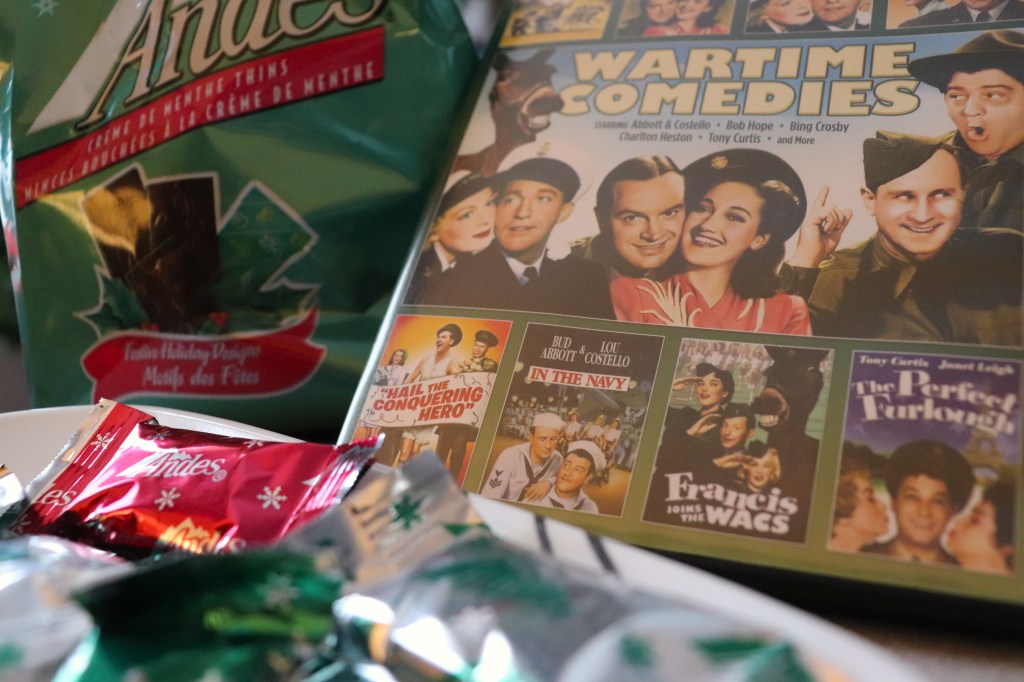
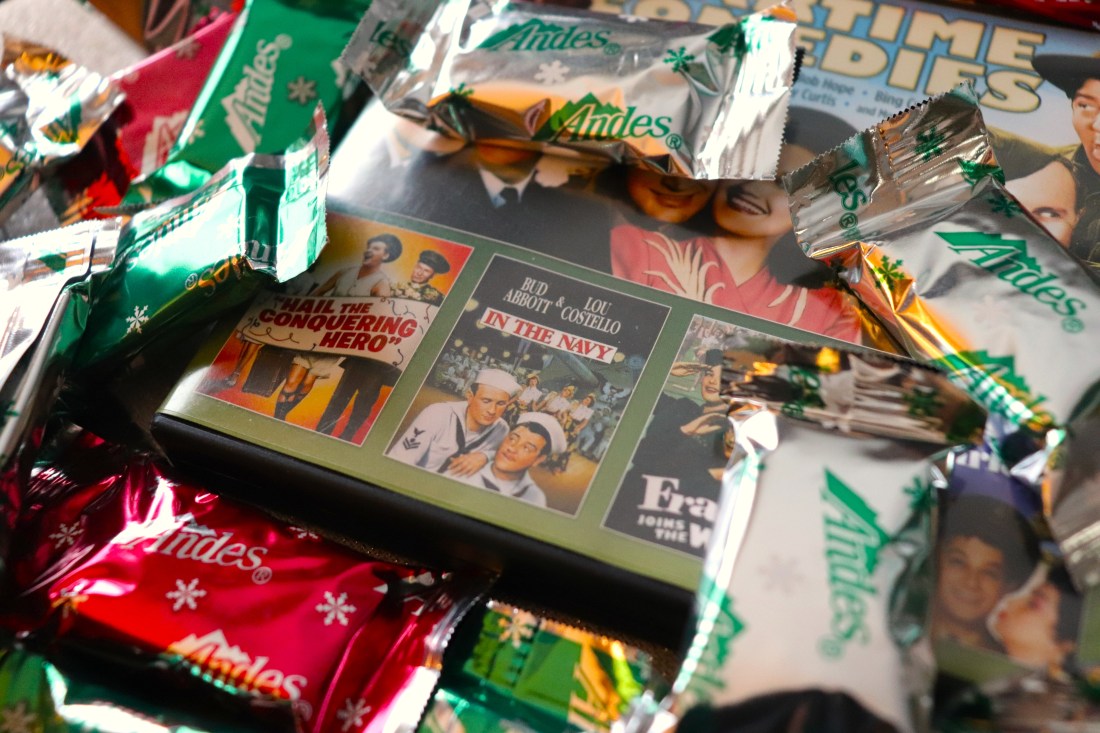
Andes thin chocolate mints (because it’s Christmas, dammit, and I need something sweet!)

Fun facts:

-Release date: May 31, 1941

-Budget: $379,207 (estimated)

-Box office: $2 million (estimated)

-The final entry in Abbott and Costello’s 1941 service comedy trilogy, Keep ‘Em Flying, was released on Nov. 28. This film features the comedy duo enlisting in the U.S. Army Air Corps.

-Outside this 1941 service comedy trilogy (Buck Privates, In the Navy, Keep ‘Em Flying), Arthur Lupin directed Abbott and Costello in Hold that Ghost (1941) and Ride ‘Em Cowboy (1942). Lupin is also responsible for helming five films in the Francis franchise, which features a talking mule enlisting in various branches of the military. 

-Musical highlight: “Gimme Some Skin, My Friend,” by the Andrews Sister

(despite the blatant cultural appropriation on display, originally being recorded by The Delta Rhythm Boys, this is the movie’s catchiest number by far)

Back to Bataan (1945) review- military retribution through cinema

The American public was riding a collective high in the spring of 1945, with the Third Reich having officially surrendered to the Allies in early May of that year.

With the fighting in Europe now wrapping up, the United States military turned its full attention to the Pacific theatre of World War II, with the hope of bringing this destructive conflict to a swift end.

Several weeks after Germany’s surrender, American cinemas were able to capitalize off this massive change in fortune through the release of Edward Dmytryk’s Back to Bataan, a film that chronicles the US’ attempt to liberate the Philippines from Japanese control.

Now, I’ve sampled a decent number of WWII-era propaganda for this blog, including another war film starring John Wayne called Operation Pacific (1951).

While that movie was a lot more easy-going in its tone, Back to Bataan features a much more palpable sense of urgency, probably due to the fact that it was shot and released while the Philippines campaign was still underway.  

In fact, Dmytryk’s film could be seen as a form of cinematic retribution on behalf of the US military, who had been handed a monumental defeat when Japan successfully invaded and conquered the Philippine islands several years earlier.

Even though the war would eventually come to an end in summer of 1945, Back to Bataan was probably viewed as a way to keep American morale high in the interim, with a fictionalized recount of the hardship US soldiers and local resistance fighters endured to take back the commonwealth territory.

Admittedly, this “ripped-from-the-headlines” kind of story doesn’t hold nearly the same weight as it did 78 years ago, especially with world-shaking conflicts in Europe and the Middle East holding everyone’s attention in the final months of 2023.

So while Back to Bataan is pretty dated, it at least serves as a time capsule of a lesser known chapter of WWII, with some well-produced action sequences that hammer home the desperation and brutality that characterized the Pacific theatre of that war.

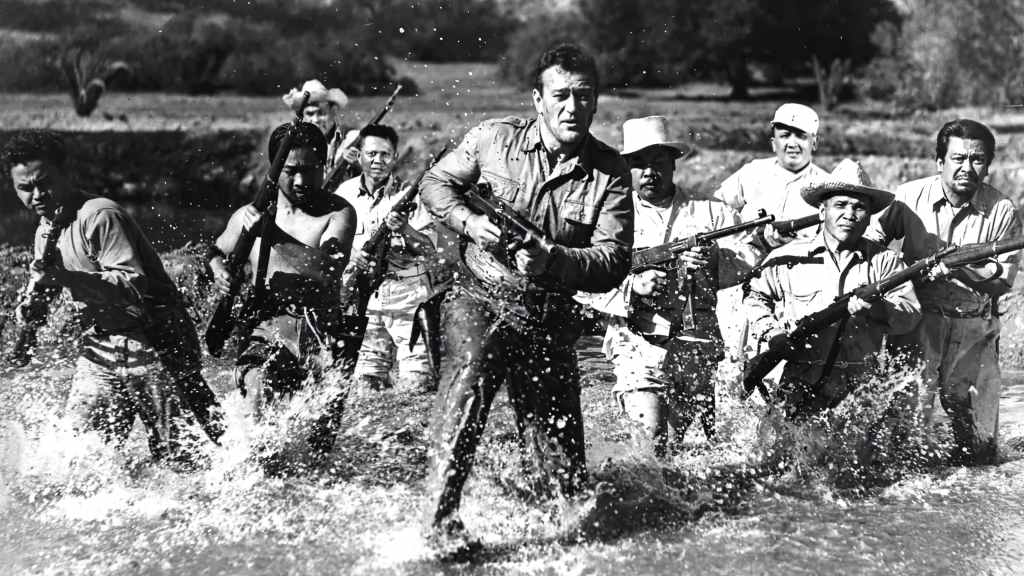
Instead of sailing the high seas like he did in Operation Pacific, John Wayne mostly sticks to dry land this time around as Joseph Madden, an army colonel who is tasked with mobilizing Filipino guerilla fighters to drive Japanese troops out of their homeland.

After making contact with some eager recruits, Madden and his men find themselves in a hopeless situation after US forces are decimated following the Battle of Bataan in early 1942.

Despite being outnumbered and outgunned, this small resistance group is determined to liberate the islands from this invading force, especially with the grandson of Filipino revolutionary Andrés Bonifacio (played by Anthony Quinn) on their side.

Some may bristle at my use of the word “propaganda” to describe Back to Bataan, but I think it’s pretty apt.

Not only does the film begin with a title card thanking the US armed forces for their aid in the production of this film, but it’s followed up by a parade of supposedly real-life American POWs rescued from Japanese prison camps in the Philippines.   

While you could brush this off as just patriotic window dressing, Dmytryk and his screenwriters actively bake these themes and images into key points of the film, usually to its detriment.

For example, the film opens with a puzzling flash forward, where US Army Rangers raid a Japanese prisoner camp near Cabanatuan City in 1945.

This scene is only included because the real-life Raid at Cabanatuan (also known as “The Great Raid”) took place in January of that year and the filmmakers wanted to include it even if they couldn’t organically work it into their story that’s set three years earlier.

By introducing the movie with such a momentous military victory, Dmytryk and his team immediately deflate the ongoing tension in favour presenting the audience with a comforting narrative right off the bat.

American movie-goers are presented with further nationalistic navel gazing once the actual plot gets underway.

This includes a moment when some Filipino school children take turns listing all the great things the US has done during its occupation of their country (like importing soda pop, baseball, and Hollywood movies).

The school’s principal then adds his two cents by proclaiming that America taught the Filipino people that “men are free or they are nothing,” underplaying the fact that the US took control of these islands through shedding lots of blood in the Philippine–American War (1899-1902).

However, the principal’s martyr status is solidified once he is executed by the Japanese several minutes later, firmly establishing the Americans as the benevolent colonizers in this scenario.  

Revisionist history aside, the scenes are pretty blunt and heavy-handed in their presentation, focusing on political talking points rather than the humanity of the people caught up in this conflict.

Thankfully, all this patriotic cheerleading is largely balanced out by the filmmakers’ sound technical expertise, particularly when it comes time to blow shit up.    

Rather than pushing the complicated action off screen, or hiding it behind convenient edits, Dmytryk’s team relies on long takes that keep a lot of the explosions in-camera.

Special credit should be also given to the stunt team on this project, who were willing to stand uncomfortably close to these pyrotechnics to create a tangible sense of danger.

This praise must be extended to Wayne himself, who noticeably performed a lot of his own stunts for this project, including a scene where he was tied to a leather harness to simulate being blown away by a mortar shell.

For the time, Back to Bataan also features some particularly grizzly kills that highlight the nasty jungle fighting that the Pacific front of WWII was known for.

Midway through the film a Filipino resistance fighter takes out a Japanese soldier with a throwing knife and the director is not shy about showing the bloody blade visibly sticking out of both sides of the sentry’s neck.

And despite not being shot in the Philippines, for obvious reasons, the filmmakers do a decent job of replicating the look and feel of a south-pacific battlefield with some interior sets and scenic exterior locations in southern California.

I understand that this visceral action aesthetic is meant to reinforce the movie’s propagandistic aims, but the caveman part of my brain can’t help but admire the high level of craftsmanship on display.

And while Wayne puts in the kind of stilted, stoic performance you would expect from this kind of film, the rest of the cast is filled out by some decent supporting performances that give the dry military proceedings some life.

Outside of veteran character actors like Beulah Bondi and Paul Fix, Anthony Quinn puts in some good work as the film’s co-lead, whose Aragorn-like reluctance to accept his destiny as a leader injects the story with some much-needed humanity.

Still, your enjoyment of this project is entirely dependent on whether or not you can disassociate it from the politics of the time.

While the US’ entry into WWII was undoubtedly a just course of action, some of the government’s domestic policies during this period were decidedly not, like the internment of Japanese citizens from 1942 to 1946.

Despite not being explicitly stated in the film itself, I can’t shake the feeling that movies like Back to Bataan were made to reassure American audiences that their xenophobic paranoia towards certain groups is justified during wartime.

But with all those caveats out of the way, I still think Dmytryk and his team put together a slickly produced piece of entertainment that works as an action movie and an interesting window into the past.

And if you’re still concerned about the film’s propagandistic aims, just know that the negative impact of one war movie from 1945 pales in comparison to all the social media misinformation currently being spread about conflicts in Israel and Ukraine.

That may seem like cold comfort, but in today’s incendiary political landscape old movies like Back to Bataan seem quaint and harmless by comparison.

That’s not a ringing endorsement, by any stretch, but these days I’ll take some dumb escapism where I can find it.

Verdict:

6/10

Corner store companion:

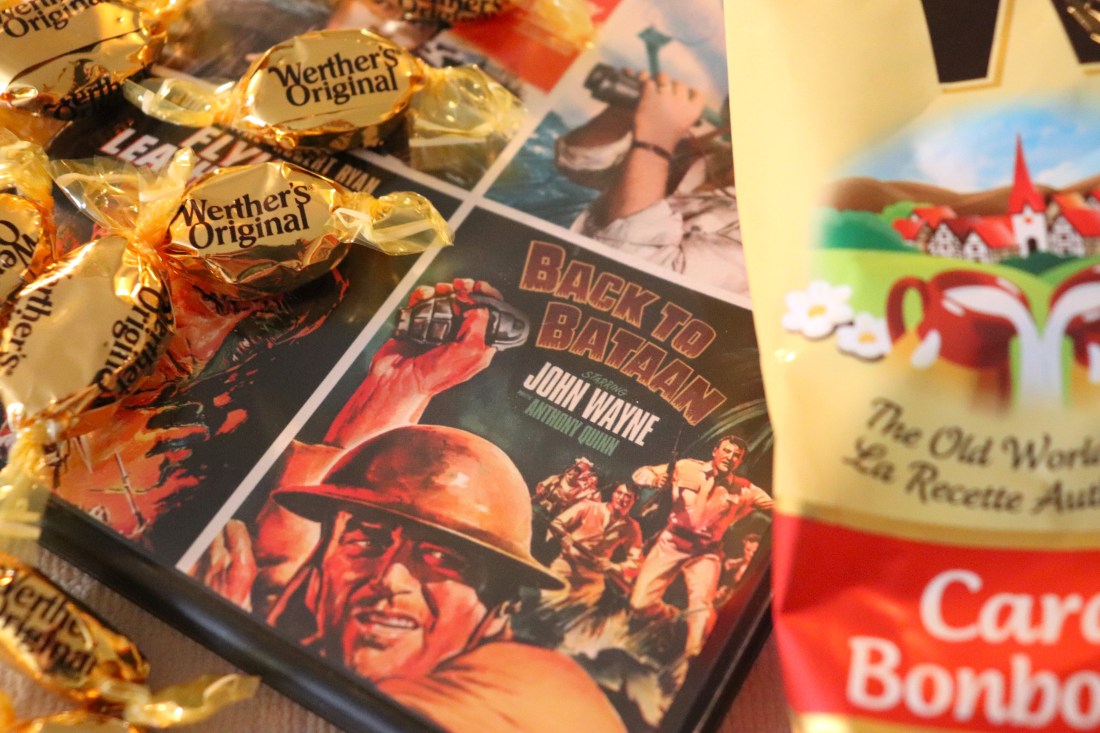
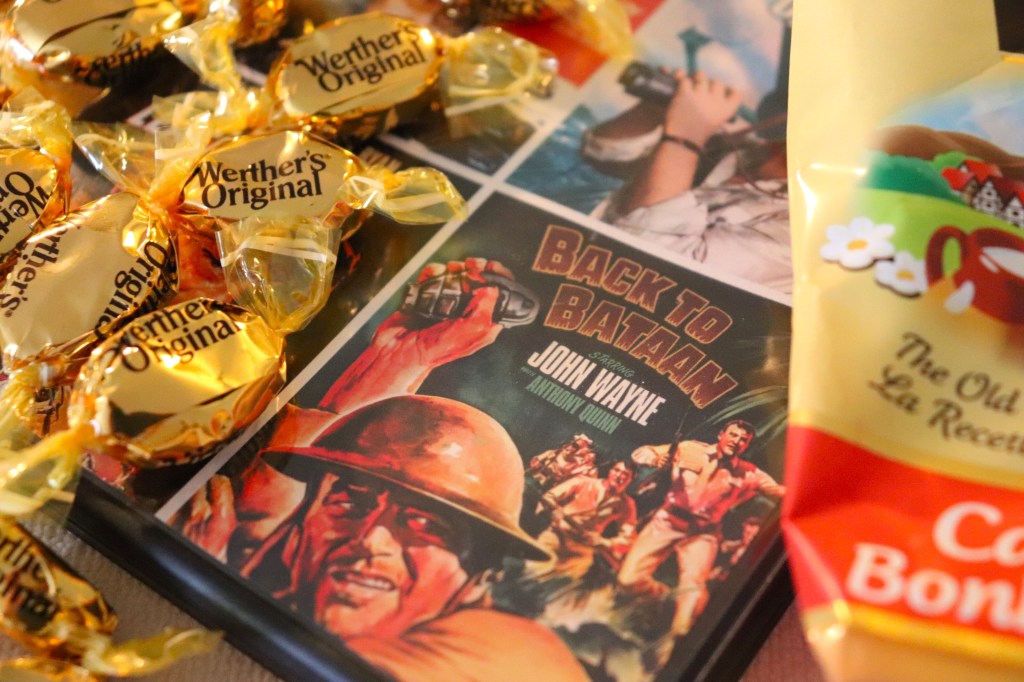
Werther’s Original Caramel Hard Candies (because it’s something your grandpa would enjoy)

Fun facts:

-Release date: May 31, 1945

-Box office: $2,490,000

-Despite the strong nationalistic themes present in Back to Bataan, director Edward Dmytryk was actually a member of the Communist Party in 1945 and was later called to testify before the House Committee on Un-American Activities. Alongside nine other directors, screenwriters, and producers —collectively known as the “Hollywood 10” — Dmytryk refused to testify before the committee and was blacklisted from the American film business as a result. However, Dmytryk managed to worm his way back into Hollywood after telling the committee about his former communist associations in 1951. He would go on to work steadily throughout the next three decades, including high-profile gigs like The Caine Mutiny in 1954 (which earned him seven Oscar nominations including Best Picture).

-The Axis occupation of the Philippines officially ended on Aug. 15, 1945 following the atomic bombing of Hiroshima and Nagasaki earlier that month. Japanese forces in the Philippines were ordered to surrender by the mainland government, who officially capitulated on Sept. 2 aboard the USS Missouri in Tokyo Bay.

-The Philippines finally received its independence on July 4, 1946 through the Treaty of Manila, which relinquished US sovereignty over the land.

Operation Pacific (1951) review-America takes a victory lap

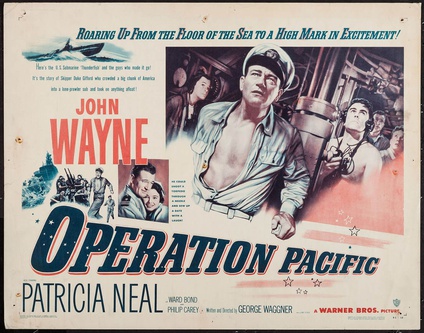
While most classic Hollywood war films have a pretty clear set of objectives (selling bonds, driving up recruitment numbers, etc.), George Waggner’s Operation Pacific (1951) is an entirely different animal.

This John Wayne-led naval adventure is much more celebratory and easy-going in tone, clearly riding off the protracted high that many Americans were still feeling since World War II ended six years earlier.

As a result, the film is a lot more interested in exploring what a soldier’s life might be like after “the fight” comes to an end, rather than providing some insight into what this specific conflict looked like in a larger context.

Even though this tone might upset some military diehards, Operation Pacific actually benefits from the gift of hindsight, since it doesn’t get completely bogged down in the cynical saber rattling that kneecaps so many other war films of that era.

The plot of Operation Pacific revolves around Duke Gifford (Wayne), who serves as an executive officer aboard a submarine called the USS Thunderfish during World War II.

After returning from a dangerous mission in the Philippines, Duke runs into his ex-wife Mary Stuart (Patricia Neal) while on leave at Pearl Harbor.

Even though the two still have feelings for each other, Duke’s responsibilities as a naval officer keep getting in the way of his romantic advances toward Mary, especially as his patrols in enemy waters get increasingly treacherous.

Now, some of you might be scratching your heads after reading this plot synopsis, since this sounds more like a Nicholas Sparks novel rather than a gritty war epic starring John Wayne.

This element caught me by surprise as well, since lengthy sections of the film are dedicated to Wayne and Neal making doe eyes at each other, while a lot of the naval combat scenes are pushed to the sidelines.

Operating Pacific also goes out of its way to depict the more blasé and uneventful aspects of military life that border on the comical, some of which wouldn’t be out of place in an Abbott and Costello movie.

In one scene, while on shore leave, Wayne is tasked with bailing his men out of a Honolulu jail after they get into a drunken brawl with some local police officers.

When the crew is at sea, they use some of their down time to screen a movie in the submarine’s mess hall.

And after rescuing an infant from enemy territory, the men of the USS Thunderfish figure out how to feed the child using a rubber glove.

While these moments do tonally clash with the naval combat scenes—which are awash with gunfire, explosions and technical mumbo jumbo — they do add some much-needed variety to what would otherwise be a pretty by-the-numbers war movie.

And by shifting the film’s focus away from the “battlefield,” Waggner (who also wrote the screenplay) is very clearly trying to appease a post-World War II audience, whose appetite for outright bloodshed had definitely cooled after six years of peacetime. *

Plus, by 1951 the US Baby Boom was noticeably underway, with the romance between Wayne and Neal in this film serving as an obvious nod to the kind of cathartic, romantic energy embodied in classic wartime imagery like Alfred Eisenstaedt’s “V-J Day in Times Square” photograph.

In fact, this film is so uninterested with broader conflict itself that there’s not really any main antagonist to speak of.

Sure, Wayne has to butt heads with a fellow soldier who is also after his ex-wife’s affections, but their relationship is always very cordial and never escalates beyond a harsh word.

Because of this, most of the film’s charm comes from its quieter moments, where the main characters hang out and discuss what life is like back on dry land.

That being said, Operation Pacific does slightly buckle under some clichés that one would expect from a Hollywood war epic from that era.

For one thing, a lot of the film’s action sequences rely way too heavily on stock imagery, which isn’t spliced into the director’s original footage in an organic fashion.

Additionally, Waggner is pretty upfront about presenting this story as a piece of military propaganda, opening up the movie with a Star Wars-style crawl that pays tribute to those who lost their lives in the line of duty.

While there’s nothing wrong with this kind of cinematic remembrance, it does set the tone for a movie that casts World War II in an overly simplistic light, where all American soldiers are depicted as being absolute paragons of virtue.

This approach to characterization turns into a problem whenever the movie veers off into a territory that isn’t morally black and white, like the aforementioned moment where Wayne has to bail his men out of jail.

Even though these characters assaulted several police officers under the influence of alcohol, this scene is largely played for laughs, where the crew is ultimately left off the hook for committing such a serious crime.

This uncritical eye is prevalent throughout the rest of the movie as well, since the filmmakers don’t provide any insight into the Imperial Japanese Navy, outside of the fact that they are a mostly faceless enemy who must be defeated.

Thankfully, this outdated propaganda isn’t so heavy handed that it ruins the movie, although everyone’s mileage may vary (especially if you don’t care for the term “Japs” being thrown around in casual conversation).

And even if you’re not a big fan of romance being mixed in with your violent war movie, at least take comfort in the fact that Waggner does a pretty decent job of balancing those two elements throughout the film’s 111-minute runtime.

For what it’s worth, I’ve seen this kind of genre bending done way worse, with Paul Gross’ crushingly melodramatic Passchendaele (2008) immediately coming to mind.

Plus, in this case, the relationship between Wayne and Neal actually saves Operation Pacific from being completely irrelevant to a 2021 audience.

After all, [SPOILERS] their successful reconcilement at the end of the movie is obviously meant to tap into America’s desire to return to some state of normalcy after a long period of societal upheaval.

And in that respect, Operation Pacific has become way more relatable than ever in the seven decades since its original release now that the country (and North America more broadly) is turning the tide in the fight against COVID-19. **

Verdict:

6/10

Corner store companion:

Ghirardelli sea salt chocolate (because it’s the only nautical-themed snack food that I could find)

Fun facts:

-Release date: Jan. 27, 1951

-Budget: $1.46 million (estimated)

-Box office: $2.56 million (US), $1.3 million (worldwide)

-Retired US navy admiral Charles A. Lockwood served as a technical advisor on Operation Pacific to ensure its accuracy when depicting submarine warfare. According to Wikipedia, Hollywood producers sought out Lockwood a couple more times to advise them on a variety of other film projects, including Hellcats of the Navy (1957), On the Beach (1959), and Up Periscope (1959).  

-Near the finale of Operation Pacific, the men of the USS Thunderfish can be seen exchanging film canisters with a friendly American sub so that both crews can enjoy a movie night. These films, Destination Tokyo (1943) and George Washington Slept Here (1942), were both produced by Warner Bros. Pictures in real life.

-Following the release of Operation Pacific, George Waggner mostly directed television for the remainder of his career, including episodes of The Green Hornet, Maverick, The Man from U.N.C.L.E. and Batman.

* I realize that the US was involved in the Korean War by 1951, but that conflict wasn’t nearly as pervasive in American society as World War II was, so I think my original point stands.

** I sincerely hope this statement doesn’t become extremely dated in the coming weeks and months.

Commandos Strike at Dawn (1942) review- Uncle Sam gets creative with his recruitment techniques

The 1940s was truly a golden age in terms of Hollywood produced war propaganda.

Not only would these productions play as cartoons or documentary shorts before the beginning of a feature film, but sometimes they would take the form of the main attraction itself.

This can even be seen through a screen classic like Casablanca, which was made entirely to capitalize on America’s decision to enter the Second World War and reassure the US public that their government had made the right decision.

John Farrow’s Commandos Strike at Dawn, released at the very tail end of 1942, operates on that very same logic, since its plot and characters are meant to serve as an stand-in for America’s transition from neutrality to outright involvement in the Allied war effort.

In this film, the role of audience surrogate doesn’t go to Humphrey Bogart but Paul Muni, who plays a mild-mannered Norwegian fisherman whose sleepy village is taken over by the Third Reich in 1939.

While Muni’s character originally believes that the best course of action is to simply cooperate until the war blows over, he’s gradually pushed to violence after witnessing the atrocities committed by the Nazis and recruits a squad of British commandos to help liberate his home.

Now, when I use the term “propaganda” to describe this film, I don’t use it in an entirely negative sense. After all, I’m perfectly willing to stomach some ham-fisted messaging in my entertainment as long as the end product is well-made.

For example, even though Casablanca is a pretty transparent World War II allegory, it’s done with a certain level of sophistication and the film contains a pretty timeless love story that still strikes a cord with audiences to this day.

Unfortunately, the same really can’t be said for Commandos Strike at Dawn, since the filmmakers settle for cheap gimmicks that relegate the production to being simply a product of its time.

This kind of tone is established in the first couple seconds of the film, when the opening credits prominently display all the flags of the Allied powers, including the Soviet Union’s hammer and sickle. This kind of intro immediately dates the film, especially with the Cold War being right around the corner.

Even though there are times where the movie’s attempts to be timely do work out in its favour (like how the characters mention the persecution of Jews at a time when they were being slaughtered in concentration camps in real life) this kind of tacky filmmaking has way more misses than hits.

Although Muni is a compelling lead, he’s saddled with a lot of corny lines about how “nobody’s going to win the war for anybody else,” which sound like they are meant to lecture the 1942 audience rather than inform the movie’s characters.

The rest of the film’s cast is even more disposable.

Despite the fact that all the major players are given a long introduction through a fairly impressive tracking shot, most of them disappear halfway through the movie as the narrative focuses exclusively on Muni and his mission to coordinate a rescue operation.

The worst example of this is probably Muni’s love interest, who doesn’t affect the plot in any way and only seems to exist to reassure the audience that their protagonist has (if I may borrow a term from Red Letter Media) a “case of the not gays.”

The writers don’t even have the decency to provide us with a main antagonist, and settle for flooding the screen with a bunch of nameless German foot soldiers instead.

With that being said, the one segment of the cast who do manage to make an impression are the “British” commandos themselves.

The climactic clash between them and the Nazis feature some really impressive stunt work, which probably has something to do with the fact that they were played by real-life members of the Canadian Armed Forces.

Commandoes(1)

What’s even better is that director John Farrow compliments their military acumen with some good production decisions, since a lot of explosions are done in-camera and aren’t watered down by post-production trickery.

With that being said, basically none of these commandos are given personalities or even a single line of dialogue, which means it’s hard to get emotionally invested in this climax beyond admiring the pure spectacle of it.

And that’s probably the biggest problem with Commandos Strike at Dawn: it doesn’t know what it wants to be.

Sure, the filmmakers make a big show at the beginning about how they want to present an intimate character piece, but it’s clear by the final frame of the film that that’s all window dressing.

Instead, they’d much rather settle for showcasing flashy pyrotechnics and real-life military hardware, something that would have worked as long as they fully committed to this idea.

As a result, Farrow and his team fall victim to the classic filmmaking mistake of trying to make a movie for everyone, which inevitably means that they made a movie for no-one (especially by 2018 standards).

(Side note: it’s clear that the final climactic battle wasn’t shot in the early in the morning, but I guess “Commandos Strike at Mid-Day” wouldn’t have looked great on a movie poster.)

Verdict:

4/10

Corner store companion:

Bits & Bites Original (because it should have stuck to doing one thing, instead of mixing a bunch of stuff that doesn’t belong together).

IMG_0278

Fun facts:

-Release date: Dec. 30, 1942.

-Box office gross: $1.5 million (estimated).

-This film was nominated for an Oscar in the category of Best Scoring of a Dramatic or Comedy Picture at the 1944 Academy Awards (the same year Casablanca won Best Picture).

-Paul Muni is probably best know for starring in the original Scarface from 1932, when the title character was an Italian gangster named Tony Camonte.

-Even though he’s kind of slumming it in this movie, Muni has five Oscar nominations for Best Actor under his belt, with an eventual win in 1937 for starring in The Story of Louis Pasteur.

-Unexpected cameo: Lillian Gish (a silent movie star best known for playing the pivotal role of Elsie Stoneman in the Birth of a Nation) makes her first screen appearance in almost a decade by portraying one the Norwegian villagers under Nazi siege.

-According to IMDB, the entirety of this film was shot on Vancouver Island, British Columbia.