The Story of Us (1999) review: messy but undeniably heartfelt

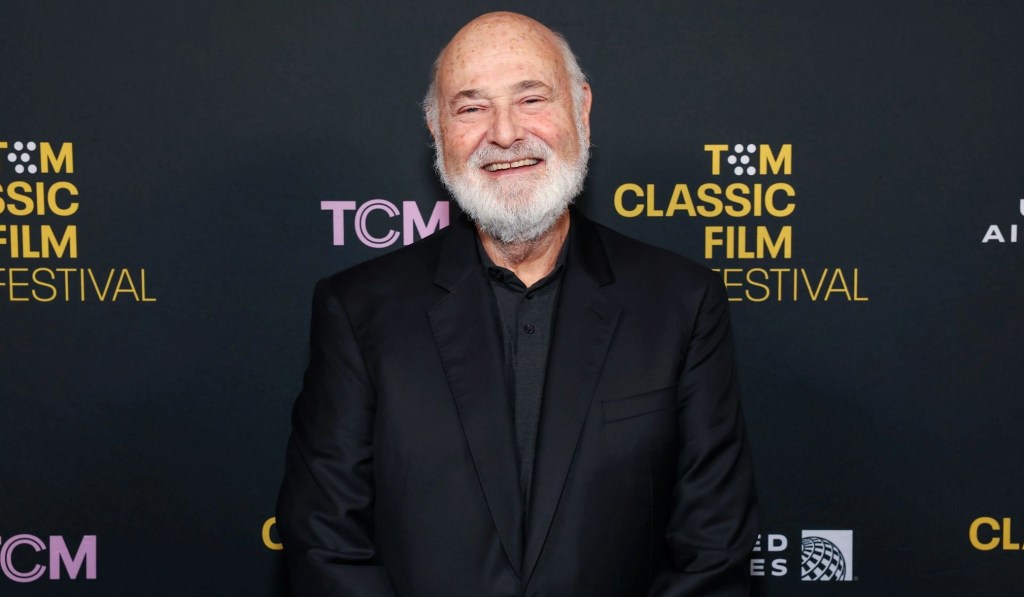
Last year was a non-stop cavalcade of horrific news, with the murder of Rob Reiner and his wife Michele (at the hands of their own son) capping off those rotten 12 months on the worst possible note.

The one thin silver lining to this grim affair was the massive outpouring of love that emerged in its aftermath, where fans, colleagues, and friends commemorated Reiner’s talent as a filmmaker alongside his strong moral fiber as a person.  

From a career perspective, one of the big through lines people focused on was Reiner’s versatility as an artist. Not only was he praised for his roles in front of the camera, but Reiner’s ability to spearhead a variety of genre projects as a director also came into sharper focus.

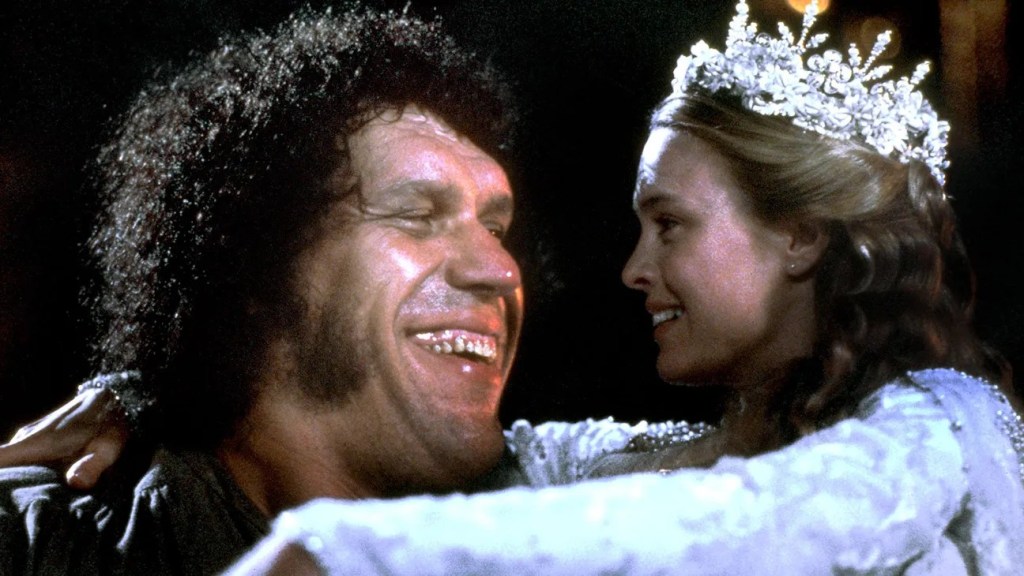
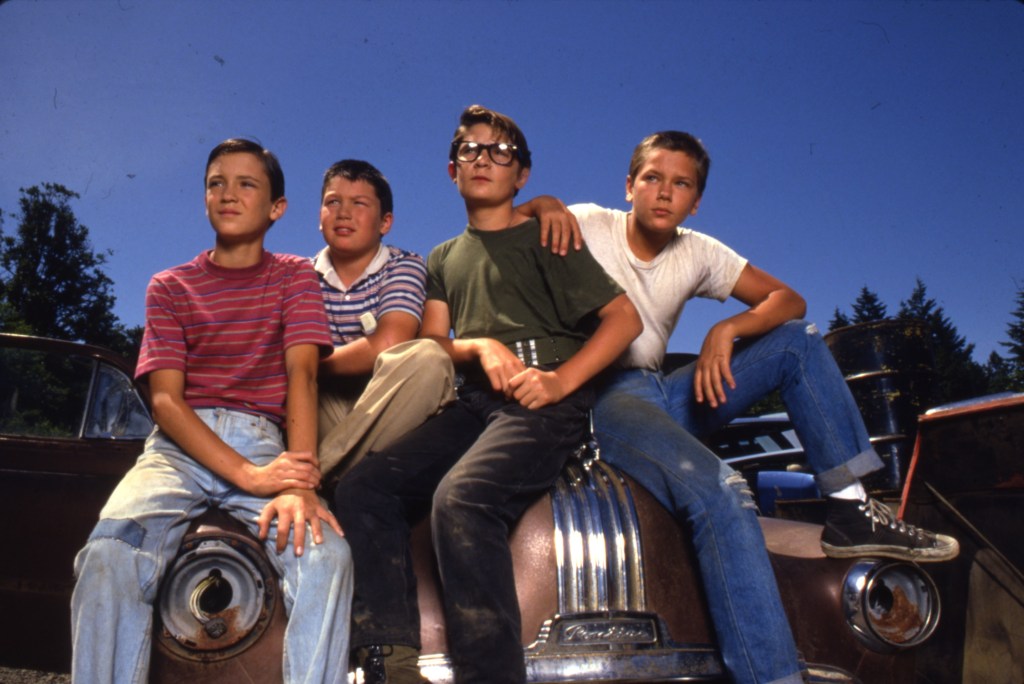
A brief scan through Reiner’s filmography will reveal classic coming-of-age dramas (Stand By Me), fantasy adventure (The Princess Bride), romantic comedies (When Harry Met Sally…), psychological horror (Misery), legal dramas (A Few Good Men), and mockumentaries (This Is Spinal Tap).

One film that wasn’t included in a lot of these wistful retrospectives (at least from what I saw) was The Story of Us (1999), a turn-of-the-millennium romantic drama that charts the troubled marriage of a couple played by Bruce Willis and Michelle Pfeiffer.

Looking at the reviews from that time, it’s easy to see why this film isn’t held in high regard today. On Rotten Tomatoes the movie holds a dubious 28% rating based on 128 reviews, with the critical consensus slamming it as “dull” and “predictable.” The audience score isn’t much better.

However, viewing the film with fresh eyes in 2026, I think The Story of Us is a worthy addition to Reiner’s catalogue, since it manages to embody the sensitivity, humour, and humanity that tied so many of his works together.

The plot of The Story of Us focuses squarely on Ben (Willis) and Katie (Pfeiffer), whose marriage of 15 years is on the verge of outright collapse. When their two children go away to camp for the summer, the couple are left in a state of limbo, not knowing if they should stay together for the kids or just make a clean break.

Ben and Katie’s relationship history is conveyed in a largely non-linear fashion, with the first act of the film being dominated by these brief flashbacks that catch the audience up to speed. Not all of these snippets are told in chronological order, so you’re largely reliant on context clues (like the characters’ changing hairstyles) to figure out when each scene fits into the timeline.

While all this is going on, Willis and Pfeiffer also provide dueling narration from the future, looking back on their turbulent marriage with a healthy degree of hindsight.

On paper, this narrative structure sounds like a mess and, admittedly, it can be a little discombobulating at first. However, I thought the editing team managed to string these disparate pieces together in a way that complimented the story. After all, the disruptive way these short flashbacks are inserted into the film mimics how a lot of people remember the past (i.e. chopped up into disorganized peaks and valleys with flimsy connective tissue in between). Plus, this jigsaw-like storytelling method kept my brain engaged throughout, as I was subconsciously filling in the gaps as the plot progressed.  

The dual narration also serves a purpose beyond just filling dead air. Outside of providing further insight into how each character views their failings as a romantic partner, the ambiguity of their dialogue leaves you hanging in suspense, since it’s not clear if they’re still married until the very end.

That being said, the film does slow down in its second act, with the interruptive flashbacks being dialed back considerably. This breathing room allows Willis, Pfeiffer, and the script to take centre stage, for good and for ill.

On one hand, Pfeiffer puts her all into the role of Katie. She is totally believable as a woman who feels overwhelmed and consumed by her role as a mother, so much so that she doesn’t have anything left to invest into her role as a wife.

Willis, meanwhile, is significantly less believable as the goofy sitcom dad. It’s not like he hasn’t demonstrated some acting range throughout his career, managing to shed that macho, tough guy image for movies like The Kid (2000) and The Sixth Sense (1999). But this role in The Story of Us seems far beyond Willis’ capabilities, especially whenever he’s asked to put on a funny voice or anchor an extended comedy bit.

At least the two of them work well together as a dysfunctional couple. Any scene involving Willis and Pfeiffer arguing or suffering through an artificially cordial dinner with their children is tense, with so much unspoken conflict bubbling beneath the surface.

The script, similarly, has its good and bad moments.

Sometimes, it seems like the writers are lazily treading into Men Are From Mars, Women Are From Venus type territory when the characters discuss how each sex views relationships. An early scene involving Ben and Katie’s respective friends talking about this subject at separate lunch dates seems like the cast of Seinfeld and Sex and the City are being artificially cross cut together.

Additionally, it’s kind of lame that the film’s overriding conflict ultimately gets resolved [SPOILERS] via a profound declaration of love from one of the characters. It just seems like a cheap and easy way to wash away the complicated relationship dynamics that were being explored for the previous 90 minutes.  

Still, the script manages to shine in some other key areas.

For one thing, the film wisely resists the urge to dive into outright melodrama or soap opera shenanigans as a shortcut.

Both Willis and Pfeiffer never committed infidelity, and they don’t resort to hurling kitchenware at each other to make a dramatic point.

Instead, the film shows (mostly through dialogue) that the key reason their relationship fell apart was far more mundane, with unfulfilled dreams, tragic miscommunication, and the growing responsibilities of parenthood creating a rift that’s far too wide to mend.

The filmmakers hammer this idea home by veering off into outright surrealism at one point, with Willis and Pfeiffer attempting to reconcile in bed before being interrupted by the ghostly apparitions of their parents.  A nightmarish scenario, for sure, but it does succinctly illustrate how these characters are products of their own dysfunctional upbringings. 

I also respect the fact that there is no clearcut villain in the story. Throughout the runtime, both characters bring up valid critiques of their partner while simultaneously falling prey to their own insecurities and lashing out. This largely leaves it up to the audience to determine who is in the right or wrong, making you feel, in a way, like you are a kid stuck between mom and dad fighting.

Thankfully, Reiner and his team make this difficult-to-stomach material digestible through several methods.

One is the calming soundtrack composed and cultivated by Eric Clapton, which serves as an acoustic balm that soothes any mental abrasions caused by all the marital strife on screen.

Another source of comfort is some well-placed humour.

While there are definitely some clunkers that don’t land, the film has enough clever lines and witty repartee to ensure that the whole enterprise doesn’t get swallowed up by its own self seriousness.

One of my favourite bits comes from Reiner himself, who plays Willis’ close friend and insists at one point that expecting the “perfect” marriage is as delusional as calling the fatty top of our legs an “ass.”

Several scenes later, Willis, who is suffering a mental breakdown, throws this simile back in Reiner’s face by telling him to shove a bread basket “up the tops of your legs.”

Admittedly, this is not the most refined joke in the world. It was even singled out by Roger Ebert in his scathing one-star review of the film as being an example of why this material doesn’t work.  

But something about Willis’ screeching delivery and Reiner’s calm look of embarrassment really worked for me, elevating what could have been a disposable, juvenile gag by tapping into some genuine human emotion.

That’s kind of the movie’s entire appeal in a nutshell: unsophisticated and sloppy in places, but undeniably earnest in what it’s trying to accomplish.

This material has undoubtedly been explored in better films, with Noah Baumbach’s Marriage Story (2019) and Richard Linklater’s Before Midnight (2013) both providing keener insight into the cataclysmic messiness of a failing marriage.

The Story of Us, while far more scattershot in its execution, at least comes at this difficult subject matter with a great deal of empathy, which is in such short supply these days that I’ll clasp onto anything that attempts to bring a civilizing force back into conversations surrounding relationships.

That humanizing eye is really what made Reiner as a filmmaker, with many of his most famous works eschewing brash cynicism in favour of celebrating the humanity of the characters on screen.
So with that in mind, perhaps it’s time to give The Story of Us another look for those who dismissed it 27 years ago.

It may not be perfect and doesn’t come close to eclipsing Reiner’s outright classics, but watching this movie at least puts the filmmaker’s career, as a whole, into better perspective, which is a worthwhile exercise now that he’s no longer with us.
Verdict:

7/10

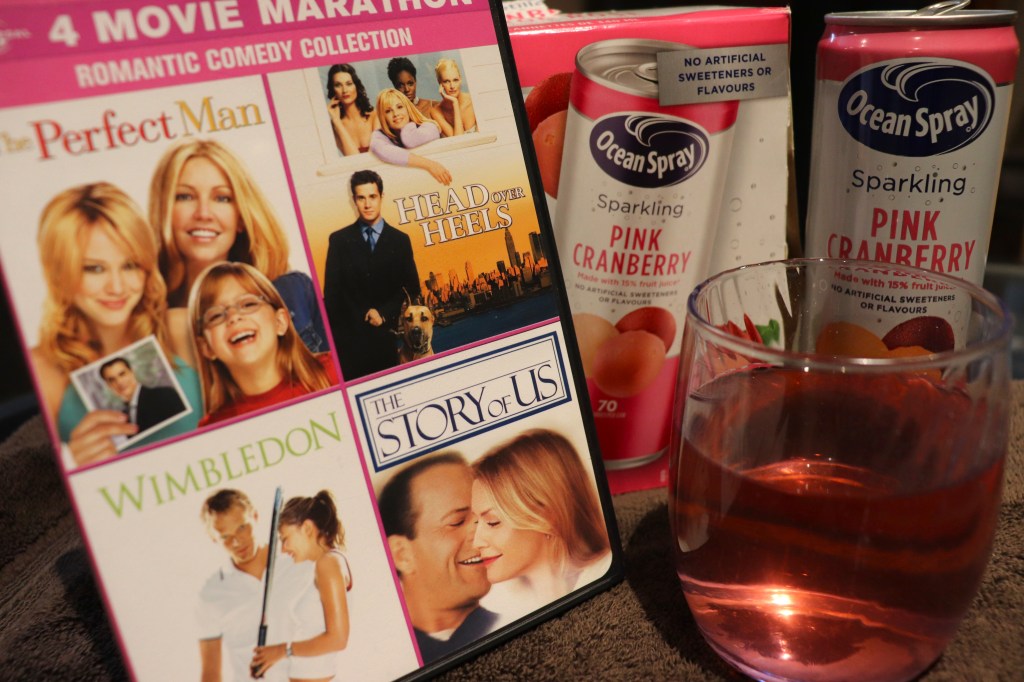
Corner store companion:

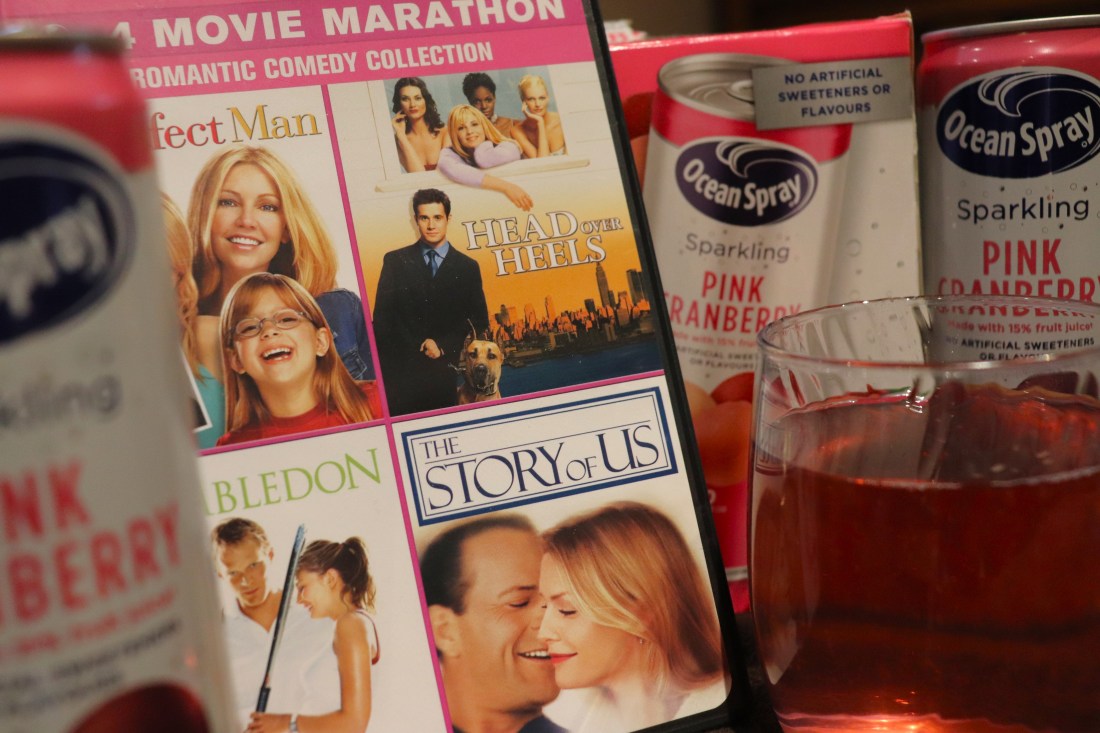
Ocean Spray Sparkling Pink Cranberry Beverage (because it’s light and refreshing, which should wash the unpleasant taste of a failing marriage out of your mouth)
Fun facts:

-Release date: Oct. 15, 1999

-Budget: $50 million

-Box office: $58.9 million

-Reiner had directed 29 features before his untimely death, with his final film being Spinal Tap II: The End Continues (2025). A follow-up concert film titled Spinal Tap at Stonehenge: The Final Finale was completed and scheduled to be released this year, but has been delayed due to Reiner’s death.

-Both Willis and Pfeiffer were dealing with some serious personal strife at the time of filming. Willis was going through his own divorce with Demi Moore, while Pfeiffer was grappling with her father’s death and the dissolution of her production company (Via Rosa Productions).

Musical highlight: “Classical Gas” by Mason Williams (plays over a pivotal scene in the third act when one of the characters has an epiphany)

-This film can currently be watched in its entirety on YouTube

The Lucky One (2012) review-Sparks on autopilot

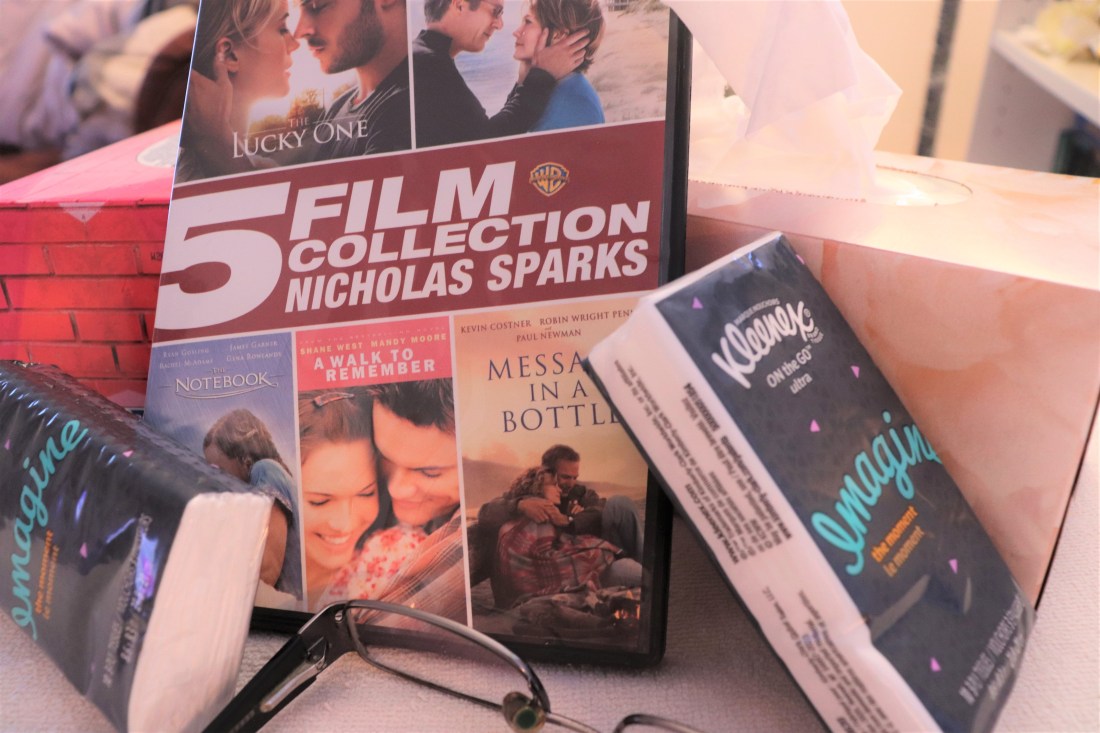
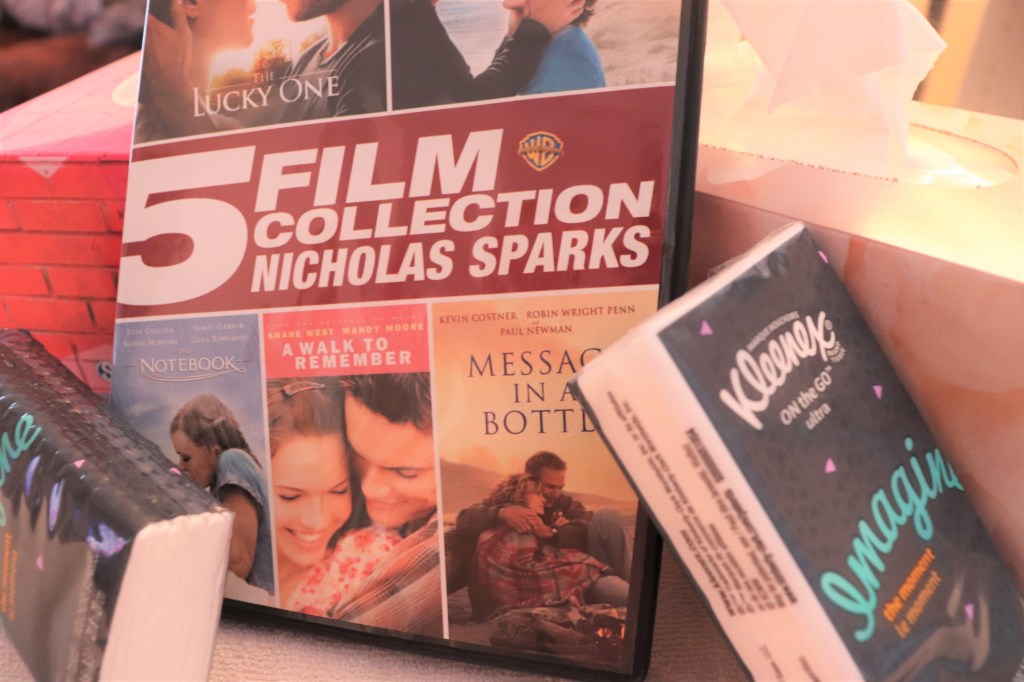
After watching Scott Hicks’ The Lucky One (2012) last month, I finally polished off my 5-Film Nicholas Sparks Collection from Warner Brothers.

Having never indulged in any of Sparks’ romantic dramas before purchasing this DVD set, I was originally bracing for a pretty miserable movie marathon based on bad word-of-mouth and poor critical reception across the board.

However, running through all five films has proven to be a much more well-rounded viewing experience in terms of quality, with distinctive peaks (The Notebook, A Walk to Remember), valleys (Message in a Bottle) and plateaus (Nights in Rodanthe).

With this in mind, I was hoping to end this journey on a high note with The Lucky One, especially since this project boasted another attractive cast and picturesque American setting.

Unfortunately, this film also turned out to be a greatest hits compilation of all the worst elements of the four previous entries in this collection, with cheesy dialogue, ludicrous plotting and flat characters who belong in a cartoon.

Because of this, my initial journey into the world of Nicholas Sparks ended with more of a whimper than a PG-13 rated bang.

In case the trailer didn’t make it clear, the eponymous “Lucky One” of the story is Logan (Zac Efron), a US marine who miraculously survived several near-death experiences during a recent tour of Iraq.

Logan believes that his good fortune is due to a random photo he found in the dirt moments before a mortar shell killed several of his squad mates.

After returning state-side, Logan vows to find the woman featured in this photograph, eventually stumbling upon dog kennel owner Beth (Taylor Schilling) in a sleepy Louisiana town.

Rather than telling Beth the real reason why he showed up out of nowhere Logan applies to work at the kennel instead, allowing their romantic relationship to blossom on top of a healthy foundation of lies.

Of course, the flimsiness of this premise is suspiciously familiar to Message in a Bottle (1999), where the main character of that film also withholds the truth in order to get closer to a potential lover.

While Efron is not nearly as creepy or manipulative as Robin Wright was in Message, his character’s decision to lie by omission still comes across as being an extremely lazy way of manufacturing conflict.

After all, one of Logan’s defining characteristics in The Lucky One is that he is an honest and good-natured hunk, which doesn’t gel at all with the deceptive nature of his meet-cute with Beth.

I know screenwriter Will Fetters was bound by the constraints of the original source material, but judging by the Wikipedia summary for Sparks’ 2008 book he already changed around the basic plot structure for this movie adaptation. So, from where I’m sitting, a couple more tweaks couldn’t hurt.

For this hypothetical re-write, Fetters should also look at revising the other major antagonistic force in this story, which is Beth’s divorced husband Keith.

While actor Jay Ferguson is no stranger to playing jerks on TV shows like Mad Men, here he’s given absolutely nothing to work with portraying a romantic rival who is more warthog than man.

Basically, every negative trait you could associate with a jealous ex is put into a blender and poured into this character’s mould to make Efron look even better by comparison.

Outside of being physically and emotionally abusive to the mother of his child, Keith is also written to be a spoiled redneck who uses his status as the town sheriff to bully and intimidate people he doesn’t like (knowing full well that his judge father will absolve him of any wrongdoing).  

This character is so comically evil that he even points a loaded gun at Efron’s dog near the end of the movie, an action that should put him on the shit list of every viewer who isn’t an outright serial killer.

But despite this, the filmmakers also attempt to give Keith a rushed redemption arc at the tail end of the story, even though such a development isn’t earned or organic in the least.

But spotty writing is far from the only thing weighing The Lucky One down.

On a technical level, this film is littered with awkward cuts and weird editing decisions that give the proceedings a very amateurish feel.

At times it seems like the filmmakers simply lost certain footage during post-production, forcing them to splice certain scenes together without all the connective tissue.

For example, there’s one moment where Beth tells Logan about a treasured memory of her dead brother, where he sealed up one of her books in a brick wall.

However, this revelation lacks a lot of emotional impact on screen since the director didn’t include a close-up of the object in question, making it look like Schilling is staring at nothing.

In terms of acting, most of the cast actually turn in a respectable performance given the subpar material they have to work with.

Riley Thomas Stewart is particularly impressive as Beth’s nine-year-old son Ben, who outshines a lot of the adult actors in terms of presence and charisma.

Blyth Danner also gets saddled with some of the best lines as Beth’s sassy grandmother, reminding me, once again, of Message in a Bottle and how Paul Newman steals that movie in a similar, gender-flipped role.

While Efron does a decent job of playing the strong, silent type, it’s a shame he couldn’t decide on an accent to really anchor his performance.

Most of the time he sounds like your typical California surfer bro, but every once in a while he decides to deliver his lines with a Southern twang for some reason.

And as good an actor Efron can be given the right project, he’s not talented enough to save some of the Harlequin Romance novel-level dialogue he’s asked to spit out, like when he tells Schilling that “You should be kissed every day, every hour, every minute.”

But then again, that kind of corniness is what makes these movies (and the books they’re based on) so successful.

Having sat through five Sparks adaptations now, I’ll admit that there is something very appealing about how these different filmmakers lean into this highly romanticized material so unapologetically.

Through populating each movie with endless sunsets, vast aquatic scenery, vintage vehicles, and impossibly beautiful people, they’re able to create the perfect breeding ground for a love story that isn’t confined to a specific decade in late 20th century America.

The Lucky One is no different, with director of photography Alar Kivilo doing a lot of the heavy lifting to create that signature look and feel.

But unlike some of the better films in the Sparks canon (The Notebook, A Walk to Remember), this 2012 entry doesn’t have a strong enough script to elevate this unmistakably shallow subject matter.

Even though the movie tries to establish some depth early on by making a big deal about Logan’s PTSD, that important character detail is all but abandoned as soon as the romance with Beth gets fully underway. 

So in the end, The Lucky One doesn’t have a lot to offer besides some purely superficial elements that one can already experience by staring at the film’s generic theatrical poster.

And while this did represent a sour conclusion to my first foray into the world of Nicholas Sparks, I remain mildly interested in seeing how his six remaining movie adaptations turn out.

After all, this franchise is successful for a reason, and I feel like I’m getting closer to cracking that code with every new screening.

Verdict:

4/10

Corner store companion:

Carnaby Sweet marshmallow hearts (because it’s some cheap, sugary crap that should only be consumed around Valentine’s Day)

Fun facts:

-Release date: April 20, 2012

-Budget: $25 million (estimated)

-Box office: $60,457,138 (domestic), $99,357,138 (worldwide)

-While The Lucky One received mostly negative reviews from critics, the film picked up a number of Teen Choice Awards (choice movie actor-Efron, choice movie-drama) and a single People’s Choice Award (favourite dramatic movie actor-Efron). Riley Thomas Stewart was also nominated for a Young Artist Award for his performance in this film as Schillings’ son Ben.

-The Louisiana house where Beth lives was re-used for the 2014 Nicholas Sparks film adaptation for The Best of Me.

-Outside of feature films, director Scott Hicks has a history of helming documentaries and music videos for the Australian rock band INXS.

Musical highlight: “The Story” by Brandi Carlile (plays over the end credits)

Nights in Rodanthe (2008) review-vicarious vacation viewing

Producing a worthy follow-up to a hit movie is always an unenviable task, even in the world of Nicholas Sparks book-to-film adaptations.

However, George Wolfe was saddled with this very responsibility when he was hired to direct Nights in Rodanthe (2008) a few years after the release of The Notebook (2004).

Even though it received a mixed critical reception, The Notebook proved to be a sleeper hit at the box office and would go on to gain a massive cult following, thanks in part to its period setting, attractive cast and unapologetic sentimentality. 

In fact, critics have given The Notebook a serious re-evaluation over the last decade, with some publications now considering it to be one of the best chick-flicks of all time.

However, no such accolades have been given out to Nights in Rodanthe, which was met with an overall shrug from critics and audiences at the time of its release and has mostly been forgotten outside of the most passionate Sparks supporters.

And while it’s easy to see why this film faded into obscurity, Nights in Rodanthe at least offers enough nice scenery and atmosphere to justify a Sunday-afternoon viewing, even if the central romance doesn’t really work.

The plot of Nights in Rodanthe revolves around single mom Adrienne (Diane Lane), who is struggling with whether or not she should let her estranged husband back into her life after he cheated on her.

While Adrienne is mulling this question over, she’s charged with overseeing her best friend’s bed-and-breakfast for the weekend, even if the seaside hotel only has a single guest checking in.

This one guest turns out to be handsome doctor Paul (Richard Gere), who is attracted to Adrienne despite the fact that he is dealing with some intense personal shit in his own life.

Even though I already provided a preamble on The Notebook, Nights in Rodanthe is actually much more comparable to Message in a Bottle (1999)—another Sparks novel adaptation where the central romance is the least interesting part of the movie.

In this case, Diane Lane really does all the heavy lifting, since her protagonist exudes a tremendous amount of flustered charm that is sure to connect with a lot of single moms out there.

After all, these women often get shuffled off to the sidelines in a lot of mainstream Hollywood movies, where their role in the overarching story is relegated to giving out sage advice while exercising no real agency of their own.  

So it’s refreshing to see an older woman’s story take centre stage in a big movie like this, and Lane does an excellent job of articulating a lot of the challenges of being a single mom without turning into a gross caricature.

This is best exemplified in Adrienne’s relationship with her teenage daughter (played by Mae Whitman), since the pair have a combative dynamic at the start but gradually develop more empathy for each other as the plot moves forward.

Unfortunately, Richard Gere’s character isn’t nearly as engaging, since he spends the majority of the movie brooding and looking constipated.

And this kind of mopey attitude bleeds into his on-screen relationship with Lane as well, since the two actors don’t have a lot of chemistry while their two characters have little in common beyond the fact that they are both attractive, single and have kids.

Because of this, the pair’s romance never feels like anything beyond a brief weekend fling, even though the screenwriters pretend like they are crafting some once-in-a-lifetime love that can never be replicated.

However, the real star of Nights in Rodanthe isn’t any individual member of the cast.

Instead, the most captivating presence on screen belongs to the Rodanthe Inn itself and the beautiful North Carolina beach-front property that surrounds it.

Admittedly, all the Nicholas Sparks films I’ve seen up until now have flexed some impressive cinematography. But this is the first time all that energy and skill has been funneled into making one specific location look appealing.

And director of photography Affonso Beato gives the audience a pretty breathtaking intro into this sea-side hotel, providing a panoramic view of the building that begins on the inside of Gere’s car and ends at the check-in counter.

Even though the interior of the hotel was built in a studio, the production crew did an excellent job of making it look like a place you would want to spend your vacation, with plenty of calming colours, eccentric wallpaper, and natural lighting on display.

In fact, this production design was so influential that the real-life owners of this hotel decided to completely renovate their interiors following the film’s release to more closely resemble what was on screen.

And like I mentioned before, this kind of beautiful imagery follows Lane and Gere whenever they leave the hotel to take a scenic stroll on the beach or enjoy a dockside cook out in a nearby town.

Unfortunately, all the postcard scenery in the world can’t compensate for a weak central romance, especially since that’s the main reason why most people pay money to watch these Sparks adaptations in the first place.

But I still think there is something to be said for the laid-back atmosphere that Wolfe and his team created for this film, not just through some expert cinematography but a well-crafted, ambient score as well.

After all, sometimes you just want to sit back and relax by watching a movie like Nights in Rodanthe, where the stakes are low and most of the conflict is strictly internal.

While this slice-of-life drama has been done way better by directors like Richard Linklater, Greta Gerwig, and Hayao Miyazaki, Wolfe works with the material he’s given and still manages to overcome some of the film’s narrative shortcomings through his keen cinematic eye.

Couple that together with Lane’s endearing lead performance and Nights in Rodanthe becomes the movie equivalent of taking a relaxing vacation with a very charming tour guide.

And after the last year-and-a-half, I think we could all use a nice vacation, even if you’re not ready to get off the living room couch just yet.

Verdict:

6/10

Corner store companion:

Quaker Crispy Minis (because it’s the kind of snack you can equally enjoy laying on the beach or sitting on the couch)

Fun facts:

-Release date: Sept. 26, 2008

-Budget: $30 million (estimated)

-Box office: $84.4 million (worldwide)

Nights in Rodanthe was shot in several locations across North Carolina, including the Village of Rodanthe itself.

-Shortly after filming on Nights in Rodanthe was completed, the hotel featured in the movie (called “Serendipity” at the time) was condemned due to an insufficient foundation. The building was eventually bought by a new set of owners, moved to a more secure location nearby and renamed “The Inn at Rodanthe.” It remains open to this day

Nights in Rodanthe marks the third screen collaboration between Richard Gere and Diane Lane after The Cotton Club (1984) and Unfaithful (2002).

-While director George Wolfe’s film work has been sporadic throughout the 2010s, he came back with a vengeance in 2020 by helming Ma Rainey’s Black Bottom.  The film (based on a play by August Wilson) went on to win two Oscars for costume design and makeup/hairstyling and bagged another three nominations (including a posthumous nod for Chadwick Boseman).

-Musical highlight: “In Rodanthe” by Emmylou Harris (plays over the end credits)

Operation Pacific (1951) review-America takes a victory lap

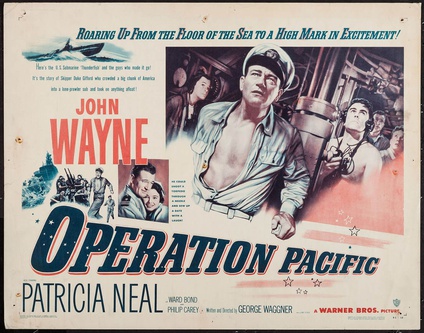
While most classic Hollywood war films have a pretty clear set of objectives (selling bonds, driving up recruitment numbers, etc.), George Waggner’s Operation Pacific (1951) is an entirely different animal.

This John Wayne-led naval adventure is much more celebratory and easy-going in tone, clearly riding off the protracted high that many Americans were still feeling since World War II ended six years earlier.

As a result, the film is a lot more interested in exploring what a soldier’s life might be like after “the fight” comes to an end, rather than providing some insight into what this specific conflict looked like in a larger context.

Even though this tone might upset some military diehards, Operation Pacific actually benefits from the gift of hindsight, since it doesn’t get completely bogged down in the cynical saber rattling that kneecaps so many other war films of that era.

The plot of Operation Pacific revolves around Duke Gifford (Wayne), who serves as an executive officer aboard a submarine called the USS Thunderfish during World War II.

After returning from a dangerous mission in the Philippines, Duke runs into his ex-wife Mary Stuart (Patricia Neal) while on leave at Pearl Harbor.

Even though the two still have feelings for each other, Duke’s responsibilities as a naval officer keep getting in the way of his romantic advances toward Mary, especially as his patrols in enemy waters get increasingly treacherous.

Now, some of you might be scratching your heads after reading this plot synopsis, since this sounds more like a Nicholas Sparks novel rather than a gritty war epic starring John Wayne.

This element caught me by surprise as well, since lengthy sections of the film are dedicated to Wayne and Neal making doe eyes at each other, while a lot of the naval combat scenes are pushed to the sidelines.

Operating Pacific also goes out of its way to depict the more blasé and uneventful aspects of military life that border on the comical, some of which wouldn’t be out of place in an Abbott and Costello movie.

In one scene, while on shore leave, Wayne is tasked with bailing his men out of a Honolulu jail after they get into a drunken brawl with some local police officers.

When the crew is at sea, they use some of their down time to screen a movie in the submarine’s mess hall.

And after rescuing an infant from enemy territory, the men of the USS Thunderfish figure out how to feed the child using a rubber glove.

While these moments do tonally clash with the naval combat scenes—which are awash with gunfire, explosions and technical mumbo jumbo — they do add some much-needed variety to what would otherwise be a pretty by-the-numbers war movie.

And by shifting the film’s focus away from the “battlefield,” Waggner (who also wrote the screenplay) is very clearly trying to appease a post-World War II audience, whose appetite for outright bloodshed had definitely cooled after six years of peacetime. *

Plus, by 1951 the US Baby Boom was noticeably underway, with the romance between Wayne and Neal in this film serving as an obvious nod to the kind of cathartic, romantic energy embodied in classic wartime imagery like Alfred Eisenstaedt’s “V-J Day in Times Square” photograph.

In fact, this film is so uninterested with broader conflict itself that there’s not really any main antagonist to speak of.

Sure, Wayne has to butt heads with a fellow soldier who is also after his ex-wife’s affections, but their relationship is always very cordial and never escalates beyond a harsh word.

Because of this, most of the film’s charm comes from its quieter moments, where the main characters hang out and discuss what life is like back on dry land.

That being said, Operation Pacific does slightly buckle under some clichés that one would expect from a Hollywood war epic from that era.

For one thing, a lot of the film’s action sequences rely way too heavily on stock imagery, which isn’t spliced into the director’s original footage in an organic fashion.

Additionally, Waggner is pretty upfront about presenting this story as a piece of military propaganda, opening up the movie with a Star Wars-style crawl that pays tribute to those who lost their lives in the line of duty.

While there’s nothing wrong with this kind of cinematic remembrance, it does set the tone for a movie that casts World War II in an overly simplistic light, where all American soldiers are depicted as being absolute paragons of virtue.

This approach to characterization turns into a problem whenever the movie veers off into a territory that isn’t morally black and white, like the aforementioned moment where Wayne has to bail his men out of jail.

Even though these characters assaulted several police officers under the influence of alcohol, this scene is largely played for laughs, where the crew is ultimately left off the hook for committing such a serious crime.

This uncritical eye is prevalent throughout the rest of the movie as well, since the filmmakers don’t provide any insight into the Imperial Japanese Navy, outside of the fact that they are a mostly faceless enemy who must be defeated.

Thankfully, this outdated propaganda isn’t so heavy handed that it ruins the movie, although everyone’s mileage may vary (especially if you don’t care for the term “Japs” being thrown around in casual conversation).

And even if you’re not a big fan of romance being mixed in with your violent war movie, at least take comfort in the fact that Waggner does a pretty decent job of balancing those two elements throughout the film’s 111-minute runtime.

For what it’s worth, I’ve seen this kind of genre bending done way worse, with Paul Gross’ crushingly melodramatic Passchendaele (2008) immediately coming to mind.

Plus, in this case, the relationship between Wayne and Neal actually saves Operation Pacific from being completely irrelevant to a 2021 audience.

After all, [SPOILERS] their successful reconcilement at the end of the movie is obviously meant to tap into America’s desire to return to some state of normalcy after a long period of societal upheaval.

And in that respect, Operation Pacific has become way more relatable than ever in the seven decades since its original release now that the country (and North America more broadly) is turning the tide in the fight against COVID-19. **

Verdict:

6/10

Corner store companion:

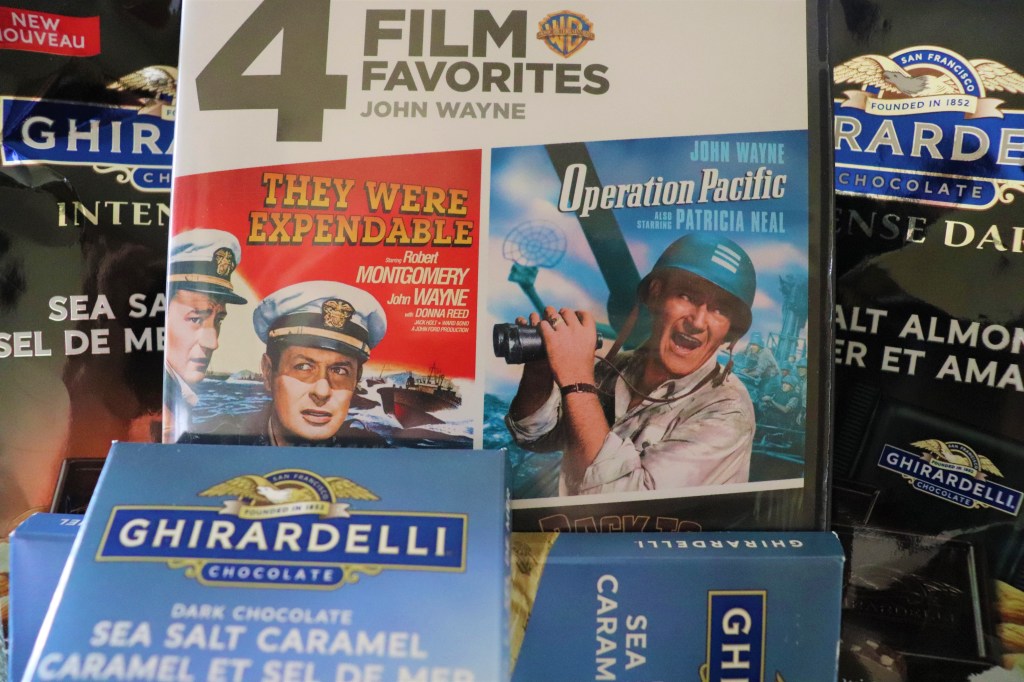
Ghirardelli sea salt chocolate (because it’s the only nautical-themed snack food that I could find)

Fun facts:

-Release date: Jan. 27, 1951

-Budget: $1.46 million (estimated)

-Box office: $2.56 million (US), $1.3 million (worldwide)

-Retired US navy admiral Charles A. Lockwood served as a technical advisor on Operation Pacific to ensure its accuracy when depicting submarine warfare. According to Wikipedia, Hollywood producers sought out Lockwood a couple more times to advise them on a variety of other film projects, including Hellcats of the Navy (1957), On the Beach (1959), and Up Periscope (1959).  

-Near the finale of Operation Pacific, the men of the USS Thunderfish can be seen exchanging film canisters with a friendly American sub so that both crews can enjoy a movie night. These films, Destination Tokyo (1943) and George Washington Slept Here (1942), were both produced by Warner Bros. Pictures in real life.

-Following the release of Operation Pacific, George Waggner mostly directed television for the remainder of his career, including episodes of The Green Hornet, Maverick, The Man from U.N.C.L.E. and Batman.

* I realize that the US was involved in the Korean War by 1951, but that conflict wasn’t nearly as pervasive in American society as World War II was, so I think my original point stands.

** I sincerely hope this statement doesn’t become extremely dated in the coming weeks and months.

A Walk to Remember (2002) review-Is it dusty in here or something?

My inaugural journey into the Nicholas Sparks cinematic universe got off to a shaky start last year, with Message in a Bottle (1999) providing lots of beautiful imagery but a fundamentally flawed love story at its core.

Because of this, I booted up A Walk to Remember (2002) with some serious reservations, expecting the same unbalanced experience that failed to show me why Sparks’ brand of romantic fiction has resonated with so many people.

However, this time around, the cast and crew behind the author’s second big-screen adaptation really went out of their way to sell you on the central relationship between the two leads, which is all you really need for this kind of movie to work.

The plot of A Walk to Remember revolves around rebellious high schooler Landon (Shane West), whose tendency to hang around with the wrong crowd eventually lands him in hot water with the law.

In order to avoid jail time and expulsion, this troubled young man signs up for a variety of community service programs, which puts him in close proximity with fellow student Jamie (Mandy Moore).

Even though they come from different backgrounds, the pair form an unlikely romantic bond that puzzles Landon’s friends and worries Jamie’s minister father. 

Now, if you read that synopsis (or watched the above trailer) and rolled your eyes I wouldn’t blame you.

This “star-crossed lovers” premise has been executed hundreds of times on film and A Walk to Remember does very little to mix up that formula.

In fact, it’s almost comedic how far director Adam Shankman goes to position West and Moore as an unlikely couple in the beginning.

Not only does the pair dress like they are inhabiting different centuries, but the film’s soundtrack even reinforces this disconnect by giving each character contrasting musical cues.

While Moore is usually surrounded by a choir or gentle, ambient music, West’s bad boy interloper is constantly backed by a punk or grunge band whenever he is on screen.

Even though this technique accomplishes its goal of distinguishing these two characters, the filmmakers lay it on way too thick, to the point where each scene transitions feels like you are jumping into a completely different movie.

This ham-fisted set-up also isn’t helped by some clunky dialogue early on, where screenwriter Karen Janszen decided to cram a lot of Jamie’s backstory into a single conversation.

But as the plot moves forward, a lot of those glaring weaknesses begin to fade away as the dynamic between Moore and West finally takes shape, which is hands down the best part of the movie.

Not only does the pair have crazy chemistry, but Janszen also maps out some pretty satisfying character development through their evolving relationship.

Like most great movie romances, Landon and Jamie bring the best out of each other as they become closer, helping to fill an emotional void that both characters have had to endure because of an absent parental figure.

Once this bond really takes hold, both characters demonstrate their ability to grow as people, with Jamie learning to come out of her shell while Landon finally showcases some empathy that he had been lacking up until this point.

And then, cruelly, Sparks pulls the rug out from under the audience with a third act revelation that has made this story a prolific tearjerker for an entire generation of readers and moviegoers.  

A WALK TO REMEMBER, Mandy Moore, Shane West, 2002 (c) Warner Brothers/courtesy Everett Collection.

Again, nothing about this framework is revolutionary, and A Walk to Remember got righteously raked over the coals by critics when it was originally released for being “boring,” “melodramatic,” “cliché-ridden” and even “simple-minded.”

However, I believe that this simplicity is why the movie works so well, since it is laser focused on the two appealing leads and doesn’t get bogged down in a bunch of unnecessary sub plots.

In fact, one of the film’s biggest missteps, in my eyes, are these brief digressions involving Landon’s estranged father, who doesn’t meaningfully add to the plot and should have been cut out of the story altogether.

Because, at the end of the day, all the audience really cares about is watching Moore and West interact on screen, and for very good reason.

 The back and forth between these two is very fun to watch, since they genuinely appear to enjoy each other’s company and don’t rely on the film’s soundtrack or cinematography to do the heavy lifting.  

Moore is particularly impressive inhabiting a role that requires her to act like a full-grown adult stuck in a teenager’s body, especially since she was only 17-18 at the time of filming. 

And when that tragic third act revelation finally rears its ugly head, her performance actually takes on a whole new layer of meaning, encouraging you to watch the whole movie again with this new information in mind.

Admittedly, these two strong lead performances aren’t backed up by any real impressive filmmaking, since Shankman’s direction is pretty bland and doesn’t hold a candle to the scenic vistas that were on display throughout Message in a Bottle.  

That being said, he does show some flourishes every now and again by utilizing the occasional long take, including a series of lengthy tracking shots that introduce a lot of the supporting cast in the opening minutes of the movie.   

Still, I’m not going to pretend like Shankman’s mise-en-scène in A Walk to Remember is particularly noteworthy or eye-catching.

In fact, it seems like most of those key visual elements—like composition, production design, lighting and costuming—are being used to service the two main leads as opposed to all the surrounding scenery.

But, in retrospect, that decision was probably for the best, since the relationship between Moore and West is the main selling point of the movie. And in that respect, I think most people left the theatre back in 2002 feeling like they got their money’s worth.

Overall, I think the main reason why A Walk to Remember succeeds where other romantic dramas fail is that the central love story is simple and earnest.

Even when the plot veers off into some heavy subject matter later on, the film doesn’t feel overly manipulative or like it is trying too hard to make the audience weep.

Instead, those tears flow from a very natural place, which is a testament to Janszen’s script and the original source material.

I don’t know if any of Sparks’ other screen adaptations contain similar levels of emotional potency, but I’m looking forward to seeing where this journey takes me.

After all, if I’m going to cry living under these lockdown conditions, I’d prefer my source of woe to be a piece of media rather than the crushing realization that I can’t see my friends and family right now.

Er …. anyway … Happy Valentine’s Day!!!

Verdict:

7/10

Corner store companion:

Scotties and Kleenex brand tissues (because you’ll really need them for the final reel of this film)

Fun facts:

-Release date: Jan. 25, 2002

-Budget: $ 11,800,000 (estimated)

-Box Office Gross: $ 41, 281,092 (domestic), $47,494,916 (worldwide)

A Walk to Remember serves as Mandy Moore’s first major movie role following her well-established career in music. Before this film, she mostly nabbed supporting roles in films like Dr. Dolittle 2 and The Princess Diaries.

-Many of the sets featured in A Walk to Remember were used by the cast and crew of Dawson’s Creek, a long-running teen drama that was also shot in Wilmington, North Carolina.  

-Even though Sparks’ original novel took place in the 1950s, he and the filmmakers decided to update the setting to the 1990s/2000s for the screen adaptation, believing that this change of scenery would resonate a lot more with modern audiences.

-In a 2015 interview with The Wrap, Shane West revealed that he was so enamored with the 1967 Chevrolet Camaro he drove in this film that he bought this classic muscle car following the first week of shooting.

-Like Moore, Shane West has an extensive background in music as well as acting, serving as the lead singer of the punk bands Johnny Was in the 1990s and Twilight Creeps in the 2010s.

-Musical highlight: “Cry” by Mandy Moore (this thematically appropriate song plays over the movie’s closing credits)

Message in a Bottle (1999) review- missing that crucial spark

When it comes to film criticism, I always try to take my professional life out of the equation, especially when a movie decides to mimic the world I inhabit as reporter.

But Luis Mandoki’s Message in a Bottle (1999), based on a novel by Nicholas Sparks, contains such a flagrant example of journalistic malpractice from the main character that I couldn’t help but roll my eyes at what’s otherwise a pretty enjoyable romantic drama.

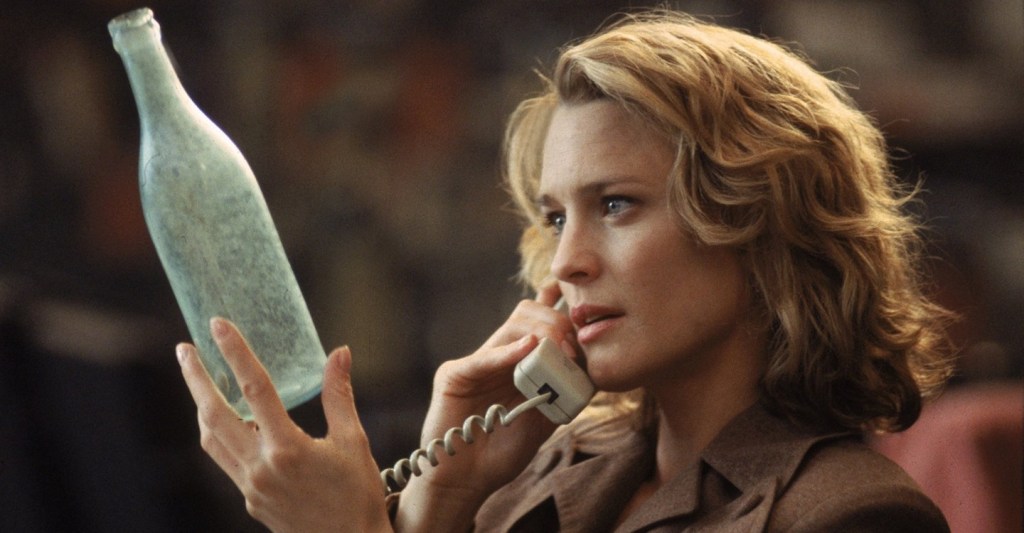
The film stars Robin Wright as Theresa Osbourne, a researcher for the Chicago Tribune who conducts a nation-wide search for a mystery man after one of his love letters (contained in a bottle, naturally) washes up on the shore of a nearby beach.

Theresa’s search eventually leads her to a sleepy sea-side town in North Carolina, where she comes face-to-face with the author himself: a soft-spoken widower played by Kevin Costner.

Even though Theresa was sent there to gather information on the man (Garrett) and his tragic love story, she neglects to disclose the real reason for her visit, not wanting to spoil the mutual attraction that’s growing between them.

Now, there’s a lot wrong with this set-up on multiple levels.

In terms of journalistic ethics, Theresa failing to divulge her true assignment to Garrett from the get-go is incredibly sketchy, since she’s gathering sensitive details about a man’s dead wife under false pretenses.   

This approach might have made sense if the character worked for a scuzzy tabloid newspaper that is completely devoid of editorial scruples.

But in the real world, even the gutter trash “reporters” that work for TMZ announce who they are when they harass celebrities at the airport, so I don’t know why Sparks and screenwriter Gerald Di Pego decided to portray the Chicago Tribune staff in such a negative light (intentionally or not).

On a writing level, this deceitful action also drags down Wright’s otherwise solid lead performance as Theresa, who is meant to be this kind, empathetic figure but just comes across as being manipulative.

No matter how many times she shares a cute moment with Garrett or even his crusty father Dodge (played by Paul Newman), I couldn’t get invested in these relationships since they are built on a foundation of lies.

Of course, it’s obvious why they decided to include this plot element in the story: to build tension.

Theresa’s deception serves as a kind of Sword of Damocles for the narrative, something that hangs over the central romance and threatens to destroy it at any second.

And while every good love story needs tangible conflict beyond a “will they, won’t they?” dynamic, a seemingly good-hearted person lying to a grieving widower by omission seems like the laziest possible way to inject that sort of speed bump into the plot.

In my view, Message in a Bottle (1999) would be vastly improved if Theresa simply revealed her intentions to Garrett from the outset.

Not only is this approach more consistent with how the character is written, but it also provides a much more interesting avenue for conflict, where she gradually has to win Garrett’s trust as both a reporter and romantic partner throughout the course of the story.

I know my fixation on this one plot point is a little over-the-top, but that’s only because it drags down a movie that I really wanted to like.

After all, this is my first time indulging in a Nicholas Sparks story, and it’s easy to see why his specific slice of romantic fiction has spawned such a vast media empire on the printed page and silver screen.

For one thing, the film’s cinematography is consistently gorgeous, with Oscar-nominated DP Caleb Deschanel doing an expert job of capturing the beauty of costal America that Sparks loves to write about.

Some lingering shots of sailboats and crashing ocean waves might wander into the territory of scenery porn, but that at least has some relevance to the plot, reinforcing Theresa’s desire to abandon her life in the big city to live with Garrett.

This idyllic, small-town atmosphere is made even more appealing thanks to a really strong supporting cast, who come across as the exact kind of people you would want to chat up after checking into a bed and breakfast.

Paul Newman really shines in this capacity, with his character’s salt-of-the-earth wisdom and sassy comebacks leading to some of the film’s best moments.

Plus, the movie’s soundtrack features a bevy of easy-listening icons like Faith Hill, Sheryl Crow and Sarah McLachlan, which compliments this laid-back aesthetic in a very meaningful way.

Of course, Message in a Bottle has a couple other things holding it back aside from a single questionable writing decision at its core.

For one thing, the film’s runtime clocks in at over two hours, which is way too long for this kind of movie and it really kills the momentum in the third act.

You’ll also notice that I haven’t commented on Costner’s qualities as a romantic lead up until this point, and that’s because he barely registers as a presence on screen.

I understand that it’s difficult to squeeze a compelling performance out of a character who is meant to emotionally withdrawn, but Costner never really manages to get himself out of first gear, even when he’s asked to deliver a passionate monologue later on in the movie.

It’s almost like he suffers from the reverse problem of his co-star (Wright), since Costner’s wooden acting doesn’t compliment some admittedly solid character writing from Sparks and Di Pego.

Unfortunately, these two incomplete characters don’t coalesce into a compelling whole, which is a big problem when your romantic leads are the movie’s biggest selling point.  

Despite this film’s mixed quality, it still hasn’t discouraged me from watching the remaining four entries in my “5 Film Collection: Nicholas Sparks” DVD set.

Clearly the author has tapped into a formula that resonates with a lot of people—having sold over 115 million copies of his books worldwide—and I’m curious to see if the more appealing qualities of Message in a Bottle (1999) are way more prevalent in future film adaptations.

But hopefully this story marks the last time Sparks dips his toes into writing about the world of journalism, since he’s clearly out of his depth when it comes to this subject.  

Verdict:

5/10

Corner store companion:

Sensations Cracker Assortment (because this is possible one of the whitest movies I’ve ever seen)

Fun facts:

-Release date: Feb. 12, 1999

-Budget: $80,000 (estimated)

-Box Office Gross: $52,880,016 (domestic), $118,880, 016 (international)

Message in a Bottle is the first of 11 total Nicholas Sparks film adaptations. Altogether, these movies have grossed a combined $ 889,615,166 worldwide. 

-While all of Sparks’ films manage to turn a profit, none of them are critical darlings. Out of all 11 movies, The Notebook has come the closest to achieving a “fresh” rating on Rotten Tomatoes at 53 per cent.

-Sparks originally published Message in a Bottle back in 1998. It was his second official novel after The Notebook in 1994.

-Sparks’ most recent written work, The Return, was released back in September of this year, which marked his 21st published novel. He’s also written two non-fiction books.

-Kevin Costner was nominated for a Golden Raspberry Award (Worst Actor) in 2000 for his performance in both Message in a Bottle and For The Love of the Game.

-Musical highlight: “Carolina” by Sheryl Crow (plays over the end credits)