
Writing about an actor or filmmaker’s work shortly after their death is always a dicey exercise.
On one hand, if the film is good, you can use it as a stepping stone to wax poetic on their entire career. I got that opportunity earlier this year through reviewing The Story of Us (1999), which I found to be quite enjoyable and emblematic of director Rob Reiner’s broader filmography.
However, if the movie is bad, you run the risk of coming across as a callous engagement farmer who is dancing on someone’s grave for clicks. This puts me in an awkward position having recently watched Logan’s War: Bound by Honor (1998), a made-for-TV movie starring recently deceased action star Chuck Norris.
Because the movie IS bad (no doubt about it), so how do I thread that needle without sounding like a brazen opportunist?
But I soon realized that even the most diehard Norris fans (I’m talking about the people who enjoy his work unironically, outside of all the internet memes), would probably admit that Logan’s War is not his best.
It marks a time when Norris had all but given up his role as a theatrical leading man and he was more than willing to rest on his laurels as a mainstay of scripted CBS programming.
Plus, despite getting top billing, Norris barely appears in this movie and only dishes out his trademark martial arts ass whoopings in the last five minutes.
So, I think trashing Logan’s War is a pretty safe prospect, given that it barely registers as a Norris vehicle at all and just comes across as some cheap movie-of-the-week that’s meant to be played in the background at a West Texas retirement home.
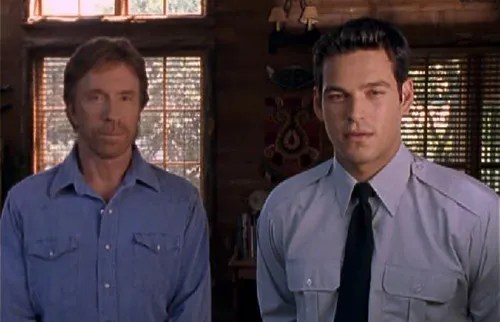
In terms of screentime, the real star of this film is the titular Logan (Eddie Cibrian), who’s orphaned as a young boy after his entire family is murdered by the mob.
After being taken in by his uncle Jake (Norris), Logan vows revenge and is trained in martial arts, eventually using these skills to become an Army Ranger.
But government-sanctioned bloodshed can only satisfy Logan for so long, and he eventually leaves the military to set his sights on finally killing mobsters who wronged him as a child.
From this synopsis, you’ve no doubt noticed that this movie covers a lot of ground, so much so that you’re probably wondering how the filmmakers elegantly squeeze all these story beats into a svelte 95-minute runtime.
Well, the short answer is: they don’t.
Instead, the movie just kind of arbitrarily switches genres every 30 minutes or so. It starts out as a coming-of-age story before transitioning into a military action film, leaving just enough room at the end for an urban revenge thriller to take over at the end.
This means that barely any time is dedicated to letting these disparate elements marinate, with all plot and character development flying by at lightning speed.
The cast member who suffers the most from this relentless pacing is Brendon Ryan Barrett, who plays Logan at 10 years old. Despite being saddled with some pretty heavy material (mourning the brutal murder of his parents and baby sister), Barrett manages to navigate these complex emotions with remarkable poise despite his age.

But just as we’re getting used to following this kid’s emotional journey, the film transitions to Cibrian as adult Logan, and all the groundwork that Barrett laid is thrown out the window.
It’s not that Cibrian is bad or anything, but the script basically doesn’t give him the opportunity to emote past the cool, stoic professionalism one normally associates with action heroes from the 1980s and 90s.
As for Norris, he’s such a non-entity in this film that he might as well not be there.
While he’s definitely up to the task of leading a grizzled pep talk or patriotic training montage, he doesn’t have the acting chops to anchor all the scenes in between. He showcases maybe two or three different facial expressions throughout the entire film, and his voice rarely rises above a dull monotone.
And then, he disappears for a 30-minute stretch in the middle of the film, like he couldn’t even be bothered to star in his own movie.
As a result, Logan’s War comes across as low effort and half-baked most of the time, even for a TV movie from this decade.
Outside of all the cheap production tricks (stock sound effects, digital zooms, flat lighting, etc.), the film’s writers can’t even commit to their zanier ideas.
Early in the story, it’s revealed that Logan possesses a supernatural ability called a “proximity sense.” It’s essentially a bootleg “Spidey Sense” or a watered-down version of “the Shining,” where Logan receives a vision of the future that warns him of incoming danger.
Is introducing psychic superpowers into a grounded action drama incredibly dumb and creatively bankrupt? Sure. But at least this reveal caught my attention and made me wonder how they’re going to incorporate this element into the film’s myriad fight scenes.
Unfortunately, the scriptwriters (which includes Norris and his brother Aaron) either got bored of Logan’s “proximity sense” or just plain forgot about it, since it doesn’t factor into the last third the movie.
I’m just saying, Logan could have definitely used these superpowers in the film’s climax, where he takes on an entire mansion full of armed mobsters.
The only reason he doesn’t perish during this assault is thanks to a last-minute save from Norris, who shows up despite not knowing about his nephew’s plan ahead of time.
At the very least, this nonsensical plot development leads to the movie’s best (and funniest) moment, where a 58-year-old Norris takes out the main villain by drop kicking him through a car windshield.
Now, clips like this might give you the impression that the action choreography in Logan’s War is consistently crazy and off-the-wall. However, the reality is that most of the fight scenes are pretty bog standard and not that different from what you would find in an average episode of Walker, Texas Ranger.
Norris’ stunt team is obviously very talented, but there’s nothing really going on behind the camera to enhance all the punches, kicks, and grapples.
In fact, some of the production decisions actively take away from the action, such as the filmmakers’ annoying tendency to inject slow motion into a lot of the fight scenes.
This makes a lot of the action choreography appear slow and stagey, like the cast is performing a martial arts demo for a crowd at Six Flags.
There are occasional flourishes of interesting action outside of Norris’ hilarious windshield kick, like when Cibrian takes out two mobsters by firing his Desert Eagle while hanging upside down in a broom closet.
But those moments are few and far between, which is a major problem when seeing Norris and his acolytes beat up bad guys is the only reason you’d watch one of these movies in the first place.
Instead, all you’re left with is something that looks and feels like an extended TV pilot that never got picked up for a full slate of episodes.
This kind of half-hearted approach to filmmaking is emblematic of the rest of Norris’ career.
Heading into the 21st century, he would eventually move away from full-time acting altogether, using his status as an elder statesman of cheesy action schlock to star in Polish bank commercials and book cameos as himself in other movies.
Today’s younger film fans will probably only recognize Norris as this parody version of himself, alongside his public opposition to gay marriage, signal boasting of Barack Obama birtherism conspiracy theories, and repeated endorsement of a country that’s currently committing a horrific genocide in the Middle East.
So while Logan’s War is a pretty forgettable film overall, it could be seen as a tipping point where Norris decided to just cash in on past glories and fully commit himself to bad politics.
That being said, his legacy hasn’t been etched in stone quite yet, since we’re only a couple months removed from his death at the age of 86.
And even though we won’t know what future generations will think of Norris’ career and public persona, I’m fairly certain that Logan’s War won’t be remembered fondly … outside of that climactic dropkick of course. That shit is evergreen.
Let’s watch it again, shall we …
Verdict:
4/10
Corner store companion:
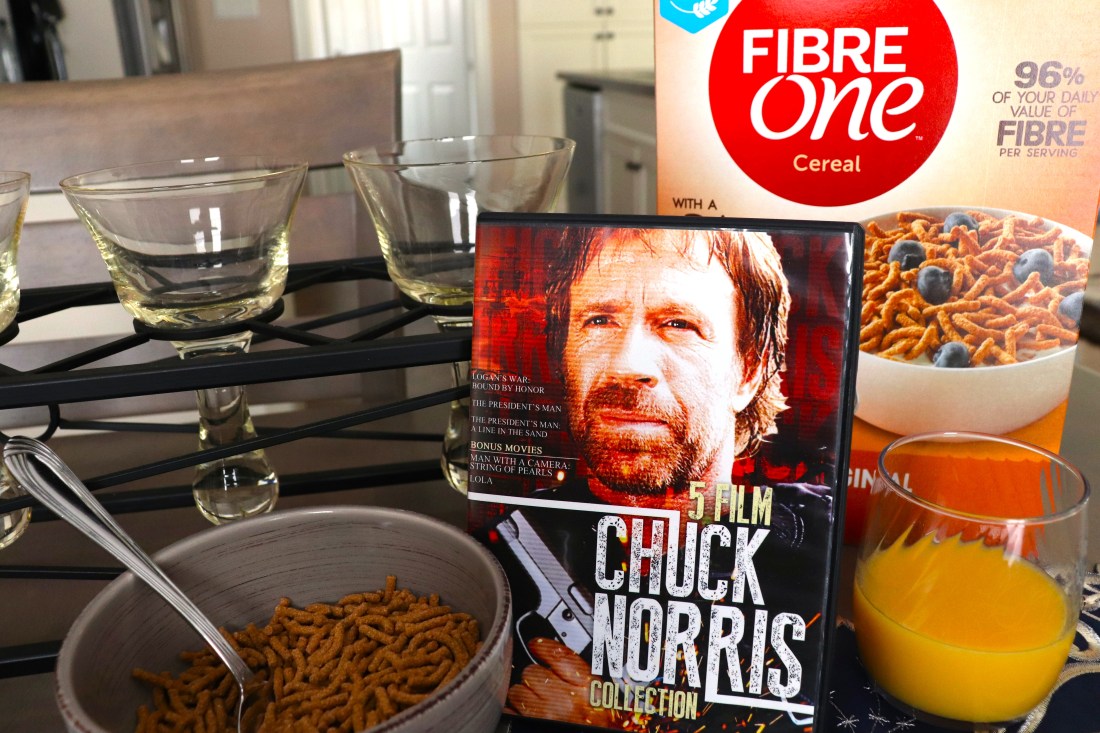
Fibre One Cereal (because if you’re watching a Chuck Norris film in 2026, chances are you need more fibre in your diet)

Fun facts:
-Air date: Nov. 1, 1998
-Logan’s War was created under Norris Brothers Entertainment, a production company run by Norris and his brother Aaron. NBE is also responsible for producing the later seasons of Walker, Texas Ranger and other TV movies starring Norris such as The President’s Man (2000).
-Norris will appear in at least one more film following his death in March. According to IMDB, he has a supporting role in the horror comedy Zombie Plane (starring Vanilla Ice), which is scheduled for a late 2026 release.
–Logan’s War: Bound by Honor can be watched in its entirety online through the official Samuel Goldwyn Films YouTube channel.