

Media consumers of the streaming era will never truly know the pleasure of randomly flipping through cable channels on a lazy Sunday afternoon, which was one of the most reliable forms of entertainment for bored youth growing up in the 1990s and early 2000s.
Sure, most of the television programs available during that weekend block were infomercials or reruns of ancient sitcoms, but every once in a while you would stumble upon a random action movie that would catch your attention.
Even if the film wasn’t very good, there was something captivating about getting thrown into the middle of a car chase or shootout without the ability to rewind, forcing you to fill in the gaps using your childish imagination.
These impromptu screenings would also serve as a nice bonding experience between you and your dad, who would reliably drop whatever he was doing at the sound of gunfire and explosions and sit down on the couch next to you.
It’s in this environment that movies like Jack Sholder’s Renegades (1989) really thrive, since you don’t need to engage with it at an emotional level and just get to enjoy the cheap spectacle before Sunday dinner is ready.
However, watching this film as an adult on DVD is an entirely different story, since its underlying hollowness is inescapable in this format and you don’t have mom’s famous shrimp pasta dish to help soften the blow.
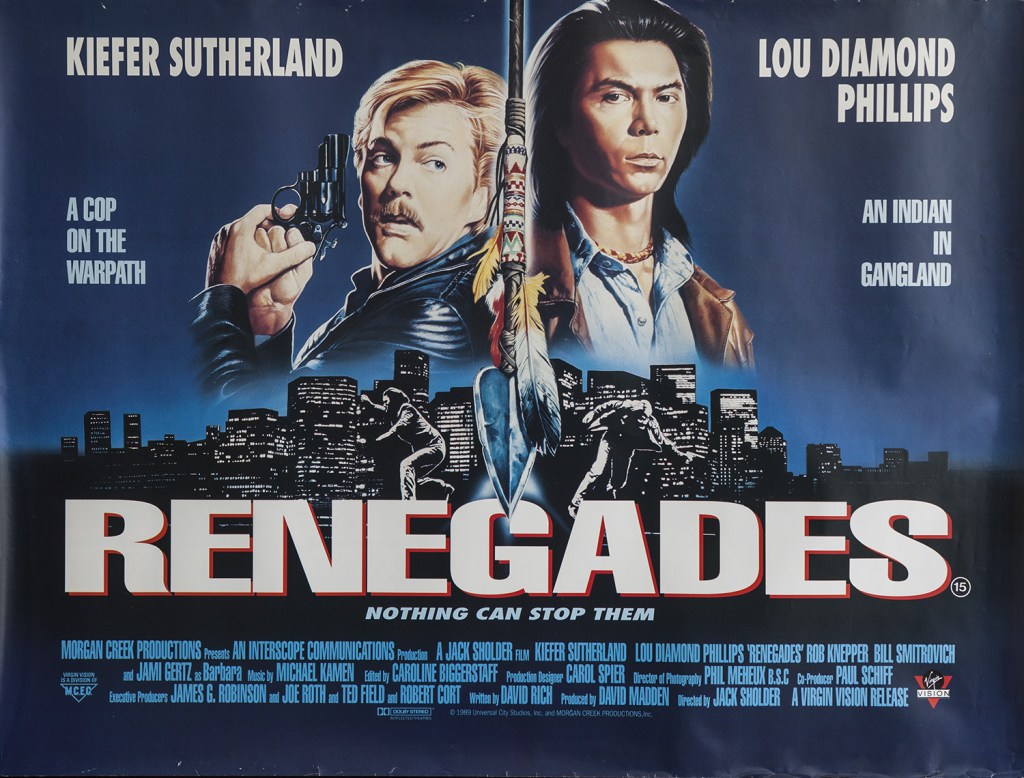
Like so many action movies of the 1980s, Renegades can easily be slotted into the buddy-cop genre, with Kiefer Sutherland and Lou Diamond Phillips starring as an undercover police officer and Native American tourist visiting Philadelphia, respectively.
When Sutherland’s involvement in a diamond heist results in a precious artefact being stolen from Phillips’ tribe, the pair must team up to bring down the bad guys.
From there, the plot unfolds in a pretty predictable fashion, since the two start out not trusting each other but gradually develop a bond as they get closer to cracking the case.
But unlike more famous buddy-cop movies from that era — like Lethal Weapon (1987) or 48 Hours (1982) — screenwriter David Rich doesn’t do a good job of giving these characters contrasting personalities.
Instead, both Sutherland and Phillips are written to be loose cannons who don’t abide by the rule of law when it comes to tracking down the people who have wronged them.
As a result, most of the conflict between these two is purely driven by the plot or superficial elements like their background, which isn’t very compelling.
It’s also pretty apparent that screenwriter David Rich was only interested in fleshing out one main character out of the two.
Sutherland’s undercover cop is at least given a decent backstory to explain his motivation throughout the story, since the audience is explicitly told that his father was a corrupt police officer who died in disgrace.
Meanwhile, Phillips’ character is completely shrouded in mystery, with details surrounding his upbringing only briefly hinted at through sparse bits of dialogue.
To compensate for this lack of depth, Rich takes the lazy route of imbuing Phillips with Jedi superpowers, hoping that viewers will be won over by his quick reflexes and ability to tap into “the force” whenever his family is in danger.
But believe it or not, this one-note Hollywood depiction of the “noble savage” gets old pretty quickly, especially since Phillips’ chemistry with Sutherland is average at best.

Thankfully, Renegades at least delivers in the action department, with a handful of standout sequences that elevate it over the Steven Seagal-tier shlock that was circulating in the industry around that same time.
A car chase 20 minutes into the movie is honestly worth the price of admission alone, where Sutherland is forced to drive a getaway car at gunpoint after the aforementioned diamond heist goes horribly wrong.
Parts of this scene actually reminded me of the famous car chase from William Friedkin’s The French Connection (1971), where the director used a lot of first-person camera shots to create a palpable sense of danger.
The level of automotive destruction on display is also reminiscent of John Landis’ The Blue Brothers (1980), albeit with a less comedic touch.
The movie’s climactic night-time shootout at a horse ranch is similarly high on spectacle, since the filmmakers expertly compensate for a lack of natural light by setting the surroundings on fire.
And while the rest of the film’s action sequences aren’t up to that same high standard, they are at least well-edited and contain a lot of messy carnage that a more timid director would have shied away from.
Needless to say, these meaty chunks satiated my inner bloodlust and made me temporarily forget about the less desirable aspects of Renegades, like its cliched dialogue, generic music, and pedestrian plot that often veers off into being nonsensical.
But as soon as the action quiets down and you’re given some room to think, all these weaknesses bubble to the surface and the film falls apart.
Even the movie’s inciting incident is half-baked, since the main bad guy decides to take a breather from getting chased by the cops and steal Phillips’ family heirloom (a spear) for no reason.
Because of this, the protracted MacGuffin hunt that follows feels totally perfunctory, almost like the filmmakers were looking for the weakest excuse possible to link a couple of (admittedly cool) action sequences together.
Again, this kind of viewing experience is much better suited for the long-lost days of weekend cable TV, where you could put it on in the background as you wrestled with your brother or finished your homework before school on Monday.
But experiencing Renegades through the lens of an adult who is interested in obscure DVD collections, I can’t help but feel like something was lost in translation, almost like I was watching a foreign-language film with the subtitles turned off.
So unless I get my hands on a time machine, the optimal viewing conditions for this film are lost forever, and all I’m left with is a standard 80s cop movie that features good action but is severely lacking in emotional stakes.
Sounds like my last Tinder date.

Verdict:
5/10
Corner store companion:
McCain Pizza Pockets (because it’s the kind of food that also peaked in the 1990s and early 2000s)

Fun facts:
-Release date: June 2, 1989
-Budget: $16 million
-Box office: $20 million
-Because of Louis Diamond Phillips’ mixed heritage (Spanish-Filipino on his mother’s side and Scottish-Irish, Cherokee on his father’s side) he’s been able to portray a variety of ethnicities throughout his acting career, including Native American. Through preparing for Renegades, Phillips grew closer to the Indigenous community and was even adopted by an Oglala Lakota Sioux family in 1991. His Lakota name translates to “Star Keeper.”
-Outside of helming Renegades, Jack Solder is probably best known for directing A Nightmare on Elm Street 2: Freddy’s Revenge (1985).
-While Renegades is set in Philadelphia, it was mostly shot in and around Toronto.
-Sutherland and Phillips would later reunite in a two-episode run of the popular TV action drama 24. During this section of season one, Phillips plays the warden of a secret detention facility who encounters CTU agent Jack Bauer (Sutherland) investigating the attempted assassination of a presidential candidate.
-Musical highlight: “Only the Strong Survive” by Bryan Adams (plays over the end credits)


 Corner Store Cinema