Man Hunt (1984) review- a journey into the uncanny valley

If you’re looking to pick a fight on social media these days, a good place to start (outside of the ongoing Israel-Hamas conflict) is talking about generative artificial intelligence.

This is especially true in sections of the internet where people like to discuss the arts, since this new technology is viewed (depending on who you ask) as something that will either revolutionize the entertainment industry or bring about its downfall.

Personally, most of the AI-generated images and videos I’ve seen aren’t a convincing substitute for the projects made by flesh-and-blood creators, since they almost always possess some bizarre alien quality that makes my skin crawl.

However, the recent advances in AI shouldn’t distract you from the fact that humans have always had the potential to produce works of art that are completely uncanny, off-putting, and devoid of logic.

Enter Fabrizio De Angelis’ Man Hunt (1984), a neo western so lazy and nonsensical in its construction that you think the script was written during a drunken round of Mad Libs.

Admittedly, this does result in somewhat of an engaging viewing experience, since you’re constantly left wondering when the next wacky story development or plot hole will pop up. 

But taken as a whole, Man Hunt’s pervasive weirdness can’t sustain a feature-length runtime and it just leaves you with the creeping feeling that your home has sprung a gas leak.

Some may look at this film’s synopsis on IMDB or Wikipedia and conclude that I’m being a little hyperbolic, since the set-up is typical western shenanigans.

The plot of Man Hunt revolves around a nameless stranger (Ethan Wayne), who buys a pair of horses at a rodeo and accidently wanders onto some land belonging to a corrupt rancher (Ernest Borgnine).

After the rancher steals the horses for himself, the stranger gets thrown in prison after attempting to retake his property.

The rest of the film details the stranger’s attempts to escape from captivity and clear his name, all the while trying to stay one step ahead of the law.

You’ve probably seen a variation of this plot in a dozen other movies, but it’s the way that De Angelis and his crew tell this story that’s truly baffling.

For one thing, the stranger’s first escape from prison is never shown or discussed on screen, even though it’s supposed to represent a major turning point in the story.

Before you can get your head around such a weird creative decision, the stranger is immediately caught and gets thrown back behind bars, leading to his second escape minutes later.

After hijacking a bus and blasting his way through an army of cops, the stranger is then given safe passage thanks to Borgnine’s corrupt rancher, whose change of heart comes out of nowhere and is never given any explanation.

This kind of plot progression would make sense if Man Hunt was a comedy or Zucker Brothers-esque parody of old prison break movies.

But the tone of the film is deadly serious throughout its 91-minute runtime, which exposes the grim reality that De Angelis and his team have no idea what they’re doing.

That lack of direction is laid bare in the first four minutes of the film, which consists almost entirely of boring b-roll footage of the rodeo where the stranger buys his horses.

This opening remains a pretty blatant example of “Shooting the Rodeo,” a term coined by RedLetterMedia that describes the tendency for directors of low-budget movies to pad their runtime by filming real public events.

Man Hunt is an especially egregious example of this trope, since De Angelis lingers on this intro for way too long and includes elements like unnecessary slow motion to add insult to injury.  

These strange filmmaking techniques persist throughout the entire narrative, so much so that I was almost convinced that De Angelis was trying to create the kind of surreal, dream-like atmosphere one would find in a David Lynch movie.

But unlike Lynch’s works, Man Hunt is a pretty boring and lifeless affair for long stretches of its runtime, which is made even worse by a lead performance that is dull as dishwater.     

For those of you who are unaware, Ethan Wayne is the son of Hollywood icon John Wayne, who found work as an actor throughout the 1980s, 1990s, and early 2000s.

A brief scan of Wayne Jr.’s acting credits reveal that he never really made it as a major leading man like his dad, and in Man Hunt it’s easy to see why.

Pretty much every line that comes out of his mouth is stiff and robotic, almost like he’s a non-English speaker who learned the language for this role.

Wayne’s monotone performance extends to his blank facial expressions, which I’m assuming he employed to come across as a stoic western hero archetype just like his father.

But Wayne just doesn’t have the presence or charisma to pull this off and ends up looking like a pretender, especially when he’s asked to do anything physical.

This includes a couple of embarrassing running scenes, where Wayne gets to show that he has all the dignified grace and coordination of a young Steven Seagal.

To be fair, even a lauded thespian like Orson Wells would have trouble grasping this material, since it never finds its footing in a consistent style or tone.

Instead, the filmmakers decide to put a bunch of other movies in a blender, with the beginning of Man Hunt serving as a clumsy fusion of First Blood (1982) and Cool Hand Luke (1967).

The last third of the film ultimately becomes a downscaled version of Clint Eastwood’s The Gauntlet (1977), where the stranger has to evade an army of trigger-happy cops.

And to the film’s credit, these chase sequences do at least feature a lot of impressive pyrotechnics and automotive stunt work.

One scene near the end of the film stands out as a particular highlight, where a police cruiser flips over and showers the concrete street with broken glass.

Seconds later, two cruisers collide into each and explode, treating us to the amusing sight of flaming wheels skipping down the road.

All this technical expertise comes to a head in the film’s climax, where [SPOILERS] Wayne gets cornered in a mobile home and the cops open fire on him for what feels like five minutes.

This one-sided shooting is so excessive that it becomes a complete farce and instantly reminded me of a famous gag from The Naked Gun 21/2(1991).

Unfortunately, the filmmakers had to ruin this fun time by delivering one of the dumbest endings that’s ever been committed to celluloid.

Once Wayne emerges from this bullet-riddled trailer, completely unscathed of course, the cops go to arrest him, but he has a secret weapon up his sleeve.

Instead of carrying a gun or smoke bomb, the stranger produces a bill of sale which proves that he legally bought the horses at the beginning of the story.

This magical receipt completely freezes the corrupt cops in their place and forces them to let the stranger go, even though they were trying to unlawfully cut him into Swiss cheese seconds earlier.

Of course, this piece of paper shouldn’t absolve Wayne of all the property damage and lives he put in mortal danger during his multiple escape attempts.

But I guess we’re well past the point of pretending like Man Hunt takes place in a world that adheres to logic or reason, unless there’s some real legal precedent that gives you immunity from all manner of prosecution if you simply yell “It’s okay, officer! I have a receipt!!”

I know I’ve spent a lot of time on this one plot point, but I think it’s a microcosm of how disorienting this film is as a whole.

Almost every aspect of this project feels artificial or randomly generated, from its script to the acting to the musical score.

Part of me feels like this comes down to De Angelis’ inexperience as a director, since Man Hunt is only his third feature film after nearly a decade of producing Italian genre schlock.

Perhaps that jump into the director’s chair was too much to handle, so he resorted to throwing a bunch disparate American film tropes at the wall to see what would stick.  

De Angelis’ scattershot approach to directing Man Hunt is probably what triggered the AI comparison I brought up earlier, since that technology (in its current form) is only able to generate new works of art using pieces of pre-existing material.

Some may argue that this is no different than the creative process most humans undertake, and maybe there is some merit to that line of thinking.

But with a man-made trainwreck like Man Hunt, I can at least trace the creative influences of the people who worked on it and see that the director went on to embrace his exploitation roots by making films like Killer Crocodile (1989), Karate Rock (1990), and Breakfast With Dracula (1993).

This form of film analysis is infinitely more interesting than looking at the prompts and lines of code that went into creating an AI-generated blockbuster, which sounds about as fun as filing my taxes.

I would much rather look into the history of a deeply imperfect filmmaker than stare into the gaping maw of a machine-driven algorithm, even if the former ends up producing a completely incomprehensible piece of shit like Man Hunt.    

Verdict:

3/10

Corner store companion:

Buffalo Ranch Pringles (because this film is seriously lacking in real western flavour)

Fun facts:

-Release date:

Nov. 30, 1984 (West Germany)

Dec. 6, 1984 (Italy)

-Outside of the film’s original Italian title of Cane Arrabbiato (which roughly translates to “Mad Dog”), Man Hunt was also known as Uppercut Man in France.

-For most of his directing career, Fabrizio De Angelis was credited under the more American-sounding name of “Larry Ludman,” including for his work on Man Hunt. De Angelis also directed under the alias of “Ted Russell” for Breakfast With Dracula (1993).

-As an actor, Ethan Wayne is probably best known for portraying Storm Logan on The Bold and the Beautiful. Wayne played this character throughout 217 episodes of the long-running soap opera, eventually retiring from acting after he left the show for good in 2003.

Man Hunt can currently be watched in its entirety on YouTube (with Asian subtitles).
Back to Bataan (1945) review- military retribution through cinema

The American public was riding a collective high in the spring of 1945, with the Third Reich having officially surrendered to the Allies in early May of that year.

With the fighting in Europe now wrapping up, the United States military turned its full attention to the Pacific theatre of World War II, with the hope of bringing this destructive conflict to a swift end.

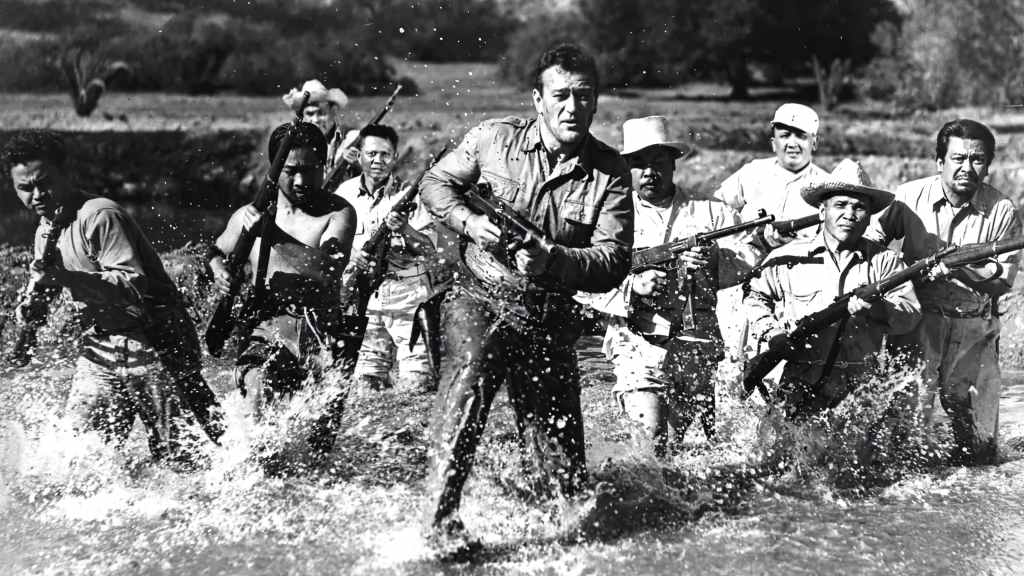
Several weeks after Germany’s surrender, American cinemas were able to capitalize off this massive change in fortune through the release of Edward Dmytryk’s Back to Bataan, a film that chronicles the US’ attempt to liberate the Philippines from Japanese control.

Now, I’ve sampled a decent number of WWII-era propaganda for this blog, including another war film starring John Wayne called Operation Pacific (1951).

While that movie was a lot more easy-going in its tone, Back to Bataan features a much more palpable sense of urgency, probably due to the fact that it was shot and released while the Philippines campaign was still underway.  

In fact, Dmytryk’s film could be seen as a form of cinematic retribution on behalf of the US military, who had been handed a monumental defeat when Japan successfully invaded and conquered the Philippine islands several years earlier.

Even though the war would eventually come to an end in summer of 1945, Back to Bataan was probably viewed as a way to keep American morale high in the interim, with a fictionalized recount of the hardship US soldiers and local resistance fighters endured to take back the commonwealth territory.

Admittedly, this “ripped-from-the-headlines” kind of story doesn’t hold nearly the same weight as it did 78 years ago, especially with world-shaking conflicts in Europe and the Middle East holding everyone’s attention in the final months of 2023.

So while Back to Bataan is pretty dated, it at least serves as a time capsule of a lesser known chapter of WWII, with some well-produced action sequences that hammer home the desperation and brutality that characterized the Pacific theatre of that war.

Instead of sailing the high seas like he did in Operation Pacific, John Wayne mostly sticks to dry land this time around as Joseph Madden, an army colonel who is tasked with mobilizing Filipino guerilla fighters to drive Japanese troops out of their homeland.

After making contact with some eager recruits, Madden and his men find themselves in a hopeless situation after US forces are decimated following the Battle of Bataan in early 1942.

Despite being outnumbered and outgunned, this small resistance group is determined to liberate the islands from this invading force, especially with the grandson of Filipino revolutionary Andrés Bonifacio (played by Anthony Quinn) on their side.

Some may bristle at my use of the word “propaganda” to describe Back to Bataan, but I think it’s pretty apt.

Not only does the film begin with a title card thanking the US armed forces for their aid in the production of this film, but it’s followed up by a parade of supposedly real-life American POWs rescued from Japanese prison camps in the Philippines.   

While you could brush this off as just patriotic window dressing, Dmytryk and his screenwriters actively bake these themes and images into key points of the film, usually to its detriment.

For example, the film opens with a puzzling flash forward, where US Army Rangers raid a Japanese prisoner camp near Cabanatuan City in 1945.

This scene is only included because the real-life Raid at Cabanatuan (also known as “The Great Raid”) took place in January of that year and the filmmakers wanted to include it even if they couldn’t organically work it into their story that’s set three years earlier.

By introducing the movie with such a momentous military victory, Dmytryk and his team immediately deflate the ongoing tension in favour presenting the audience with a comforting narrative right off the bat.

American movie-goers are presented with further nationalistic navel gazing once the actual plot gets underway.

This includes a moment when some Filipino school children take turns listing all the great things the US has done during its occupation of their country (like importing soda pop, baseball, and Hollywood movies).

The school’s principal then adds his two cents by proclaiming that America taught the Filipino people that “men are free or they are nothing,” underplaying the fact that the US took control of these islands through shedding lots of blood in the Philippine–American War (1899-1902).

However, the principal’s martyr status is solidified once he is executed by the Japanese several minutes later, firmly establishing the Americans as the benevolent colonizers in this scenario.  

Revisionist history aside, the scenes are pretty blunt and heavy-handed in their presentation, focusing on political talking points rather than the humanity of the people caught up in this conflict.

Thankfully, all this patriotic cheerleading is largely balanced out by the filmmakers’ sound technical expertise, particularly when it comes time to blow shit up.    

Rather than pushing the complicated action off screen, or hiding it behind convenient edits, Dmytryk’s team relies on long takes that keep a lot of the explosions in-camera.

Special credit should be also given to the stunt team on this project, who were willing to stand uncomfortably close to these pyrotechnics to create a tangible sense of danger.

This praise must be extended to Wayne himself, who noticeably performed a lot of his own stunts for this project, including a scene where he was tied to a leather harness to simulate being blown away by a mortar shell.

For the time, Back to Bataan also features some particularly grizzly kills that highlight the nasty jungle fighting that the Pacific front of WWII was known for.

Midway through the film a Filipino resistance fighter takes out a Japanese soldier with a throwing knife and the director is not shy about showing the bloody blade visibly sticking out of both sides of the sentry’s neck.

And despite not being shot in the Philippines, for obvious reasons, the filmmakers do a decent job of replicating the look and feel of a south-pacific battlefield with some interior sets and scenic exterior locations in southern California.

I understand that this visceral action aesthetic is meant to reinforce the movie’s propagandistic aims, but the caveman part of my brain can’t help but admire the high level of craftsmanship on display.

And while Wayne puts in the kind of stilted, stoic performance you would expect from this kind of film, the rest of the cast is filled out by some decent supporting performances that give the dry military proceedings some life.

Outside of veteran character actors like Beulah Bondi and Paul Fix, Anthony Quinn puts in some good work as the film’s co-lead, whose Aragorn-like reluctance to accept his destiny as a leader injects the story with some much-needed humanity.

Still, your enjoyment of this project is entirely dependent on whether or not you can disassociate it from the politics of the time.

While the US’ entry into WWII was undoubtedly a just course of action, some of the government’s domestic policies during this period were decidedly not, like the internment of Japanese citizens from 1942 to 1946.

Despite not being explicitly stated in the film itself, I can’t shake the feeling that movies like Back to Bataan were made to reassure American audiences that their xenophobic paranoia towards certain groups is justified during wartime.

But with all those caveats out of the way, I still think Dmytryk and his team put together a slickly produced piece of entertainment that works as an action movie and an interesting window into the past.

And if you’re still concerned about the film’s propagandistic aims, just know that the negative impact of one war movie from 1945 pales in comparison to all the social media misinformation currently being spread about conflicts in Israel and Ukraine.

That may seem like cold comfort, but in today’s incendiary political landscape old movies like Back to Bataan seem quaint and harmless by comparison.

That’s not a ringing endorsement, by any stretch, but these days I’ll take some dumb escapism where I can find it.

Verdict:

6/10

Corner store companion:

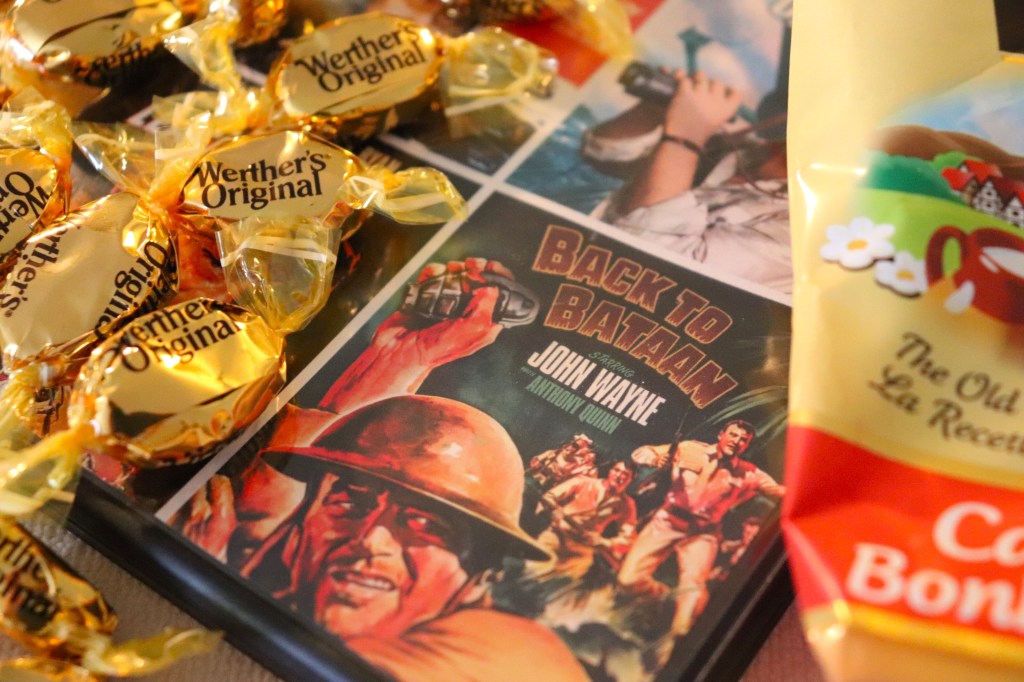
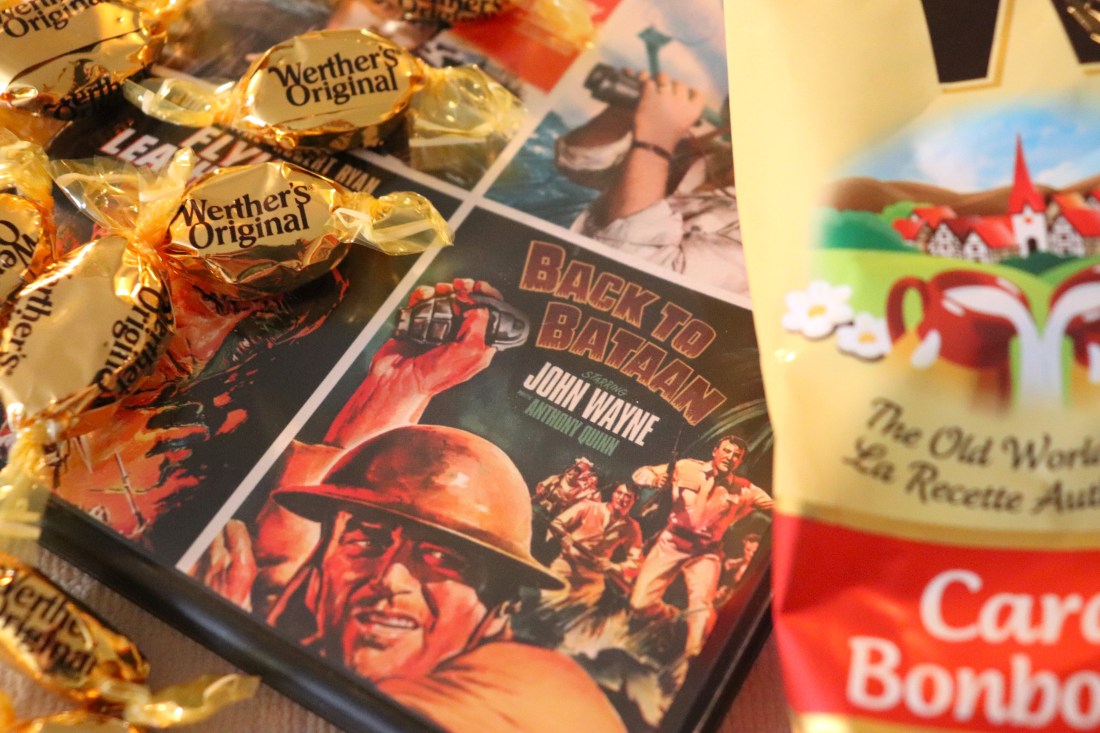
Werther’s Original Caramel Hard Candies (because it’s something your grandpa would enjoy)

Fun facts:

-Release date: May 31, 1945

-Box office: $2,490,000

-Despite the strong nationalistic themes present in Back to Bataan, director Edward Dmytryk was actually a member of the Communist Party in 1945 and was later called to testify before the House Committee on Un-American Activities. Alongside nine other directors, screenwriters, and producers —collectively known as the “Hollywood 10” — Dmytryk refused to testify before the committee and was blacklisted from the American film business as a result. However, Dmytryk managed to worm his way back into Hollywood after telling the committee about his former communist associations in 1951. He would go on to work steadily throughout the next three decades, including high-profile gigs like The Caine Mutiny in 1954 (which earned him seven Oscar nominations including Best Picture).

-The Axis occupation of the Philippines officially ended on Aug. 15, 1945 following the atomic bombing of Hiroshima and Nagasaki earlier that month. Japanese forces in the Philippines were ordered to surrender by the mainland government, who officially capitulated on Sept. 2 aboard the USS Missouri in Tokyo Bay.

-The Philippines finally received its independence on July 4, 1946 through the Treaty of Manila, which relinquished US sovereignty over the land.

Operation Pacific (1951) review-America takes a victory lap

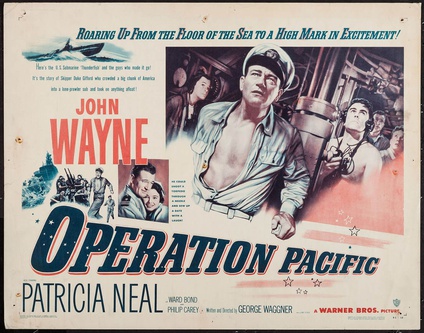
While most classic Hollywood war films have a pretty clear set of objectives (selling bonds, driving up recruitment numbers, etc.), George Waggner’s Operation Pacific (1951) is an entirely different animal.

This John Wayne-led naval adventure is much more celebratory and easy-going in tone, clearly riding off the protracted high that many Americans were still feeling since World War II ended six years earlier.

As a result, the film is a lot more interested in exploring what a soldier’s life might be like after “the fight” comes to an end, rather than providing some insight into what this specific conflict looked like in a larger context.

Even though this tone might upset some military diehards, Operation Pacific actually benefits from the gift of hindsight, since it doesn’t get completely bogged down in the cynical saber rattling that kneecaps so many other war films of that era.

The plot of Operation Pacific revolves around Duke Gifford (Wayne), who serves as an executive officer aboard a submarine called the USS Thunderfish during World War II.

After returning from a dangerous mission in the Philippines, Duke runs into his ex-wife Mary Stuart (Patricia Neal) while on leave at Pearl Harbor.

Even though the two still have feelings for each other, Duke’s responsibilities as a naval officer keep getting in the way of his romantic advances toward Mary, especially as his patrols in enemy waters get increasingly treacherous.

Now, some of you might be scratching your heads after reading this plot synopsis, since this sounds more like a Nicholas Sparks novel rather than a gritty war epic starring John Wayne.

This element caught me by surprise as well, since lengthy sections of the film are dedicated to Wayne and Neal making doe eyes at each other, while a lot of the naval combat scenes are pushed to the sidelines.

Operating Pacific also goes out of its way to depict the more blasé and uneventful aspects of military life that border on the comical, some of which wouldn’t be out of place in an Abbott and Costello movie.

In one scene, while on shore leave, Wayne is tasked with bailing his men out of a Honolulu jail after they get into a drunken brawl with some local police officers.

When the crew is at sea, they use some of their down time to screen a movie in the submarine’s mess hall.

And after rescuing an infant from enemy territory, the men of the USS Thunderfish figure out how to feed the child using a rubber glove.

While these moments do tonally clash with the naval combat scenes—which are awash with gunfire, explosions and technical mumbo jumbo — they do add some much-needed variety to what would otherwise be a pretty by-the-numbers war movie.

And by shifting the film’s focus away from the “battlefield,” Waggner (who also wrote the screenplay) is very clearly trying to appease a post-World War II audience, whose appetite for outright bloodshed had definitely cooled after six years of peacetime. *

Plus, by 1951 the US Baby Boom was noticeably underway, with the romance between Wayne and Neal in this film serving as an obvious nod to the kind of cathartic, romantic energy embodied in classic wartime imagery like Alfred Eisenstaedt’s “V-J Day in Times Square” photograph.

In fact, this film is so uninterested with broader conflict itself that there’s not really any main antagonist to speak of.

Sure, Wayne has to butt heads with a fellow soldier who is also after his ex-wife’s affections, but their relationship is always very cordial and never escalates beyond a harsh word.

Because of this, most of the film’s charm comes from its quieter moments, where the main characters hang out and discuss what life is like back on dry land.

That being said, Operation Pacific does slightly buckle under some clichés that one would expect from a Hollywood war epic from that era.

For one thing, a lot of the film’s action sequences rely way too heavily on stock imagery, which isn’t spliced into the director’s original footage in an organic fashion.

Additionally, Waggner is pretty upfront about presenting this story as a piece of military propaganda, opening up the movie with a Star Wars-style crawl that pays tribute to those who lost their lives in the line of duty.

While there’s nothing wrong with this kind of cinematic remembrance, it does set the tone for a movie that casts World War II in an overly simplistic light, where all American soldiers are depicted as being absolute paragons of virtue.

This approach to characterization turns into a problem whenever the movie veers off into a territory that isn’t morally black and white, like the aforementioned moment where Wayne has to bail his men out of jail.

Even though these characters assaulted several police officers under the influence of alcohol, this scene is largely played for laughs, where the crew is ultimately left off the hook for committing such a serious crime.

This uncritical eye is prevalent throughout the rest of the movie as well, since the filmmakers don’t provide any insight into the Imperial Japanese Navy, outside of the fact that they are a mostly faceless enemy who must be defeated.

Thankfully, this outdated propaganda isn’t so heavy handed that it ruins the movie, although everyone’s mileage may vary (especially if you don’t care for the term “Japs” being thrown around in casual conversation).

And even if you’re not a big fan of romance being mixed in with your violent war movie, at least take comfort in the fact that Waggner does a pretty decent job of balancing those two elements throughout the film’s 111-minute runtime.

For what it’s worth, I’ve seen this kind of genre bending done way worse, with Paul Gross’ crushingly melodramatic Passchendaele (2008) immediately coming to mind.

Plus, in this case, the relationship between Wayne and Neal actually saves Operation Pacific from being completely irrelevant to a 2021 audience.

After all, [SPOILERS] their successful reconcilement at the end of the movie is obviously meant to tap into America’s desire to return to some state of normalcy after a long period of societal upheaval.

And in that respect, Operation Pacific has become way more relatable than ever in the seven decades since its original release now that the country (and North America more broadly) is turning the tide in the fight against COVID-19. **

Verdict:

6/10

Corner store companion:

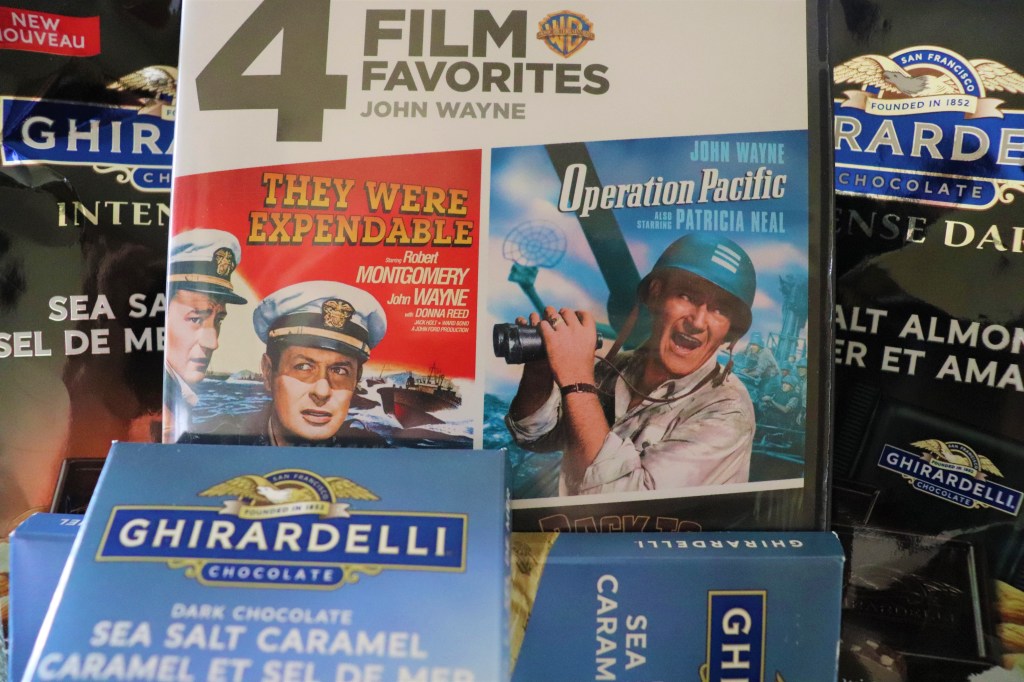
Ghirardelli sea salt chocolate (because it’s the only nautical-themed snack food that I could find)

Fun facts:

-Release date: Jan. 27, 1951

-Budget: $1.46 million (estimated)

-Box office: $2.56 million (US), $1.3 million (worldwide)

-Retired US navy admiral Charles A. Lockwood served as a technical advisor on Operation Pacific to ensure its accuracy when depicting submarine warfare. According to Wikipedia, Hollywood producers sought out Lockwood a couple more times to advise them on a variety of other film projects, including Hellcats of the Navy (1957), On the Beach (1959), and Up Periscope (1959).  

-Near the finale of Operation Pacific, the men of the USS Thunderfish can be seen exchanging film canisters with a friendly American sub so that both crews can enjoy a movie night. These films, Destination Tokyo (1943) and George Washington Slept Here (1942), were both produced by Warner Bros. Pictures in real life.

-Following the release of Operation Pacific, George Waggner mostly directed television for the remainder of his career, including episodes of The Green Hornet, Maverick, The Man from U.N.C.L.E. and Batman.

* I realize that the US was involved in the Korean War by 1951, but that conflict wasn’t nearly as pervasive in American society as World War II was, so I think my original point stands.

** I sincerely hope this statement doesn’t become extremely dated in the coming weeks and months.