Perfect Stranger (2007) review-Hitchcock for wine moms

The jury’s still out on whether or not Halle Berry is a recipient of the Oscar curse.

Even though she’s remained a household name to this day, Berry never really lived up to her potential after winning the Academy Award for Best Actress for Monster’s Ball (2001).

Rather than using that momentum to further her career as a critical darling, Berry starred in a series of bonafide clunkers instead, including Die Another Day (2002), Gothika (2003), and Catwoman (2004).

That last film even netted Berry a Razzie for Worst Actress, which she famously accepted in person with her Oscar in tow.

While Perfect Stranger (2007) is a few years removed from this famous losing streak it carries that same stench of failure, boasting piss poor box office returns and an even more dismal critical reception (10% on Rotten Tomatoes).

And while I don’t think this psychological thriller is that bad, it’s still crushingly stupid and something that definitely won’t be brought up in any of Berry’s future sit-down interviews with Oprah.

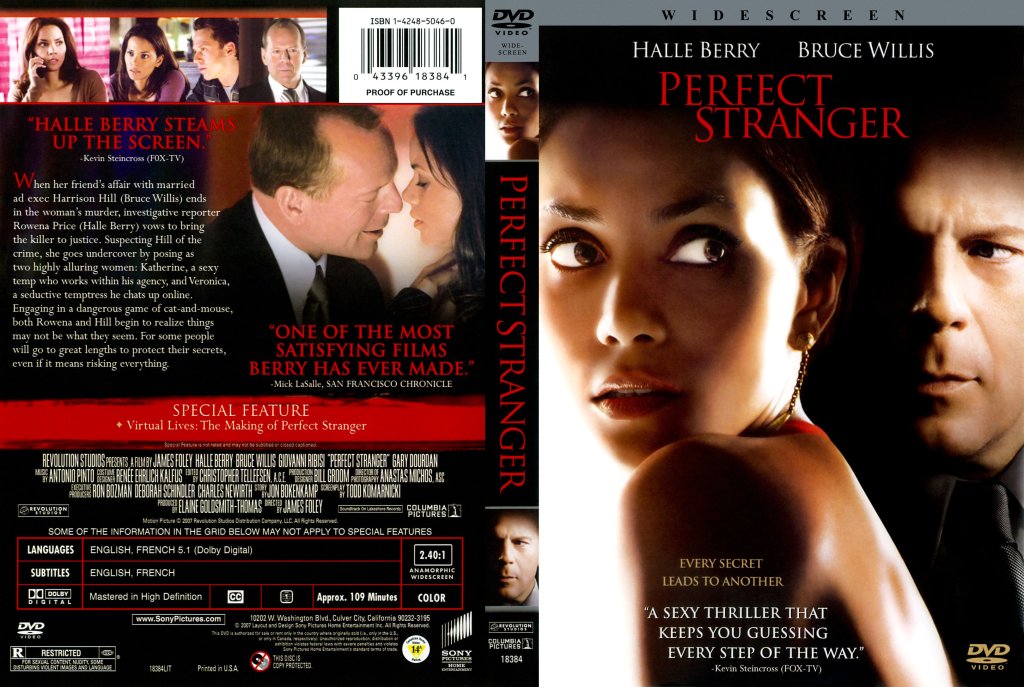
In terms of plot, Berry stars as crusading journalist Rowena Price who decides to investigate wealthy businessman Harrison Hill (Bruce Willis) after her childhood friend (who was having an affair with Hill) turns up dead.

To find the real killer, Rowena goes undercover at Hill’s ad agency and even adopts an online persona to try and seduce him on two fronts.

https://www.youtube.com/watch?v=nXHxd3wDzL4

It’s hard to talk about Perfect Stranger without veering off into the realm of spoilers, since the film’s biggest weakness is it over reliance a ludicrous plot twist that’s meant to prop up the entirety of the story.

Sticking to just the acting for just a minute, Berry’s performance as the movie’s lead is very hit and miss. She’s perfectly serviceable in scenes involving tense intrigue or flirty conversations over drinks. But whenever she’s called upon to deliver a line that’s above a dull roar, Berry can’t help but go over the top and chew up the scenery like she’s headlining a Lifetime Movie.

Thankfully, Giovanni Ribisi picks up the slack in the acting department, since he does a much better job of finding a happy medium between those two conflict tones in a supporting role as Rowena’s closest confidant and secret stalker.

Willis is also surprisingly decent at playing the sinister ad executive, although that’s probably because his dialogue is kept to a minimum.

PerfectStranger(2)

On the directing side, James Foley does a good job of emphasizing the lurid subject matter, making sure to crowd the screen with bold colours in every scene involving explicit sex and violence.

And screenwriters Jon Bokenkamp and Todd Komarnicki should be given some credit for trying to tell a story about losing one’s identity in the digital age way before the explosion of social media.

But that’s about as far as I’ll go to praise the writing, since the film’s plot is one long Shaggy Dog story.

While each individual story development isn’t too outlandish, for this kind of trashy thriller anyway, it’s all built on a foundation of sand.

Without going into specific details, the revelation of the killer’s identity and their overarching motivation comes completely out of nowhere and resembles something the producers put together at the last minute to artificially throw savvy moviegoers off the scent.

In fact, according to IMDB, the filmmakers shot three different endings for this movie, each with a different character as the killer, which means the revelation was designed to be a gimmick rather than an organic conclusion.

Unlike a good movie twist, there’s no breadcrumb trail to follow up on after the fact that puts everything in the proper context. Instead, all the audience is left with is a wet fart of a climax that’s meant to shock but not make any sense.

It’s the kind of bad ending that taints the rest of the film, even the parts that are relatively enjoyable.

Suffice it to say, Perfect Stranger is not a modern answer to the films of Alfred Hitchcock. Hell, it’s not even on the same level as 2000s M. Night Shyamalan.

It’s basically Hitchcock for wine-moms, where well-crafted suspense and intrigue is replaced by hammy acting, cheap titillation, and soap opera style plot progression.

On that level, this thriller is worth watching just for the fun of picking apart its non-sensical plots threads.

Halle Berry completionists also might want to give this film a look, although their time is probably better spent watching B*A*P*S for the 20th time.

Verdict:

5/10

Corner store companion:

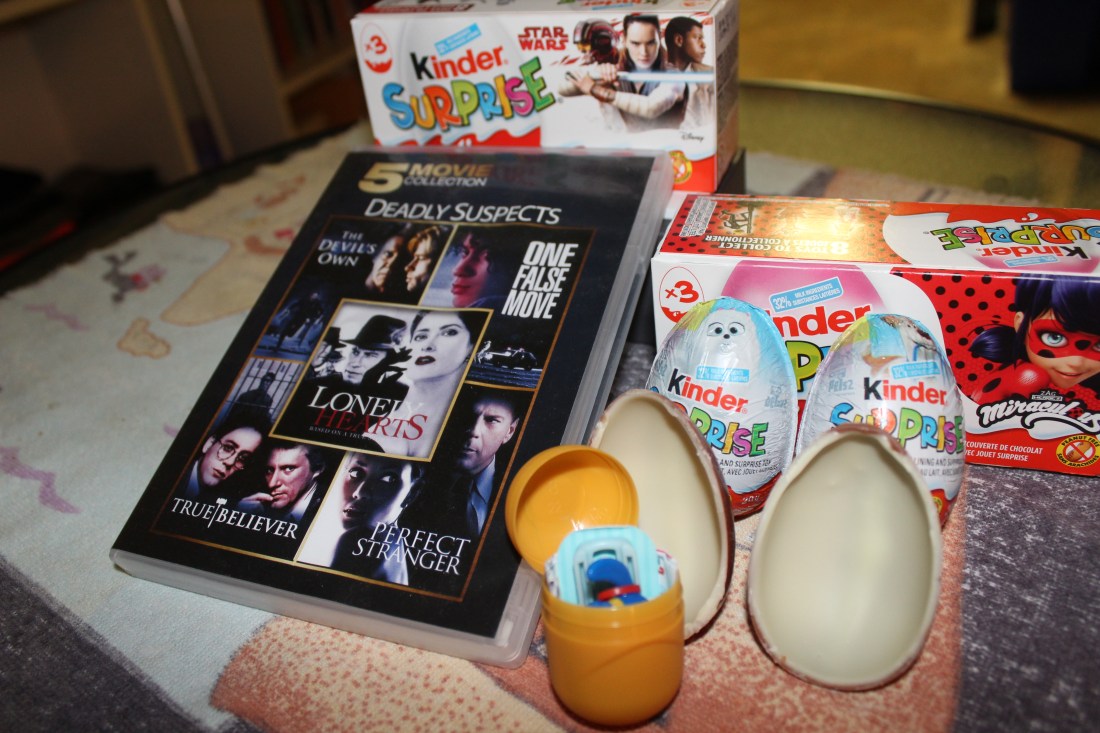
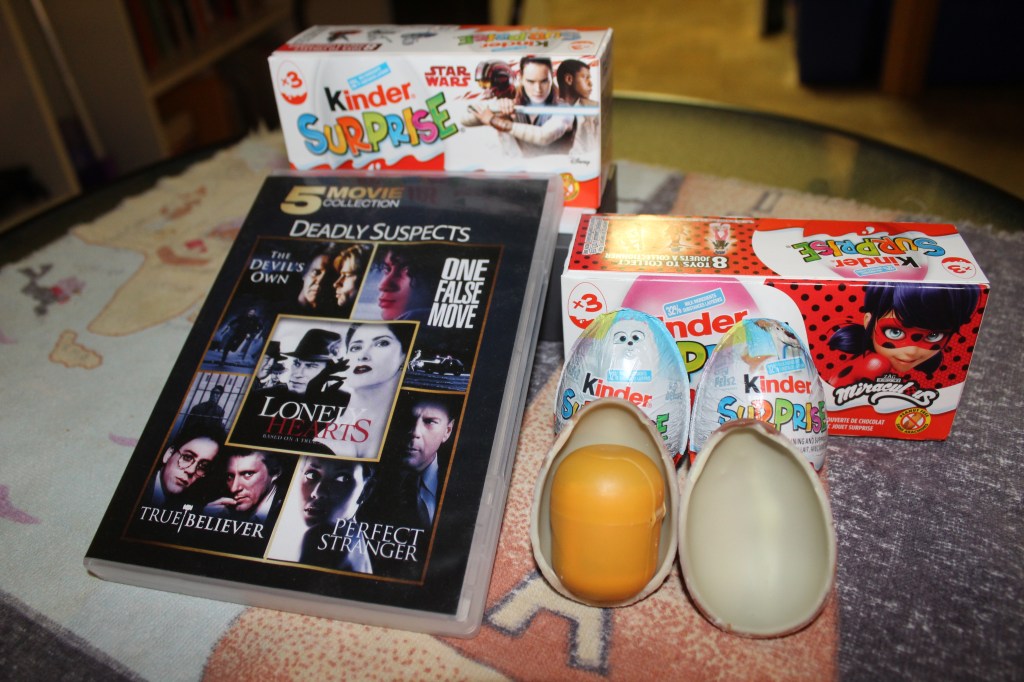
Kinder Surprise (because it’s an appealing shell containing a crappy surprise)

IMG_9002

Fun facts:

-Release date: April 13, 2007

-Budget: $60,795,000

-Box office gross: $23,984,949 (US), $73, 090, 611 (worldwide)

-Film critic Richard Roper ranked Perfect Stranger as his 10th worst film of 2007, right behind Rush Hour 3 and I Now Pronounce You Chuck and Larry.

-This movie was originally supposed to be set in New Orleans, but the script was re-written to take place in New York City after Hurricane Katrina hit during pre-production.

-Unexpected cameo: model Heidi Klum pops up briefly during a Victoria’s Secret party that is being thrown by Willis’ fictional ad agency.

-After helming Perfect Stranger, James Foley would go on to direct TV for the next decade, including episodes of Hannibal, Billions and House of Cards. He returned to the world of feature films with a vengeance in 2017-18 by directing the second and third entry in the cinematic Fifty Shades of Grey trilogy (Fifty Shades Darker and Fifty Shades Freed).

The Satanic Rites of Dracula (1973) review-Christopher Lee deserved a better send-off as the Count

Besides Bela Lugosi, Christopher Lee is probably the most prolific actor to ever don Count Dracula’s cape on the silver screen.

This is no easy feat, since the Prince of Darkness has been portrayed in over 200 films by some of the industry’s most respected thespians, like Gary Oldman, Klaus Kinski, and Frank Langella.

But from 1958 to 1973, Hammer Studios turned Lee into a horror icon by casting him as the main antagonist in their revival Dracula series that took the character into new and interesting directions.

This is definitely true for The Satanic Rites of Dracula, the last film in the series to feature Lee, since the story revolves around a morbid cult helping the Count carry out his evil deeds in 1970s London.

Luckily, the descendent of Dracula’s old foe Van Helsing (played by Peter Cushing for the fourth time) catches wind of these malicious machinations and teams up with a group of government agents to stop this undead fiend once and for all.

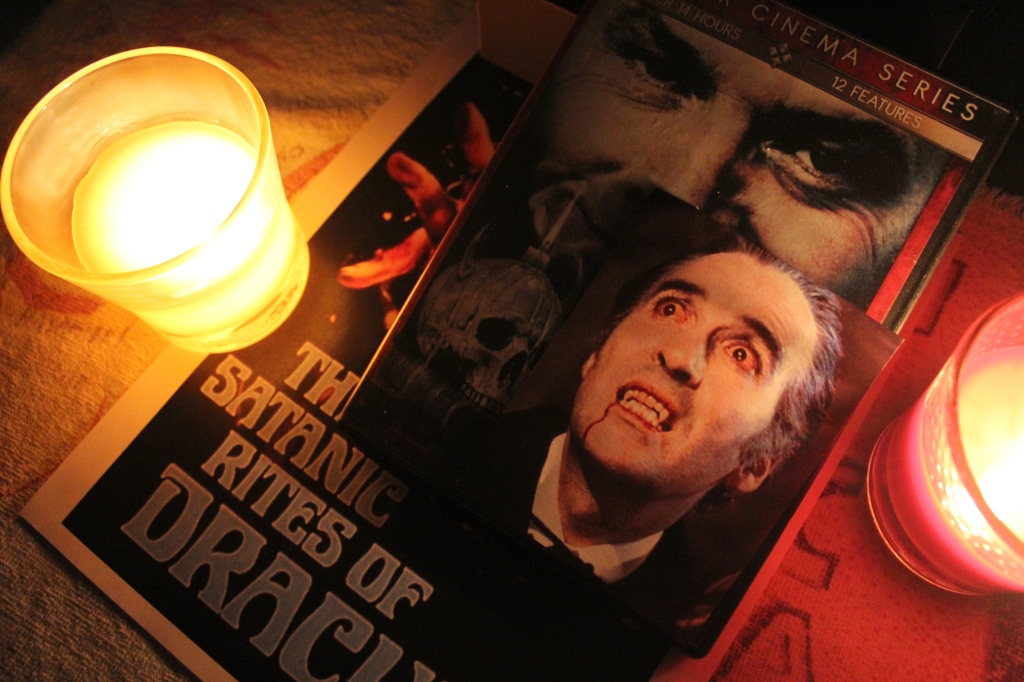
Full disclosure, I haven’t watched any of the other Hammer Dracula films starring Lee, since my horror DVD 12-pack only came bundled with this single entry.

But based on what I’ve been able to glean from online critics like James Rolfe, the series’ continuity is all over the place and doesn’t really make sense anyway.

All you need to know is that Dracula is skulking around modern day London and most of the older films’ gothic sets and atmosphere have been replaced with cheap on-location shooting.

For some reason, the filmmakers also decided to try and modernize this story by imbuing it with period appropriate funk music, which makes it sound like Shaft is going to jump out of the shadows at any moment and kick vampire ass.

The movie’s tone in general is all over the place, switching from scenes involving satanic cults and human sacrifice to dry exchanges between government agents that resemble a John le Carré spy novel.

Based on this description, you might be fooled into thinking that The Satanic Rites of Dracula is a fascinating mess of a film that keeps you hooked based on how off-the-wall some of its ideas and concepts are.

While this does happen occasionally, the movie is mostly a giant bore that barely features Lee in any meaningful way.

Dracula himself doesn’t show up until half-an-hour into the film and takes up less than 20 minutes of total screen time.

While this is apparently par for the course when it comes this series, critics like Rolfe said that previous entries at least made up for the lack of Dracula by providing some interesting performances, eerie atmosphere, and impressive gore effects.

Satanic Rites really doesn’t bring any of that to the table with its bland main characters, goofy score, and tepid use of bloodshed.

The most compelling thing about the film is Peter Cushing as Van Helsing, since he at least tries to take this bonkers material serious. Sadly, he isn’t given that much to do, since 90% of his dialogue consists of dolling out exposition.

The movie’s plot also really starts to go off the rails in its second half when Van Helsing discovers that [SPOILERS] Dracula is planning to wipe out humanity by developing a new strain of the bubonic plague. How he would be able survive in a world without human blood to feast on I have no idea.

The writers try to salvage this idiotic turn by suggesting that Dracula wants to die himself and take the world down with him. However, that doesn’t explain why he spends so much of film’s running time turning pretty English girls into his vampire brides instead of focusing on his plan to commit mass genocide.

https://www.youtube.com/watch?v=zTSsydfLalI

The last nail in this film’s coffin is its insulting finale, where [SPOILERS] Dracula meets his end by walking into a hawthorn bush.

NakedGunHeadSlap

Obviously, the people over at Hammer were running out of ways to kill Lee at the end of every movie, so I guess they came up with some bullshit about how vampires are vulnerable to the crown of thorns that Jesus wore on the cross.

So yeah, not a great way for Lee to cap off his iconic run as Dracula.

Even though the actor revealed in later interviews that he grew less and less fond of playing the character as time went on, there’s no denying that he injected some new blood into Bram Stoker’s original creation.

Not only was Lee one of the first actors to portray the Count in vivid Technicolor, but horror movie fans also got to see this classic character inflict new levels of gratuitous violence on his victims thanks to Hammer’s famously schlock-heavy approach to filmmaking.

Sadly, that initial spark of creativity is completing lacking in Satanic Rites, which ends this franchise with a dull whimper rather than a deafening bang.

But luckily, I don’t think this film hurt Lee’s legacy in the long run, since he would go on to portray a litany of other iconic movie villains until his death in June 2015 at the age of 93. And that’s on top of his decorated military service and amazing run as a heavy metal recording artist.

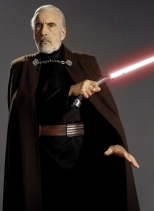
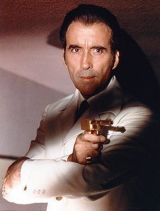
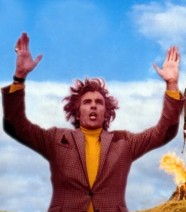
Count-dookuFrancisco_ScaramangaSarumanpm_338485

So yeah, I don’t think he gave this movie a second thought after he collected his paycheck … and that’s about all it deserves.

Verdict:

3/10

Corner store companion:

Glade scented candles (because they provide better gothic atmosphere than the movie itself)

IMG_0067

Fun facts:

-Release date: November 3, 1973 (West Germany), January 13, 1974 (UK), October 1978 (US)

-Box office gross: ₤223,450

-Alternative title: Dracula Is Alive and Well and Living in London

-While Hammer produced nine films in their revival Dracula series, Christopher Lee only appeared in seven of them. However, the second and ninth films in the franchise, The Brides of Dracula (1960) and The Legend of the 7 Golden Vampires (1974), still feature Peter Cushing as Van Helsing.

Satanic Rites wasn’t the last time Lee would be cast as Dracula, since he donned the cape one last time in the 1976 French comedy Dracula and Son.

-Before he played Dracula for the first time in 1958, Lee also got the opportunity to portray Frankenstein’s monster in Hammer’s The Curse of Frankenstein from 1957. Lee’s run as the creature only lasted one movie, since the remaining six films in the franchise focused on the adventures of Baron Victor Frankenstein, played by Cushing.

-Musical highlight: “Massacre of the Saxons” by Christopher Lee (this song has nothing to do with the movie, I just wanted to remind everyone that Lee recorded a series of heavy metal albums when he was in his late-80s and early-90s).

You Light Up My Life (1977) review- Why you should give this film (and the song) a second chance

Movies don’t always stick into the popular consciousness the way their directors would like them to. Some films, for example, are only remembered for one particular thing, whether it’s a standout scene or a single iconic performance.

You Light Up My Life is an obvious victim of this phenomenon, since many people forget that it was even a movie in the first place.

Instead, most people associate this film with its title track, which was one of the biggest hit songs of 1977, staying at the #1 position in the Billboard charts for an unprecedented, at the time, 10 consecutive weeks.

Not only did this single’s popularity make Debby Boone a star, but the following year it also netted director/composer Joseph Brooks an Oscar for Best Original Song, giving him a lot of credibility in the eyes of Hollywood elites (albeit temporarily).

Meanwhile, the original 1977 film that spawned this track is definitely not remembered as a classic, judging by its low rating on sites like Rotten Tomatoes (20%) and IMDB (4.6).

And even though the song initially fared well in the eyes of the public, its stock has severely diminished with time. In fact, if you Google “You Light Up My Life” right now you’ll find a bunch of modern culture critics writing about how it is one of the worst songs of the 1970s.

This overwhelmingly negative critical consensus on both fronts definitely came as a big surprise to me, since I found this film to be a charming romantic drama and the song to be an absolute show stealer.

MPW-39057

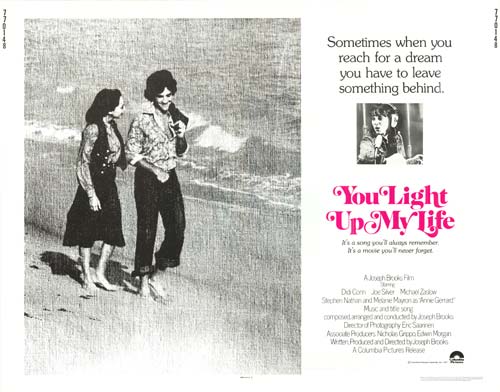
The story proper follows Laurie Robinson (Didi Conn), a working artist in Los Angeles who bounces around different commercial auditions and comedy acting gigs at the behest of her overbearing showbiz father (Joe Silver). However, her true passion lies with composing music and she even gets the opportunity to showcase this talent when she meets an established director (Michael Zaslow) by chance.

Laurie’s personal life is also put in jeopardy when she starts to develop feelings for this director, which complicates her impending marriage to another man.

Now, I’ll admit, there’s a lot of melodrama packed into this movie, especially when the run time is a slim 90 minutes. But Conn’s lead performance as Laurie really holds everything together, since she carries this entire movie on her back almost single-handedly.

It’s hard to put into words how endearing and likable she is on screen, as her character goes from audition to audition, facing rejection and failure at almost every turn. Conn’s optimistic personality and lack of cynicism really makes her a captivating underdog to watch, someone who also isn’t afraid to show cracks in that sunny demeanor when things get really rough.

Her relationship with Joe Silver is also a pivotal part of the movie’s appeal.

While Silver’s showbiz dad is totally ignorant of his daughter’s real interests, he isn’t trying to be malicious or exploit his only child for financial gain. Instead, he pushes her in a certain direction out of a genuine belief that stand-up comedy is her real passion, even though that’s mostly projection on his part.

The warm back-and-forth between Conn and Silver comes across as being very authentic and makes you believe that the actors would carry out these same conversations once the cameras stopped rolling.

In fact, most of the characters and dialogue in the movie comes across as very naturalistic, to the point where I almost thought I was watching a slice-of-life drama in the same vein as a Richard Linklater or Cameron Crowe film.

But I know what you’re asking: “What about the title song? Isn’t it awful and derail the entire movie?”

Actually, no. I would actually argue that the title track works on many levels and is one of the film’s biggest highlights.


https://www.youtube.com/watch?v=NZP9iCfkSAE

From a filmmaking point of view, this uplifting number comes in at just the right point in the story, when Laurie desperately needs a win and finally gets the chance to showcase her singing and song writing ability in front of some Hollywood big wigs.

This exulted feeling is hammered home by the way the scene is shot, since it is all presented to the audience in a single take with fluid, sweeping camera movements.

And even though Conn obvious isn’t providing her own singing voice, she still acts the hell out of this moment, since her body language and facial expressions perfectly match the pipped in vocals.

(Plus, if Rami Malek can win an Oscar for lip syncing, why should I hold back praise for another quality pantomime performance?)

On a musical level, it’s important to point out that the movie version of “You Light Up My Life” is different than the Debby Boone rendition most people are familiar with.

The track was originally performed by classically trained opera singer Kasey Cisyk, whose powerful, uplifting voice effortlessly elevates the admittedly simple lyrics and makes them sound profound.

Boone’s performance is pretty bland and lifeless by comparison, which is part of the reason why, I imagine, this song has garnered such a bad reputation in the intervening 40 years.

I also feel like the instrumental accompaniment in the movie version of the song is alot stronger, especially the string section, but that could just be my imagination.

And even if you don’t like Cisyk’s version of the “You Light Up My Life,” the film is sprinkled with a handful of other catchy numbers, with “Do You Have a Piano” being another standout.

That’s not to suggest that every song is used appropriately.

The director has a bad habit of artificially squeezing his original music into scenes just to pad out the run time, like whenever Conn has to drive from one location to another.

Plus, not every track is a winner, with the dreary “California Daydreams” coming across as a bad Simon and Garfunkel rip-off.

In terms of filmmaking weaknesses, I would be remiss not to mention that You Light Up My Life occasionally veers off into the realm of a sappy soap opera, with some cheesy lines and plot contrivances that really strain the realm of believability.

But at its core, this movie still has a beating heart and the director is obviously very passionate about showcasing the struggle one must endure to make it in the entertainment industry.

The filmmakers in general do good job of blending the music with the overarching narrative, so movie-goers who have re-watched the recent A Star is Born remake for the 15th time might get a kick out of this story too.

I know that singing You Light Up My Life’s praises won’t win me any critic brownie points, since the movie has fallen into relative obscurity and the song has garnered a pretty unshakable reputation as being seven shades of uncool.

But every now and then I’m in the mood for some romantic fluff, especially if the lead performance is strong and the soundtrack adds an extra layer of intrigue.

For everyone else, just make sure you go in with an open mind and don’t buy into the anti-hype that’s built up around this song (and the movie that bears its name) for the last four decades.

Verdict:

8/10

Corner store companion:

White Wonder Bread (because it’s bland but emotionally satisfying)

IMG_9385

Fun facts:

-If you’re wondering why director Joseph Brooks didn’t use the Kasey Cisyk version of “You Light Up My Life” for radio play it’s because he is a giant piece of shit. According to Cisyk’s second husband Ed Rakowicz, Brooks made improper advances towards the young singer and became angry when she rejected him. The director went on to hire then newcomer Debby Boone to re-record the song and even instructed her to replicate Cisyk’s performance as closely as possible.

-Even though her rendition of “You Light Up My Life” is (arguably) inferior to Cisyk’s version, Boone’s career took off like a rocket after it hit the airwaves. Not only did the single earn her an Oscar and Golden Globe for Best Original Song, but she also won a Grammy for Best New Artist in 1977 and Song of the Year in 1978.

-Brooks’ monstrous behavior with Cisyk was only the tip of the iceberg. In June 2009 he was arrested for raping or sexually assaulting over 10 different women after his assistant lured them to his Manhattan apartment. Brooks committed suicide on May 22, 2011 before he could be tried for 91 counts of rape, sexual abuse, criminal sexual act, assault, and other charges.

Star Trek scholars cite Michael Zaslow, who plays the director Didi Conn falls for, as being the franchise’s first-ever “red shirt” or expendable crew member that perishes during a planetary expedition. During the Original Series’ first official episode titled “The Man Trap,” Zaslow’s character, crewmember Darnell, famously met his end after being seduced and killed by a shape-shifting alien.

-You can watch the entire movie on YouTube for free (with Spanish subtitles) here:

https://www.youtube.com/watch?v=qxjPEwUAN7Y&t=2025s