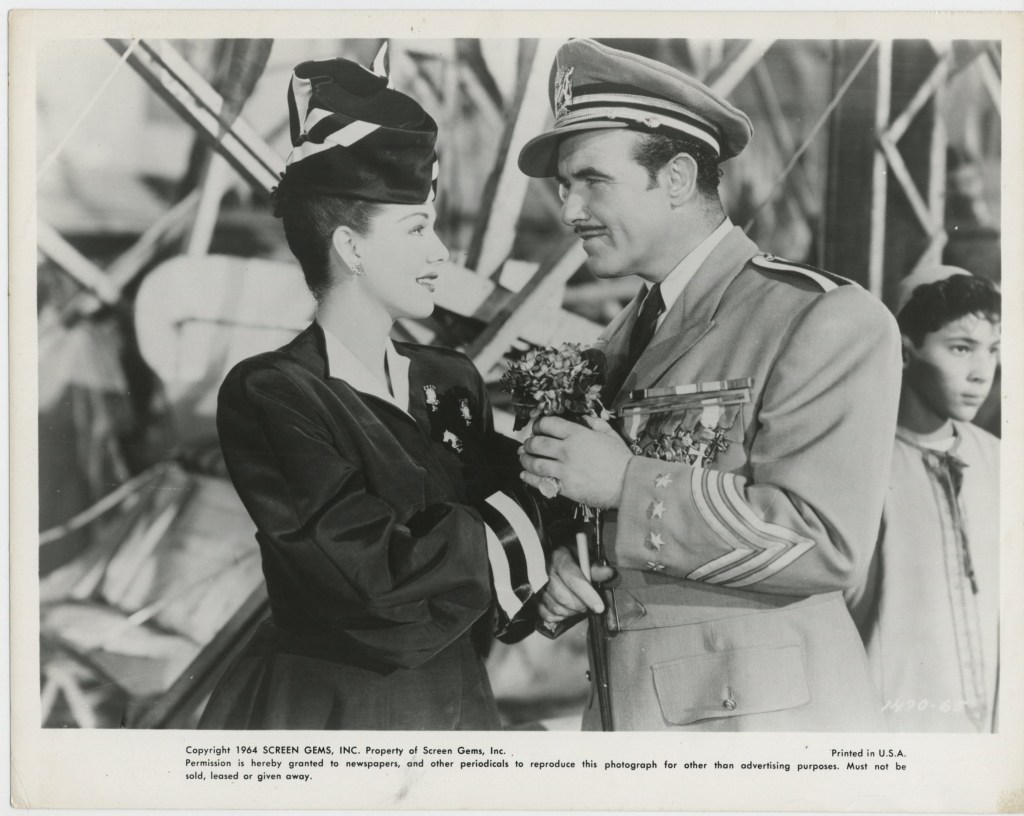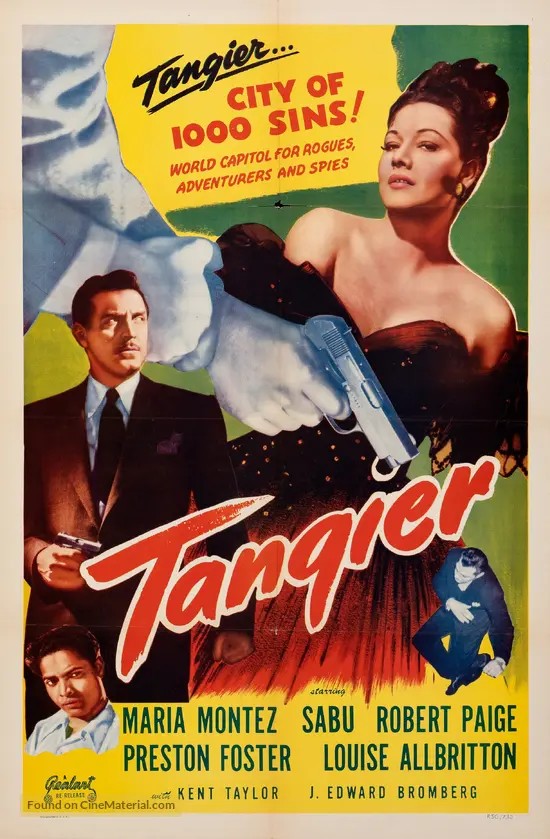
Tangier (1946) review: discount Casablanca

In modern film discourse, it’s pretty easy to call something derivative or a “rip-off.”

After all, we have over 120 years of movie history to pull from, which gives us the breathing room to spot repeated uses of certain plots, settings, and character archetypes over a period of time.  

Movie-goers from the 1940s-50s, meanwhile, weren’t burdened with the same historical hindsight and couldn’t even rely on the internet or home video releases to keep track of every time Hollywood re-used the same picturesque rock formation for a generic western backdrop.

But even with that all in mind, I still think 1946 audiences would have tilted their heads at George Waggner’s Tangier, given how many elements it blatantly lifts from Michael Curtiz’s Casablanca (1942).  

After all, Casablanca was a massive hit that netted Warner Brothers some major Oscar wins (including Best Picture), thereby guaranteeing it a firm place in the American pop culture zeitgeist.

The film’s success also encouraged Warner Brothers to produce several other films made in the same mold, with The Conspirators (1944) and To Have and Have Not (1944) liberally borrowing cast members and plot elements from Casablanca.

So by 1946, US movie fans were quite familiar with film noir set in exotic locales, where glamorous women and hard-nosed men fall in love while bringing down fascist sympathizers.

And Universal Pictures was definitely hoping to cash in on that formula with Tangier, resulting in a product that often looks and feels like Casablanca with the serial number filed off.

Despite being such a blatant knock-off, Tangier manages to retain some charm thanks to its strong cast, sharp dialogue, and moody visuals, which keep the film’s more derivative aspects at bay (for the most part).  

That being said, the parallels between Tangier and Casablanca are nakedly obvious even from a surface reading of the plot.

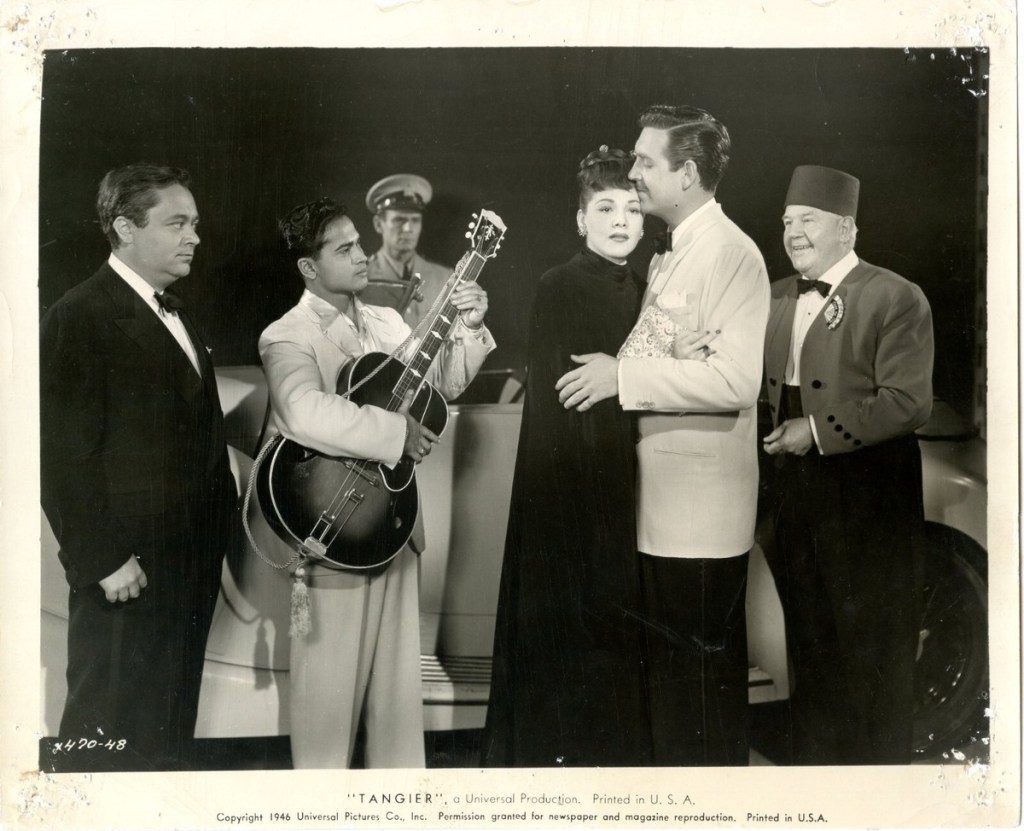
In both films, the setting is a coastal Moroccan city during World War II, with most of the action revolving around a glitzy nightclub that is frequented by all the big movers and shakers in town. The “usual suspects” in Tangier are led by American journalist Paul (Robert Paige), who is on the trail of a Nazi collaborator attempting to buy his freedom using a stolen diamond. Paul’s quest eventually intersects with club dancer Rita (Maria Montez), who is on the trail of the same Nazi collaborator for personal reasons. The two eventually team up to recover the diamond and bring the secret Nazi to justice, all the while making bedroom eyes at each other.

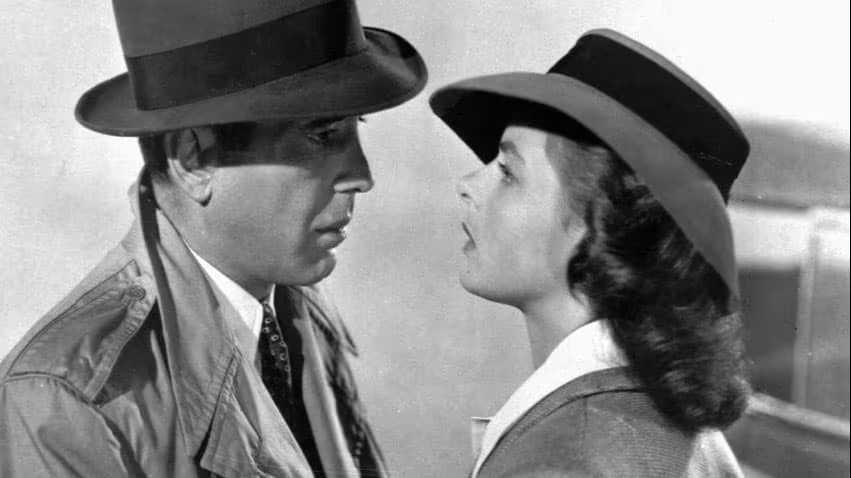
Even someone with a cursory knowledge of Casablanca could pick up on the similarities at play here. Not only is Tangier’s setting and overriding conflict virtually the same, but the romance at the centre of the story occupies the same emotional space that Humphrey Bogart and Ingrid Bergman did in the 1942 film.

In that respect, Tangier definitely pales in comparison, with the romance between Paige and Montez feeling rushed and undercooked. Even if the two have decent chemistry, their relationship develops far too quickly, with the pair agreeing to marry after only knowing each other for a single day.

The filmmakers try to compensate for this weak romance by throwing a four-way love triangle (a love square?) into the mix, but that only serves to complicate what’s already an overstuffed plot.

Luckily, most of the sights and sounds surrounding the central romance are interesting enough to keep the rest of the film on track.

Despite not really working as a couple, Paige and Montez know exactly how to play up the film noir aspect of the story. Paige’s war reporter has a roguish Hemingway flair about him, whereas Montez is totally believable as a femme fatale whose glamour is ultimately a means to end.

The supporting cast is also a rich tapestry of character actors from Hollywood’s Golden Age, who manage to squeeze a lot of life out of what are otherwise stock noir archetypes.

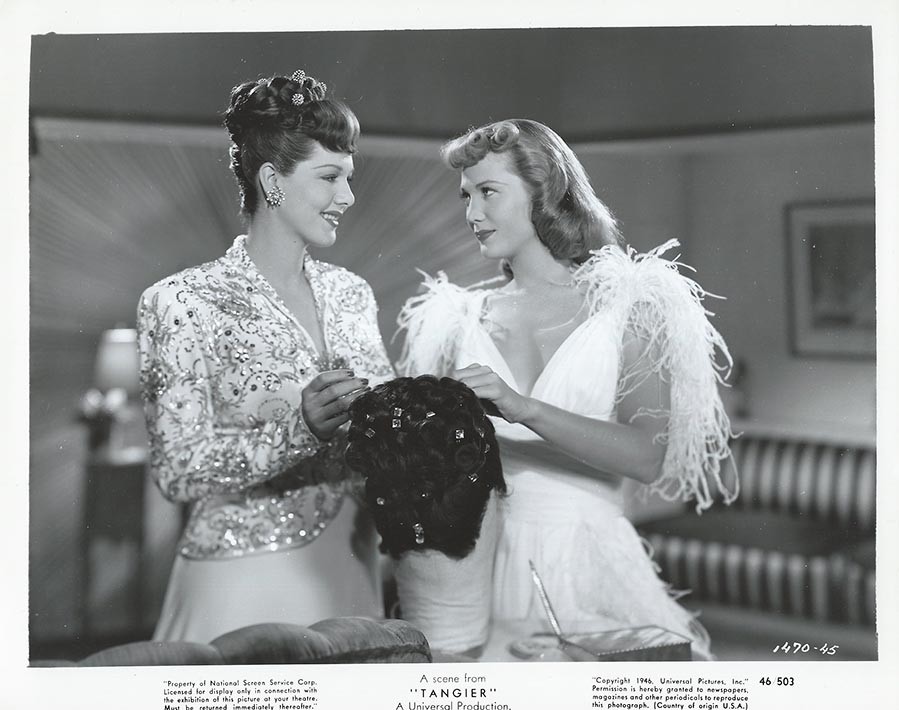
Louise Allbritton shines as a fellow club dancer who is constantly standing in Montez’s shadow, both professionally and romantically. In less talented hands, Allbritton could have come across as whiny or annoying, but she manages to hit all the right notes and make this character a genuinely tragic figure.

Meanwhile, Sabu is playing largely the same role that Dooley Wilson (Sam) occupied in Casablanca, namely the musical sidekick who is a confidant to the main hero. There’s definitely a lot of cultural baggage to unpack with this type of character, but, for what it’s worth, Sabu uses his natural charisma to inject some much-needed levity into the film.

And then there’s Preston Foster as the stuffy military police colonel, who is the main obstacle standing in the heroes’ way. Again, this sounds like a generic villain role on paper, but Foster manages to imbue his character with a kind of gentlemanly poise that makes him at least fun to watch.  

It also doesn’t hurt that the film’s overall production values are quite high, from the sets to the costumes to the classic film noir lighting that scratches a major itch for a certain breed of cinephile.

Like the best examples of the genre, the dramatic lighting filters through blinds, latticework, and prison bars, giving all the action a layer of texture that communicates awe and menace simultaneously.

The snappy dialogue is just the icing on the cake, with the cast effortlessly navigating through a steady stream of quips, comebacks, and double entendres that one would normally associate with an energetic stage play.

Unfortunately, some sound filmmaking around the edges can’t take away from the fact that Tangier doesn’t bring anything new or unique to the table to distinguish itself from other entries in the genre.

The Casablanca parallels really do drag everything down, with the filmmakers behind Tangier even having the gall to end their movie [SPOILERS] with the main characters escaping via an airfield. Where on Earth did they get that idea?

But beyond that, there’s a general sense that the filmmakers are running on autopilot, relying on the talented cast and crew to bail out what’s ultimately an unremarkable script.

Even the casting department didn’t think too deeply about who best to inhabit these characters. This film is inundated with far too many male actors with slicked back hair and pencil-thin mustaches, making it hard to tell who’s who for the first 20 minutes or so.

Still, if you have no knowledge of the films Tangier is cribbing notes from, it’s a fairly entertaining watch. Nothing life-changing of course, but it taps into an appealing vibe and aesthetic that is impossible to deny.

Plus, it’s difficult to be too harsh on a movie that takes inspiration from one of the most influential films of all time. Casablanca left a massive impact on the entertainment industry following its release, so much so that specific clips from that film are still being used as visual shorthand for what classic Hollywood romance is supposed to look like on screen.

So it’s only natural for that influence to worm its way into a bunch of other projects, whether the filmmakers are aware of that or not.  

In the case of Tangier, I’m pretty sure Waggner and his writers knew exactly what they were doing, since there are too many glaring similarities between the two films to ignore.

The end result is like watching a really talented cover band play through all your favourite hits; sure, you appreciate the craft and skill on display, but can’t escape that sinking feeling that a genuine creative spark is missing.

Verdict:

6/10

Corner store companion:

Compliments macaroni and cheese (because it’s a cheap alternative to the real thing, but it still gets the job done)

Fun facts:

Release date: June 6, 1946

-Tangier was one of the last films to be released under the “Universal Pictures” banner before the studio merged with International Pictures and was reorganized as “Universal-International” in July 1946.

-Following the release of Tangier, Maria Montez would only appear in nine other films before suffering a heart attack and drowning in her bathtub on Sept. 7, 1951. She was 39 years old.

-Leading man Robert Paige later became a TV newscaster in the 1960s, reporting out of Los Angeles for ABC News.

-After a multi-decade career in the film business, George Waggner transitioned to working in television in the 1960s, directing episodes of Batman, The Green Hornet, and The Man from U.N.C.L.E.

Shooter (2007) review-just off the mark

Lately, I’ve been getting this sinking feeling that certain genres of film are becoming completely irrelevant to modern audiences. This endangered species list includes any thriller or drama that touches on contemporary U.S. politics, given how chaotic, fractured, and patently absurd the real-life machinations of the current administration are. After all, how can a Hollywood screenwriter compete with the sheer ludicrousness of SignalGate or top the cartoonish villainy exhibited by a shifty interloper like Elon Musk?

In this context, Antoine Fuqua’s Shooter (2007) seems pretty tame by comparison. This is because the film’s U.S. government baddies are at least marginally intelligent and vaguely discreet when it comes to enacting their evil plans, not at all like their modern, real-world counterparts.

But regardless of the differences between Bush and Trump era politics, these conspiracy-themed thrillers can be a lot of fun, as long as they have a decent script, smooth pacing, and some tight direction.

Shooter definitely excels in a few of these areas, providing the perfect kind of disposable action movie fluff to watch on a lazy Sunday afternoon alongside your dad.

Unfortunately, the film is also weighed down by a weak lead performance and far too many genre cliches, making it hard to distinguish from the dozens of other “one man army” stories clogging up your local DVD bargain bin or drugstore book rack.

The eponymous “Shooter” in this film is Mark Wahlberg, who steps into the boots of elite Marine sniper Bob Lee Swagger. Despite being retired from the U.S. military for several years, Swagger is pulled back into service by Colonel Isaac Johnson (Danny Glover), who needs his help to thwart a presidential assassination attempt. However, the job quickly reveals itself to be a set-up, with Swagger being blamed for killing the Archbishop of Ethiopian (who was standing next to the American president during the shooting). Now on the run, Swagger must clear his name and get to the bottom of a vast conspiracy that reaches all the way to the U.S. Senate.

Like I mentioned at the top, the film’s major weak link is Wahlberg, who does very little to elevate this material above your standard action schlock.

Sure, Marky Mark pulls off the right rugged look and is convincing when he’s holding a gun. But there’s very little in his performance that helps engage the audience on an emotional level.

One moment that stuck out to me was when Swagger’s love interest (Kate Mara) tells him that the bad guys killed his dog. Rather than reacting with piercing sadness or explosive anger over the murder of his best friend, Wahlberg responds with mild annoyance, like someone just told him that he needs to replace his Brita filter.

Unfortunately, Wahlberg remains stuck in this subdued acting mode for most of the film’s runtime, offering only brief glimpses beneath his stoic persona.

I’m not suggesting he needed to break down crying every five minutes to be more relatable or whatever, but some psychological insight would have been welcome.

Maybe this could have been accomplished through casting an older actor, someone capable of bringing a genuine world-weary quality to the role.

According to IMDB, men like Clint Eastwood, Tommy Lee Jones, and Harrison Ford were all considered for the part, which sounds like a much better fit for the vibe the movie was trying to convey.

But to be fair to Wahlberg, the film’s script doesn’t do him any favours.

Despite being established as a conspiratorial shut-in (who lives in the mountains and reads the 9/11 Commission Report for fun), Swagger is surprisingly willing to trust this shadowy government figure (Glover) and fall for the most obvious frame up job of all time.

So when he’s betrayed and literally shot in the back, I was left wondering why Swagger didn’t have any contingency plans in place, since being a rigid individualist who doesn’t trust the government is one of his only defining character traits.

Plot nitpicking aside, Shooter at least delivers the goods once Wahlberg goes on the run.

While nothing approaches the tension director Andrew Davis created for The Fugitive (1993), Fuqua and his team make up for that by staging some impressive kinetic action.

This means juicy blood squibs, bright muzzle flashes, and big practical explosions, all tied together with crisp editing that makes the moment-to-moment carnage easy to follow.

The best example of this technical expertise is on display in the third act, when Wahlberg teams up with a sympathetic FBI agent (Michael Peña) to storm a rural compound full of cannon fodder enemies.

This flashy spectacle is also helped by the cast of great character actors assembled to play the bad guys.

Outside of Glover, this rogue’s gallery includes the likes of Ned Beatty as a corrupt U.S. senator and Elias Koteas as a psychopathic henchman on Wahlberg’s trail.

While these three are suitably over-the-top, and serve as the perfect rivals for Wahlberg’s salt-of-the-earth veteran, the movie does at least carve out some depth for Rade Šerbedžija.

The well-known Croatian actor makes the most of his tiny role as a wheelchair-bound sniper who is working under the thumb of Glover’s corrupt army colonel.

Even though most of his lines are relegated to a single exposition dump, Šerbedžija conveys a lot of potent regret and melancholy through his delivery alone, making me wish the movie was about him instead.  

Unfortunately, familiar action movie tropes eventually pile up and dilute whatever unique sense of identity Shooter had going for it.  Some of these trappings I’m willing to forgive, like all the bad guys not being able to hit the broad side of a barn in a firefight. But other cliches are pretty egregious and took me out of the movie. These moments include:

  • Wahlberg’s soldier buddy pulling out a photo of his wife moments before getting ravaged by bullets
  • Mara delicately dressing the wounds of a naked Wahlberg despite barely knowing him
  • One of the bad guys delivering the “we’re not so different, you and I” speech to Wahlberg as he’s being held at gunpoint
  • Wahlberg being way too cool to look back at the explosion he just set off

Many of these moments were old hat in the 1990s, so the fact that they were smuggled into a 2007 film (without anyone in production batting an eye) is very concerning.

And while Shooter is fairly generic overall, I will at least give the filmmakers credit for grounding it in the specific real-world politics of the time.

Instead of taking the coward’s way out and giving the bad guys vague motivations (as to not offend anyone), the screenwriters zero in on U.S. foreign policy being a pervasive antagonistic force.

Not only is the Abu Ghraib torture scandal mentioned by name, but most of the plot revolves around [SPOILERS] the American military covering up an African village massacre to further Big Oil business interests.

After watching my fair share of military propaganda for this blog, it was refreshing to see U.S. imperialism portrayed in a critical light, even if it is packaged in a movie where the hero solves all his problems with brute force.

In that sense, Shooter may resonate with more people in 2025 than it did in 2007, given that the current American government is explicitly threatening to annex places like Greenland, Panama, and even my home country of Canada

I’m not suggesting that a dumb action movie like Shooter will wake people up to this growing American hegemony or shake them from the kind of political apathy that allows evil to flourish.

But if someone receives a shock to the system by noticing how these goofy movie villains are being eclipsed by the sinister actions of real-world politicians, then maybe this film is a worthwhile watch after all.

Plus, did you see that scene where Wahlberg sniped three guys while standing up in a boat? That was sick!

Verdict:

6/10

Corner store companion:

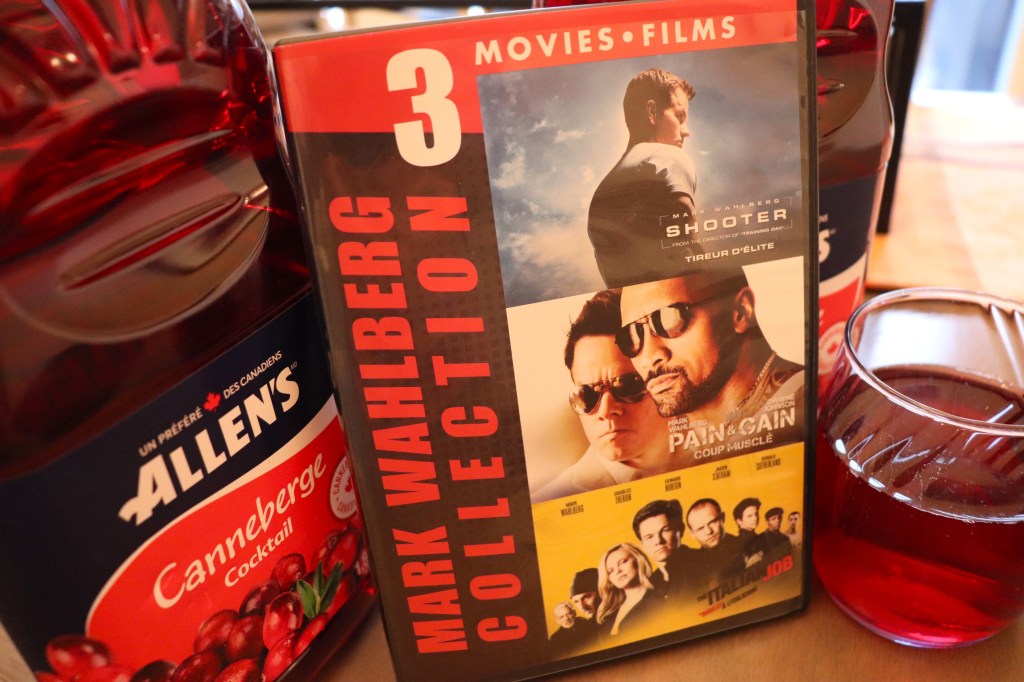
Allen’s Cranberry Juice (because when it comes to resisting U.S. imperialism, buying a Canadian food product is on the same level as watching a vaguely anti-American film from 18 years ago)

Fun facts:

Release date: March 23, 2007

Budget: $61 million

Box office: $95.7 million

-The character Bob Lee Swagger was originally created by author/film critic Stephen Hunter and first appeared in the 1993 novel Point of Impact. Hunter has written 12 books in the Bob Lee Swagger series, with the last story (Targeted) being published in 2022.

-The gun expert Wahlberg meets in the middle of the film is played by musician Levon Helm, who served as a drummer for The Band and was a 1994 inductee into the Rock and Roll Hall of Fame. Outside of his lengthy music career, Helm also appeared in films such as Coal Miner’s Daughter (1980) and The Right Stuff (1983).

-This film was later spun off into a TV series that ran for three seasons (2016-2018) on the USA Network. Ryan Phillippe took over the lead role from Wahlberg and the plot of the TV show revolved around the first three novels in the Bob Lee Swagger book series.

-Musical highlight: “Nasty Letter” by Otis Taylor (plays during the end credits)

In The Navy (1941) review-pratfall propaganda

Much has been written about the manufacturing might of the United States during times of conflict.

This is especially true during the Second World War, which sparked an industrial boom that single-handedly lifted America out of the Great Depression.

But outside of producing tanks, planes, and battleships, the U.S. was also keen on pumping out a flood of pop culture properties that kept the public sympathetic to the war effort.

This was mostly accomplished through the U.S. Office of War Information, which reviewed over 1,600 scripts throughout 1942-1945, excising anything that cast the country in a bad light.

But even before America officially entered the conflict (in December 1941), military officials were already deeply involved in various Hollywood productions, including the escapist comedies of Bud Abbott and Lou Costello.

In fact, the duo got their first big break in the movies through the military-themed Buck Privates (1941), which became so financially successful that it spawned two follow-up “service comedies” that same year.

The second part of this spiritual trilogy, In the Navy, was shot and released four months after the original, and that quick turnaround definitely shows.

While Buck Privates was charming because of its loose plot and slapstick gags, this nautical follow-up feels pretty lazy by comparison, content with coasting off Abbott and Costello’s newfound fame on the big screen.

The filmmakers’ military overseers also had a noticeably heavier hand in production this time around, to the point that the movie’s finale gets completely torpedoed thanks to third-party meddling.

As a result, it’s hard to see In the Navy as anything other than a blatant piece of military recruitment propaganda, despite it being able to squeeze in a couple decent laughs here and there.

After being relegated to a supporting role in Buck Privates, Abbott and Costello get promoted to main-character status for In the Navy, serving as a pair of hapless sailors who are eager to prove themselves on the high seas.

The duo eventually cross paths with a famous crooner (Dick Powell), who enlists in the navy under a fake name to escape the showbiz limelight.

Abbott and Costello agree to help the singer conceal his identity, which is a lot easier said than done now that an ambitious photojournalist (Claire Dodd) is on the hunt for an exclusive.

Many of the observations I made during my original review of Buck Privates hold true in this pseudo sequel, although the formula has hit some diminishing returns.

As expected, Abbott and Costello’s comedic chemistry is beyond reproach, with rapid-fire zingers and swift physical gags being delivered with pinpoint precision.

The pair work wonders even when things don’t go according to plan. An obvious outtake involving Abbott and Costello spitting water at each other is just left in the final cut of the film and remains one of biggest laughs In the Navy has to offer.

However, several of these routines drag on for far too long and bring the movie’s pace to a screeching halt.

One memorable scene involving a chaotic shell game eats up around five minutes of screen time, ending on a punchline that fails to justify such a lengthy, plotless detour.  

Another skit involving Costello’s unique math skills is similarly disconnected from the overarching narrative and is most likely included to pad the film’s runtime.

A lot of these bits are obviously holdovers from the duo’s stint on the vaudeville stage, given how they would continue to recycle this same material in future projects.

While these career callbacks had some novelty in Buck Privates, they’ve grown stale by this point, especially since these digressions are so disconnected from the ongoing plot concerning Powell’s crooner.

This is a shame, since Powell’s attempts to conceal his identity from Dodd’s photojournalist are quite charming. The pair establish a contentious yet flirty back-and-forth early on, which would have given the film another layer of appeal if it was given time to breathe.

But because of director Arthur Lubin’s focus on unrelated schtick (and another factor we’ll get into later), the film fails to synthesize its various plot threads into a cohesive whole, serving as a showcase for its headlining stars more than anything.

That being said, In the Navy does improve over Buck Privates in one area, and that is how the Andrews Sisters are used.

While the singing trio were a glorified Greek chorus last time, here they function as actual characters in the plot, with Costello looking to woo one of the sisters throughout.

Additionally, the sisters offer a wider variety of musical performances this time around, ranging from a military march to a jazzy club number to a luau-themed ditty.

Unfortunately, whatever goodwill In the Navy built up during its runtime is completely washed away in its third act.

Until this point, the movie’s propagandistic aims were visible but nothing I haven’t seen in other films produced during this era.

Just like with Buck Privates or Caught in the Draft (starring Bob Hope), the military is clearly involved in the movie’s production, providing access to vehicles, equipment, and other window dressing to present an appealing vision of service life.

However, the military’s involvement is taken one step further for In the Navy, since they basically vetoed the film’s climax.

U.S. naval officers reportedly took issue with the film’s ending sequence, where Costello [SPOILERS] unwittingly commandeers a battleship and wreaks havoc in a Hawaiian harbour.  

Not being able to edit this scene out of the movie, the studio opted to assuage the navy’s concerns via costly reshoots, which turned the real-life vehicular mayhem into a dream Costello experiences after ingesting a sedative.  

As if the “it was all a dream” ending wasn’t bad enough, the filmmakers also kneecap the ongoing romance storyline by kowtowing to this pressure from the military.

Since Powell and Dodd can’t be included in this dream sequence climax, their development as a couple is squeezed into the dying minutes of the film, having apparently resolved all their personal hangups off screen.

Some may bristle at me putting so much thought into the plot mechanics of a silly slapstick comedy, but sacrificing your big finale due to outside interests really is beyond the pale.

When this kind of meddling is so obvious, even to the naked eye, it really mutes the film’s other admirable qualities, regardless of how appealing Abbott and Costello’s brand of humour remains in the modern day.

And by the time the credits roll, all you’re left with is the feeling that you’re being fed a meal that is severely undercooked, despite there being way too many cooks in the kitchen.

But don’t let these cliched food metaphors mislead you into thinking that I’m above enjoying some World War II movies phantom-produced by Uncle Sam.

In the past, I’ve given a tepid recommendation to glorified recruitment ads starring American golden boy John Wayne (Back to Bataan, Operation Pacific), because the people behind those projects at least 1) knew how to somewhat disguise their propagandistic aims and 2) deliver on what was being advertised.

With In the Navy, the filmmakers largely failed on both of those fronts, with the movie’s only real saving grace being its eclectic soundtrack.

However, the American public obviously didn’t see it that way in 1941, since this film netted Universal Pictures a tidy profit and continued to push Abbott and Costello as a major box office draw.

The pair then used their newfound fame to help the military more directly once the U.S. officially entered the war, conducting a 78-city tour in 1942 that sold $85 million in war bonds.

Perhaps this cross-country campaign was a better venue for the two parties to collaborate, especially if their other service comedies turned out to be as slap-dash and half-baked as In the Navy.

Verdict:

4/10

Corner store companion:

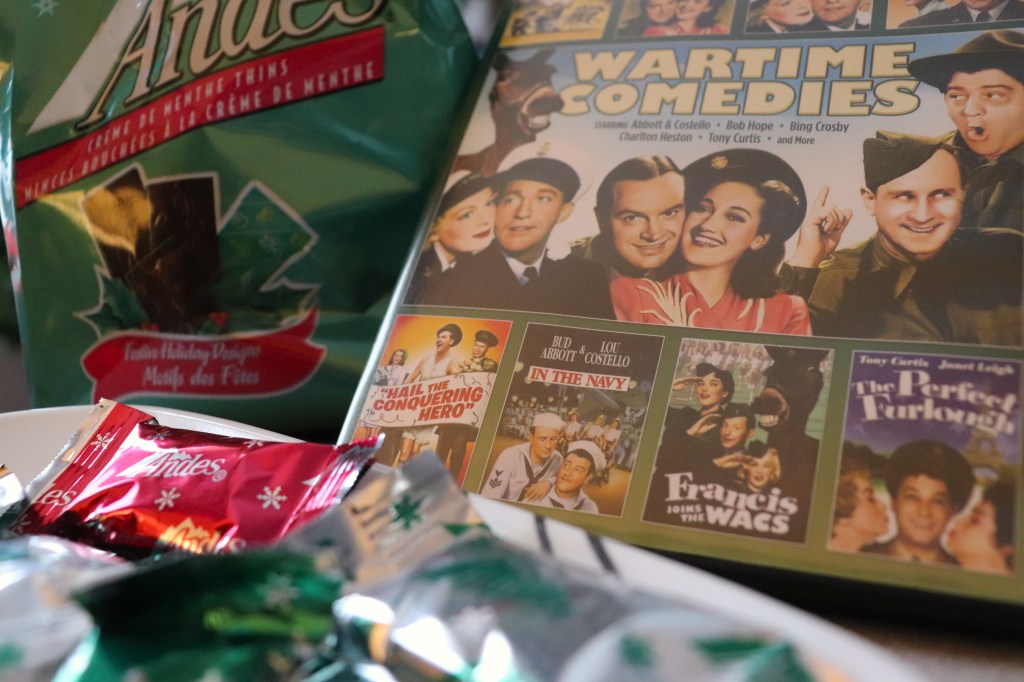
Andes thin chocolate mints (because it’s Christmas, dammit, and I need something sweet!)

Fun facts:

-Release date: May 31, 1941

-Budget: $379,207 (estimated)

-Box office: $2 million (estimated)

-The final entry in Abbott and Costello’s 1941 service comedy trilogy, Keep ‘Em Flying, was released on Nov. 28. This film features the comedy duo enlisting in the U.S. Army Air Corps.

-Outside this 1941 service comedy trilogy (Buck Privates, In the Navy, Keep ‘Em Flying), Arthur Lupin directed Abbott and Costello in Hold that Ghost (1941) and Ride ‘Em Cowboy (1942). Lupin is also responsible for helming five films in the Francis franchise, which features a talking mule enlisting in various branches of the military. 

-Musical highlight: “Gimme Some Skin, My Friend,” by the Andrews Sister

(despite the blatant cultural appropriation on display, originally being recorded by The Delta Rhythm Boys, this is the movie’s catchiest number by far)

Man Hunt (1984) review- a journey into the uncanny valley

If you’re looking to pick a fight on social media these days, a good place to start (outside of the ongoing Israel-Hamas conflict) is talking about generative artificial intelligence.

This is especially true in sections of the internet where people like to discuss the arts, since this new technology is viewed (depending on who you ask) as something that will either revolutionize the entertainment industry or bring about its downfall.

Personally, most of the AI-generated images and videos I’ve seen aren’t a convincing substitute for the projects made by flesh-and-blood creators, since they almost always possess some bizarre alien quality that makes my skin crawl.

However, the recent advances in AI shouldn’t distract you from the fact that humans have always had the potential to produce works of art that are completely uncanny, off-putting, and devoid of logic.

Enter Fabrizio De Angelis’ Man Hunt (1984), a neo western so lazy and nonsensical in its construction that you think the script was written during a drunken round of Mad Libs.

Admittedly, this does result in somewhat of an engaging viewing experience, since you’re constantly left wondering when the next wacky story development or plot hole will pop up. 

But taken as a whole, Man Hunt’s pervasive weirdness can’t sustain a feature-length runtime and it just leaves you with the creeping feeling that your home has sprung a gas leak.

Some may look at this film’s synopsis on IMDB or Wikipedia and conclude that I’m being a little hyperbolic, since the set-up is typical western shenanigans.

The plot of Man Hunt revolves around a nameless stranger (Ethan Wayne), who buys a pair of horses at a rodeo and accidently wanders onto some land belonging to a corrupt rancher (Ernest Borgnine).

After the rancher steals the horses for himself, the stranger gets thrown in prison after attempting to retake his property.

The rest of the film details the stranger’s attempts to escape from captivity and clear his name, all the while trying to stay one step ahead of the law.

You’ve probably seen a variation of this plot in a dozen other movies, but it’s the way that De Angelis and his crew tell this story that’s truly baffling.

For one thing, the stranger’s first escape from prison is never shown or discussed on screen, even though it’s supposed to represent a major turning point in the story.

Before you can get your head around such a weird creative decision, the stranger is immediately caught and gets thrown back behind bars, leading to his second escape minutes later.

After hijacking a bus and blasting his way through an army of cops, the stranger is then given safe passage thanks to Borgnine’s corrupt rancher, whose change of heart comes out of nowhere and is never given any explanation.

This kind of plot progression would make sense if Man Hunt was a comedy or Zucker Brothers-esque parody of old prison break movies.

But the tone of the film is deadly serious throughout its 91-minute runtime, which exposes the grim reality that De Angelis and his team have no idea what they’re doing.

That lack of direction is laid bare in the first four minutes of the film, which consists almost entirely of boring b-roll footage of the rodeo where the stranger buys his horses.

This opening remains a pretty blatant example of “Shooting the Rodeo,” a term coined by RedLetterMedia that describes the tendency for directors of low-budget movies to pad their runtime by filming real public events.

Man Hunt is an especially egregious example of this trope, since De Angelis lingers on this intro for way too long and includes elements like unnecessary slow motion to add insult to injury.  

These strange filmmaking techniques persist throughout the entire narrative, so much so that I was almost convinced that De Angelis was trying to create the kind of surreal, dream-like atmosphere one would find in a David Lynch movie.

But unlike Lynch’s works, Man Hunt is a pretty boring and lifeless affair for long stretches of its runtime, which is made even worse by a lead performance that is dull as dishwater.     

For those of you who are unaware, Ethan Wayne is the son of Hollywood icon John Wayne, who found work as an actor throughout the 1980s, 1990s, and early 2000s.

A brief scan of Wayne Jr.’s acting credits reveal that he never really made it as a major leading man like his dad, and in Man Hunt it’s easy to see why.

Pretty much every line that comes out of his mouth is stiff and robotic, almost like he’s a non-English speaker who learned the language for this role.

Wayne’s monotone performance extends to his blank facial expressions, which I’m assuming he employed to come across as a stoic western hero archetype just like his father.

But Wayne just doesn’t have the presence or charisma to pull this off and ends up looking like a pretender, especially when he’s asked to do anything physical.

This includes a couple of embarrassing running scenes, where Wayne gets to show that he has all the dignified grace and coordination of a young Steven Seagal.

To be fair, even a lauded thespian like Orson Wells would have trouble grasping this material, since it never finds its footing in a consistent style or tone.

Instead, the filmmakers decide to put a bunch of other movies in a blender, with the beginning of Man Hunt serving as a clumsy fusion of First Blood (1982) and Cool Hand Luke (1967).

The last third of the film ultimately becomes a downscaled version of Clint Eastwood’s The Gauntlet (1977), where the stranger has to evade an army of trigger-happy cops.

And to the film’s credit, these chase sequences do at least feature a lot of impressive pyrotechnics and automotive stunt work.

One scene near the end of the film stands out as a particular highlight, where a police cruiser flips over and showers the concrete street with broken glass.

Seconds later, two cruisers collide into each and explode, treating us to the amusing sight of flaming wheels skipping down the road.

All this technical expertise comes to a head in the film’s climax, where [SPOILERS] Wayne gets cornered in a mobile home and the cops open fire on him for what feels like five minutes.

This one-sided shooting is so excessive that it becomes a complete farce and instantly reminded me of a famous gag from The Naked Gun 21/2(1991).

Unfortunately, the filmmakers had to ruin this fun time by delivering one of the dumbest endings that’s ever been committed to celluloid.

Once Wayne emerges from this bullet-riddled trailer, completely unscathed of course, the cops go to arrest him, but he has a secret weapon up his sleeve.

Instead of carrying a gun or smoke bomb, the stranger produces a bill of sale which proves that he legally bought the horses at the beginning of the story.

This magical receipt completely freezes the corrupt cops in their place and forces them to let the stranger go, even though they were trying to unlawfully cut him into Swiss cheese seconds earlier.

Of course, this piece of paper shouldn’t absolve Wayne of all the property damage and lives he put in mortal danger during his multiple escape attempts.

But I guess we’re well past the point of pretending like Man Hunt takes place in a world that adheres to logic or reason, unless there’s some real legal precedent that gives you immunity from all manner of prosecution if you simply yell “It’s okay, officer! I have a receipt!!”

I know I’ve spent a lot of time on this one plot point, but I think it’s a microcosm of how disorienting this film is as a whole.

Almost every aspect of this project feels artificial or randomly generated, from its script to the acting to the musical score.

Part of me feels like this comes down to De Angelis’ inexperience as a director, since Man Hunt is only his third feature film after nearly a decade of producing Italian genre schlock.

Perhaps that jump into the director’s chair was too much to handle, so he resorted to throwing a bunch disparate American film tropes at the wall to see what would stick.  

De Angelis’ scattershot approach to directing Man Hunt is probably what triggered the AI comparison I brought up earlier, since that technology (in its current form) is only able to generate new works of art using pieces of pre-existing material.

Some may argue that this is no different than the creative process most humans undertake, and maybe there is some merit to that line of thinking.

But with a man-made trainwreck like Man Hunt, I can at least trace the creative influences of the people who worked on it and see that the director went on to embrace his exploitation roots by making films like Killer Crocodile (1989), Karate Rock (1990), and Breakfast With Dracula (1993).

This form of film analysis is infinitely more interesting than looking at the prompts and lines of code that went into creating an AI-generated blockbuster, which sounds about as fun as filing my taxes.

I would much rather look into the history of a deeply imperfect filmmaker than stare into the gaping maw of a machine-driven algorithm, even if the former ends up producing a completely incomprehensible piece of shit like Man Hunt.    

Verdict:

3/10

Corner store companion:

Buffalo Ranch Pringles (because this film is seriously lacking in real western flavour)

Fun facts:

-Release date:

Nov. 30, 1984 (West Germany)

Dec. 6, 1984 (Italy)

-Outside of the film’s original Italian title of Cane Arrabbiato (which roughly translates to “Mad Dog”), Man Hunt was also known as Uppercut Man in France.

-For most of his directing career, Fabrizio De Angelis was credited under the more American-sounding name of “Larry Ludman,” including for his work on Man Hunt. De Angelis also directed under the alias of “Ted Russell” for Breakfast With Dracula (1993).

-As an actor, Ethan Wayne is probably best known for portraying Storm Logan on The Bold and the Beautiful. Wayne played this character throughout 217 episodes of the long-running soap opera, eventually retiring from acting after he left the show for good in 2003.

Man Hunt can currently be watched in its entirety on YouTube (with Asian subtitles).

Renegades (1989) review-optimal cable viewing

Media consumers of the streaming era will never truly know the pleasure of randomly flipping through cable channels on a lazy Sunday afternoon, which was one of the most reliable forms of entertainment for bored youth growing up in the 1990s and early 2000s.

Sure, most of the television programs available during that weekend block were infomercials or reruns of ancient sitcoms, but every once in a while you would stumble upon a random action movie that would catch your attention.

Even if the film wasn’t very good, there was something captivating about getting thrown into the middle of a car chase or shootout without the ability to rewind, forcing you to fill in the gaps using your childish imagination.

These impromptu screenings would also serve as a nice bonding experience between you and your dad, who would reliably drop whatever he was doing at the sound of gunfire and explosions and sit down on the couch next to you.

It’s in this environment that movies like Jack Sholder’s Renegades (1989) really thrive, since you don’t need to engage with it at an emotional level and just get to enjoy the cheap spectacle before Sunday dinner is ready.

However, watching this film as an adult on DVD is an entirely different story, since its underlying hollowness is inescapable in this format and you don’t have mom’s famous shrimp pasta dish to help soften the blow.

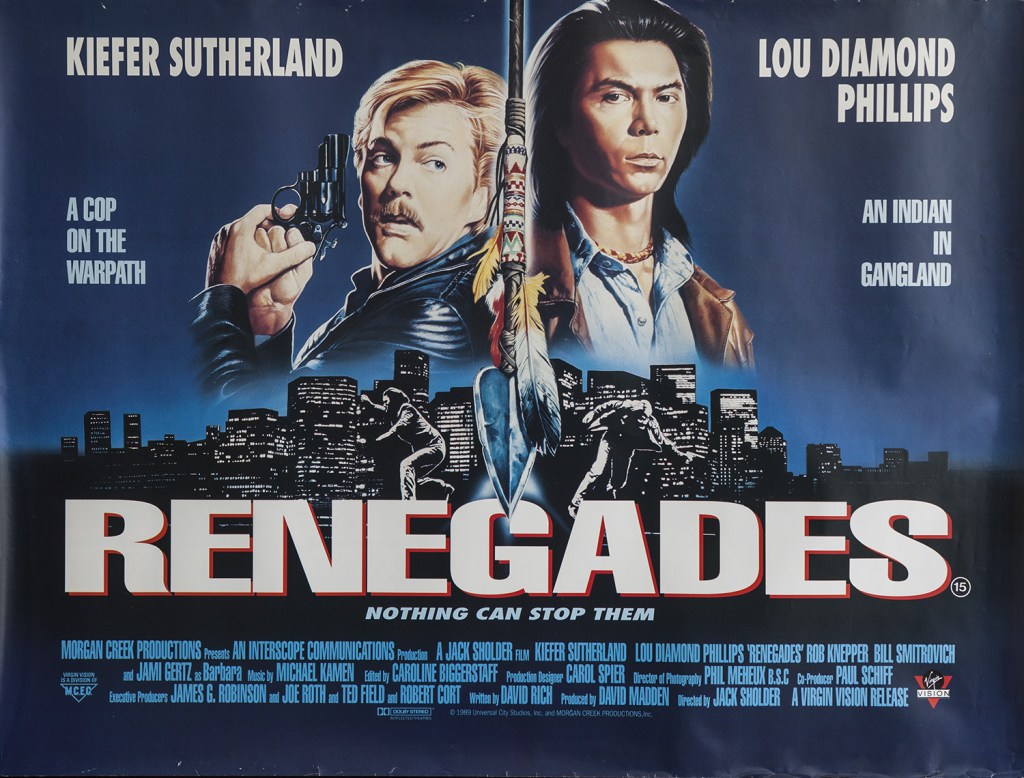
Like so many action movies of the 1980s, Renegades can easily be slotted into the buddy-cop genre, with Kiefer Sutherland and Lou Diamond Phillips starring as an undercover police officer and Native American tourist visiting Philadelphia, respectively.

When Sutherland’s involvement in a diamond heist results in a precious artefact being stolen from Phillips’ tribe, the pair must team up to bring down the bad guys.

From there, the plot unfolds in a pretty predictable fashion, since the two start out not trusting each other but gradually develop a bond as they get closer to cracking the case.

But unlike more famous buddy-cop movies from that era — like Lethal Weapon (1987) or 48 Hours (1982) — screenwriter David Rich doesn’t do a good job of giving these characters contrasting personalities.

Instead, both Sutherland and Phillips are written to be loose cannons who don’t abide by the rule of law when it comes to tracking down the people who have wronged them.

As a result, most of the conflict between these two is purely driven by the plot or superficial elements like their background, which isn’t very compelling.

It’s also pretty apparent that screenwriter David Rich was only interested in fleshing out one main character out of the two.

Sutherland’s undercover cop is at least given a decent backstory to explain his motivation throughout the story, since the audience is explicitly told that his father was a corrupt police officer who died in disgrace.

Meanwhile, Phillips’ character is completely shrouded in mystery, with details surrounding his upbringing only briefly hinted at through sparse bits of dialogue.

To compensate for this lack of depth, Rich takes the lazy route of imbuing Phillips with Jedi superpowers, hoping that viewers will be won over by his quick reflexes and ability to tap into “the force” whenever his family is in danger.  

But believe it or not, this one-note Hollywood depiction of the “noble savage” gets old pretty quickly, especially since Phillips’ chemistry with Sutherland is average at best.

Thankfully, Renegades at least delivers in the action department, with a handful of standout sequences that elevate it over the Steven Seagal-tier shlock that was circulating in the industry around that same time.

A car chase 20 minutes into the movie is honestly worth the price of admission alone, where Sutherland is forced to drive a getaway car at gunpoint after the aforementioned diamond heist goes horribly wrong.

Parts of this scene actually reminded me of the famous car chase from William Friedkin’s The French Connection (1971), where the director used a lot of first-person camera shots to create a palpable sense of danger.

The level of automotive destruction on display is also reminiscent of John Landis’ The Blue Brothers (1980), albeit with a less comedic touch.

The movie’s climactic night-time shootout at a horse ranch is similarly high on spectacle, since the filmmakers expertly compensate for a lack of natural light by setting the surroundings on fire.

And while the rest of the film’s action sequences aren’t up to that same high standard, they are at least well-edited and contain a lot of messy carnage that a more timid director would have shied away from.

Needless to say, these meaty chunks satiated my inner bloodlust and made me temporarily forget about the less desirable aspects of Renegades, like its cliched dialogue, generic music, and pedestrian plot that often veers off into being nonsensical.

But as soon as the action quiets down and you’re given some room to think, all these weaknesses bubble to the surface and the film falls apart.

Even the movie’s inciting incident is half-baked, since the main bad guy decides to take a breather from getting chased by the cops and steal Phillips’ family heirloom (a spear) for no reason.

Because of this, the protracted MacGuffin hunt that follows feels totally perfunctory, almost like the filmmakers were looking for the weakest excuse possible to link a couple of (admittedly cool) action sequences together.

Again, this kind of viewing experience is much better suited for the long-lost days of weekend cable TV, where you could put it on in the background as you wrestled with your brother or finished your homework before school on Monday.

But experiencing Renegades through the lens of an adult who is interested in obscure DVD collections, I can’t help but feel like something was lost in translation, almost like I was watching a foreign-language film with the subtitles turned off.

So unless I get my hands on a time machine, the optimal viewing conditions for this film are lost forever, and all I’m left with is a standard 80s cop movie that features good action but is severely lacking in emotional stakes.

Sounds like my last Tinder date.

Verdict:

5/10

Corner store companion:

McCain Pizza Pockets (because it’s the kind of food that also peaked in the 1990s and early 2000s)

Fun facts:

-Release date: June 2, 1989

-Budget: $16 million

-Box office: $20 million

-Because of Louis Diamond Phillips’ mixed heritage (Spanish-Filipino on his mother’s side and Scottish-Irish, Cherokee on his father’s side) he’s been able to portray a variety of ethnicities throughout his acting career, including Native American. Through preparing for Renegades, Phillips grew closer to the Indigenous community and was even adopted by an Oglala Lakota Sioux family in 1991. His Lakota name translates to “Star Keeper.”  

-Outside of helming Renegades, Jack Solder is probably best known for directing A Nightmare on Elm Street 2: Freddy’s Revenge (1985).

-While Renegades is set in Philadelphia, it was mostly shot in and around Toronto.

-Sutherland and Phillips would later reunite in a two-episode run of the popular TV action drama 24. During this section of season one, Phillips plays the warden of a secret detention facility who encounters CTU agent Jack Bauer (Sutherland) investigating the attempted assassination of a presidential candidate.

-Musical highlight: “Only the Strong Survive” by Bryan Adams (plays over the end credits)

Cattle Queen of Montana (1954) review-both of and ahead of its time

While Ronald Reagan’s transition from Hollywood to the White House has been extremely well documented, I always believed the early acting career of the 40th president of the United States was some sort of elaborate hoax.

For someone who was so influential in the realm of politics (for good or for ill), Reagan left virtually no lasting impact on the pop culture zeitgeist past the Baby Boomer generation, unlike some of his tough-guy contemporaries like John Wayne or Gary Cooper.

Up until recently, my only reference for Reagan’s filmography was a single photo of him cradling a chimpanzee in the comedy Bedtime for Bonzo (1951), which could be easily mistaken as a doctored piece of Democratic Party propaganda.

But this past Christmas, my parents provided me with irrefutable proof that Reagan’s acting career was, in fact, real by stuffing a DVD copy of Allan Dwan’s Cattle Queen of Montana (1954) into my stocking.

And after watching this western, it’s easy to see why Reagan’s run as an actor is mostly overshadowed by his political career, since he comes across as a generic leading man who relies on the same three facial expressions over and over.

Luckily, this film is largely saved by the titular “Cattle Queen” Barbara Stanwyck, who is far more compelling than her male co-star and manages to craft a likable protagonist who elevates this fairly boilerplate material.

In fact, Stanwyck is so good that it makes you (temporarily) overlook some of the film’s glaring weaknesses, like its odd production shortcuts and prevalent use of brownface for all the Indigenous characters who have speaking roles.

The plot of Cattle Queen revolves around Sierra Nevada Jones (Stanwyck), who travels from her home in Texas to Montana after her father inherits a large piece of land.

As soon as the family arrives at their destination, they are set upon by Blackfoot tribesmen, who steal their cattle herd, kill the patriarch, and take Sierra hostage, all at the behest of a corrupt local rancher.

Once she is released from captivity, Sierra vows to reclaim what’s rightfully hers and teams up with mysterious ranch hand Farrell (Reagan) to get the job done.   

Even though Cattle Queen of Montana is very much a project of its time in many respects, it does set itself apart from a lot of other Golden Age westerns through Stanwyck’s protagonist.

Rather than be relegated to the role of a love interest or a damsel in distress, Sierra Jones is a surprisingly very active character who drives most of the plot, constantly hatching schemes to outwit the bad guys and using emotional intelligence to recruit allies to her cause.

She also doesn’t hold back during the action scenes, standing toe-to-toe with Reagan and her other male co-stars once the shooting starts.

I know this sounds like very basic character writing, but these kinds of acting roles were few and far between for women in 1950s Hollywood, especially for someone like Stanwyck who was in her late 40s by this point.

But for whatever reason, Stanwyck was able to use the goodwill she built up in the industry to secure herself some meaty roles in this film and several other hard-hitting westerns like The Furies (1950) and The Maverick Queen (1956).

Judging by her performance in Cattle Queen alone, it’s easy to see why so many directors opted to give Stanwyck top billing in a traditionally male-dominated genre, since she oozes that same calm, confident charisma that defines most classic western hero archetypes.

It also doesn’t hurt that Stanwyck is surrounded by so much lovely scenery during her time on screen, with Dwan’s team opting to shoot part of this film on location at Montana’s Glacier National Park in vivid Technicolor.   

This adds a considerable amount of spectacle to what’s admittedly a pretty basic revenge story, since it gives the cast free reign to run around in real meadows and rocky outcrops instead of being stuck on an artificial studio sound stage.

Unfortunately, the use of these gorgeous landscapes is slightly undercut by some head-scratching production decisions, where the filmmakers will occasionally cut from a gorgeous wide shot of a mountain range to two actors standing in front of what’s obviously a rear projection.

Not only is this technique extremely jarring, but it’s employed inconsistently throughout the movie’s 88-minute runtime, with most other outdoor medium shots and close-ups being captured on location in either Montana or rural California.

My guess is that some footage originally shot in Montana was either lost or unusable by the time Dwan and his crew got back to Hollywood, forcing them to cobble together some insert shots on a studio backlot.

These cheap-looking transitions are made even worse by the filmmaker’s prominent use of day-for-night shooting, which makes some of the early action incredibly hard to keep track of on modern TV sets.

I understand that this technique was a necessary evil used to keep movie budgets in the black, but the end result is far from ideal, especially when you can still see puffy white clouds in scenes that are supposed to take place at night.

However, the biggest thing dragging Cattle Queen down, beyond those technical snafus, is the fact that all the Indigenous characters are quite obviously played by Italian actors.

Now, this isn’t a matter of my “liberal” sensibilities getting wounded by a practice that was much more prevalent in old Hollywood.

And in the movie’s defense, Dwan and his screenwriters at least go out of their way to portray the Blackfoot tribe in a nuanced light, casting a great many Indigenous characters as sympathetic and heroic rather than as a uniformly evil force (like in so many other western films of that era).  

Unfortunately, a lot of that hard work goes out the window as soon as actors with names like Lance Fuller and Anthony Caruso show up caked in what looks like dried mud, speaking in broken English like they’ve been clubbed in the head a couple times.

Those distracting sights and sounds are made even worse when the movie tries to posture itself as being anti-racist, with Sierra going out of her way to admonish some of her fellow White settlers for harboring prejudices towards Native Americans.

Again, it’s a nice sentiment, especially in a pre-civil rights America, but it rings very hollow when the very people you’re defending aren’t even allowed to play themselves on screen.

Despite these significant shortcomings, I still had a decent time watching Cattle Queen of Montana, especially since it served as my official introduction to Stanwyck and her filmography, which I’m very interested in exploring further.

The same can’t really be said for Reagan, since his stoic line delivery in this film is definitely better suited for the kind of rabble-rousing stump speeches that he became famous for in his political career.

But at the very least, I can now say with confidence that I’ve seen at least one Ronald Reagan film, which gives me the proper context to fully enjoy this gag from Robert Zemeckis’ Back to the Future.

Verdict:

6/10

Corner store companion:

Simple Pleasures oatmeal cookies (because this movie will remind you of a “simpler” time when you could get away with utilizing brownface to this degree)

Fun facts:

-Release date: Nov. 18, 1954

-Outside of referencing Ronald Reagan’s acting career in Back to the Future (1985), a poster for Cattle Queen of Montana is also featured in a scene immediately after Michael J. Fox arrives in 1955 Hill Valley.  

-Reagan reportedly watched this film at Camp David on Jan. 14, 1989, six days before the end of his two-term presidency.

-Reagan’s career as a screen actor lasted from 1937 to 1965 before he transitioned into politics, first becoming the Governor of California in 1966 before moving on to the White House in 1981.

– Barbara Stanwyck was nominated for four Academy Awards throughout her acting career, eventually winning an honourary Oscar statue in 1982. She also won a Primetime Emmy and a Golden Globe for her role in The Thorn Birds TV miniseries from 1983.  

– Stanwyck performed most of her own stunts in Cattle Queen of Montana, including a scene where her character goes for a swim in an icy lake.

She Demons (1958) review – micro-budgeted monotony

While independent filmmakers are often lauded for their ability to work outside the system and complete a project using a modest amount of money, they don’t always arrive at the same destination career-wise.

For example, directors like Quentin Tarantino and Paul Thomas Anderson have become critical darlings despite their humble beginnings; debuting with simple crime features that lead to increasingly complex projects.

Meanwhile, people like Robert Rodriguez and John Carpenter have largely stuck with their lurid genre roots and developed more of a cult following as a result.

Then you have luminaries like Roger Corman, who is remembered more as a genius businessman because of his ability to turn a profit by shooting fast and cheap.

Some renegade directors have even cemented a legacy through their sheer lack of talent and business sense, which is largely the case with B-movie king Ed Wood.

But for every Ed Wood there are probably a thousand independent filmmakers like Richard E. Cunha, whose name has been cast into the dustbin of history while his similarly schlocky work lives on in the realm of public domain.

One of these projects is She Demons (1958), a sleazy science-fiction horror film whose production values are about on par with an elementary school play.

But to be fair, most elementary school plays at least go to some lengths to maintain some sense of stylistic consistency, whereas Cunha’s film feels like it consists of assets leftover from eight different movies.

And while part of me always admires the entrepreneurial spirit it takes to get any film project off the ground, especially on a micro budget, I can’t ignore the reality that She Demons feels like it is held together with chewing gum and masking tape.

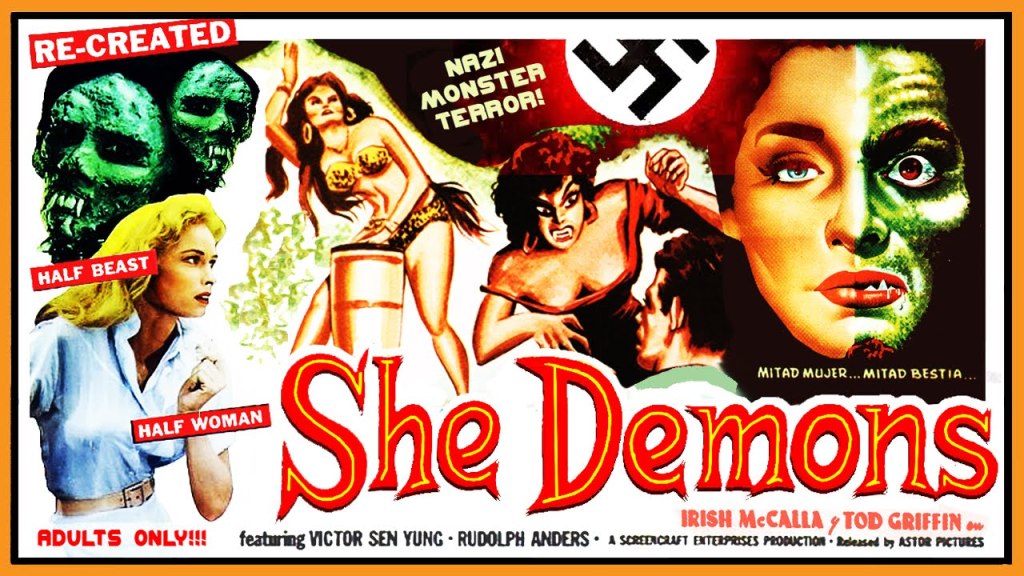
For as disjointed as this movie gets, the plot is mercifully simple from the outset, where a spoiled heiress (Irish McCalla) and her entourage get shipwrecked on an uncharted island following a hurricane.

As the group gradually explores the island they stumble upon a menagerie of horrors, including Nazi soldiers, a mad scientist, and the titular female monstrosities, which turn out to be some conventionally attractive women wearing cheap Halloween masks.

After a bunch of corny fist fights and lengthy expositions dumps, the mad scientist eventually turns his attention towards McCalla, wanting to use her youth and vitality to restore the beauty of his horribly maimed wife.

Watching She Demons I was constantly reminded of a couple old episodes of Star Trek, the ones where the Enterprise crew would visit an alien planet that looked suspiciously like Earth during World War II or the Prohibition Era.

Of course, this sense of familiarity turned out to be a cost-saving measure, since it allowed the producers to re-use old sets, props, and costumes from other Paramount properties rather than shell out a bunch of money to create new ones.

It seems like Cunha’s team operated under the same penny-pinching philosophy, except they didn’t have access to the same caliber of writers that made those original Star Trek adventures so compelling.

Here, it seems like the story of She Demons was totally dependent on whatever sets, props, and costumes the filmmakers could get their hands on, leading to a weird sense of disconnect throughout the entire 77-minute runtime.

Admittedly, some of the exterior scenes look alright, since Cunha and his team at least had the good sense to shoot on an actual beach and public park in California to maintain the illusion that his characters are stuck on a tropical island.

But that illusion completely shatters whenever the actors venture indoors and are forced to interact with these cheap sets that were either quickly made or taken from other movies.

The patchwork nature of this production is present in a lot of other places as well, with the overuse of stock footage being a repeat offender.

The filmmakers didn’t even bother to set up important establishing shots in some cases, outright omitting any depiction of the giant shipwreck that’s supposed to set the entire plot in motion.

Now, you could excuse a lot of these shortcomings as being a byproduct of the film’s reported $65,000 budget, since that kind of money doesn’t leave a lot of creative wiggle room for a sci-fi, horror mashup, even by 1958 standards.

But what isn’t excusable is the movie’s script, which is simultaneously sloppy, nonsensical, and extremely long-winded.

For whatever reason, Cunha decided to take a simple premise (people getting stuck on an island populated with monsters) and weigh it down with a bunch of extraneous nonsense.

Instead of focusing on the characters’ struggle to survive, the film keeps introducing new outlandish concepts that come out of nowhere, like long-lost Nazis, experimental gene therapy, and using lava as a renewable energy source.

Cunha gets so carried away with these ideas that the titular “She Demons” barely factor into the plot and are only used as set dressing past a certain point.

It also doesn’t help that the movie’s complicated fake science is explained during a 10-minute-long speech from the main villain that only succeeds in bringing the film to a grinding halt.

The characters themselves aren’t much to write home about either, although you can at least tell that certain members of the case are trying to squeeze something meaningful out of this bonkers script.

The only person who comes close to making a lasting impression is Rudolph Anders as the main villain, since this German actor made a career out of playing doctors and Nazis and knows how to fuse those two archetypes together.

Irish McCalla also makes an impression as the leading lady, but that probably has more to do with her measurements than her acting ability.

Tod Griffin isn’t even worth bringing up as the main love interest, since his monotone delivery constantly sounds like he’s reading his dialogue off of cue cards.

While Victor Sen Yung is saddled with the hapless role of the wisecracking sidekick, the filmmakers at least had the decency to not force him to adopt a stereotypical Asian accent (as was the style at the time).

However, that didn’t stop Cunha and his co-writer from inserting some eye-rolling Oriental-flavoured expressions into the script, getting Yung to yell “jumpin’ wanton!” and “Great Confucius’ ghost!” at various points in the movie.

And despite the overall zaniness of the plot, She Demons’ biggest sin is it is a boring watch most of the time, with a punishingly sluggish pace that only picks up in the final five minutes.

So if you’re planning a Halloween-themed bad movie night, it’s best to avoid this film even in that context, since including it in your lineup will only succeed in killing the vibe.

The only real value you can glean from watching She Demons is purely academic, since it might give you some insight on what to avoid if you plan on shooting a movie for $65,000.

Now, I know that sounds harsh, especially since scrappy movie makers like Cunha still serve as inspiration to aspiring artists looking to break into the industry today.

But as much as cinephiles like to celebrate independent filmmaking as a whole, it’s always important to acknowledge the trash alongside celebrating the treasure, with She Demons being a prime example of the former.

Verdict:

2/10

Corner store companion:

OMG! Milk Chocolately Clusters (because you deserve to enjoy a delicious snack while watching this dreck)

Fun facts:

-Release date: Jan. 3, 1958 (U.S.)

She Demons was originally released in theatres as a double feature with Giant from the Unknown (1958), another cheaply made sci-fi, horror mashup directed by Cunha and released by Astor Pictures.

-Richard Cunha got his start in show business during World War II, where he served as an aerial photographer for the military. From there, he was transferred to Hal Roach Studios in Los Angeles to make training films, newsreels, and documentaries. After the war, Cunha worked his way up to becoming a cinematographer on television and eventually started directing his own feature films.  

She Demons marked the only time actress Irish McCalla received top billing in a feature film. She was also known for her starring role in the cult TV show Sheena: Queen of the Jungle (1955-56). McCalla retired from acting in the early 1960s and would go on to establish herself as a respected oil painter.  

She Demons can be viewed in its entirety on YouTube (the picture quality here is actually an improvement over my DVD copy from Echo Bridge Entertainment).

Bandit Goes Country (1994) review – a shoddy new coat of paint

While film studios used to draw their power from the marquee stars they had under contract, it seems like the more valuable resource in the entertainment industry these days is intellectual properties.

So instead of focusing a lot of time and money on producing the next “John Wayne” or “Jimmy Stewart” picture, these movie executives are far more interested in cultivating big money-making franchises that allows them to produce as many sequels, prequels, spin-offs, and ancillary TV shows as possible.

Because of this, a significant amount of online discourse is now being dedicated to how these various studios are managing their IPs, with Disney and WarnerMedia currently catching a lot of heat for their handling of Star Wars and DC Comics projects, respectively.

Even though these multi-billion-dollar companies should be subject to public criticism, we should always keep things in perspective and realize that this dynamic could always be alot worse.

Because in my experience, I don’t ever think I’ve seen a film studio fumble the ball harder than Universal’s stewardship of the Smokey and the Bandit franchise.

After all, the original Smokey film starring Burt Reynolds became a cultural and box office juggernaut in 1977 by tapping into the rebellious spirit and easy-going attitude that characterized that particular decade.

And while the sequel that followed in 1980 was still financially successful, a lot of the magic had been lost by that point, causing director Hal Needham to sit out Part 3 altogether.

The third Smokey movie turned out to be such a thermonuclear disaster both in front of and behind the camera that the studio didn’t even touch the property again until the mid-1990s, greenlighting a series of four made-for-TV movies for Universal Television’s “Action Pack” programming block.

The first of these TV movies to emerge was Bandit Goes Country (1994), which starred Brian Bloom as the title character and saw the return of Needham to the franchise for the first time in over a decade.

Despite these familiar trappings, it’s pretty obvious that Universal was just hoping to produce a generic, low-effort action-comedy series with the “Bandit” name slapped on it.

Because without that title, this movie has no personality of its own and seems like it is riding off the coattails of other mid-90s TV schlock like Renegade or Walker, Texas Ranger more than anything.

Before you even get into the plot, Bandit Goes Country is already a mess from a conceptual level, since it’s very hard to figure out how it relates to the original three feature films.

IMDB describes this TV movie as something that “appears to be a prequel to the Smokey and the Bandit films” based on, I’m guessing, how young Bloom is compared to Reynolds during his first appearance as the character.

However, that theory goes right out the window as soon as you realize that Bandit Goes Country takes place in the 1990s and not in the 1960s like a proper prequel would require.

Additionally, the cast of this TV movie don’t feature any younger versions of the characters from the original trilogy, including Snowman (Jerry Reed) or Sheriff Buford T. Justice (Jackie Gleason).

Even some of the more superficial elements of those original movies are missing, with the Bandit’s iconic Pontiac Trans Am being traded in for a Dodge Stealth.

So based on that information, I can only conclude that Bandit Goes Country is more of an attempt to reboot the franchise with a fresh coat of paint, completely unburdened by any past continuity or canon.

While I can respect the impulse to try something different and not rely on Baby Boomer nostalgia to get by, the filmmakers clearly didn’t have any idea of where to take the character using this blank canvas.

This lack of direction is most visible in the movie’s story, which just meanders for 90 minutes and gets bogged down in a bunch of useless subplots.

The main storyline here involves Bandit returning to his hometown, where he attempts to make peace with a rival community that’s held a grudge against his people for generations.

But instead of sticking to that simple premise, the filmmakers constantly take you on these narrative detours that don’t amount to much.

These distracting subplots include:

-Bandit being hired to transport country music star Mel Tillis to his upcoming concert.

-Bandit being hounded by government agents who are investigating his cousin’s music pirating business.

-Bandit attempting to rekindle a romance with his childhood sweetheart (Elizabeth Berkley).

-Bandit trying to help another one of his old girlfriends marry her new beau in secret (since he hails from this rival community).

-Bandit picking up this random female hitchhiker, who does nothing throughout the whole movie until she decides to shack up with his cousin at the last minute for no reason (the pair had previously shared one small scene together).

With all these things happening at the same time, Bandit Goes Country feels like you’re watching someone play a redneck-themed RPG, where they decide to tackle all the side missions and completely ignore the main quest.

Story structure aside, what really sinks this television reboot is the noticeable lack of impressive automotive stunt work.

After all, this kind of thing was Needham’s big claim to fame as a director and you think that he would cook up something really special for his grand return to the series that made him a household name.

But outside of an early scene involving a light aircraft landing on a moving flatbed truck, the movie plays it pretty safe and seems reluctant to put its main character in any kind of mortal peril behind the wheel.

While I’m sure that Needham and his crew were constrained by a modest TV budget, that doesn’t excuse the sheer lack of imagination that ends up on screen.

To try and compensate, the filmmakers really lean into Bandit Goes Country’s status as a comedy, with Mel Tillis and his manager (Charles Nelson Reilly) taking on the lion’s share of the movie’s slapstick gags.

Unfortunately, most of these jokes fall completely flat and feel just as half-baked as the stunt work, something that’s become a recurring pattern in Needham’s career through films like Smokey and the Bandit II (1980), The Cannonball Run (1981) and Body Slam (1986).

The cast also don’t make a very strong impression overall, with Bloom being the worst offender as the Bandit.

To be fair, the actor was definitely set up to fail from the beginning. Stepping into Reynolds’  boots is no easy task, especially if audiences were only familiar with Bloom’s work through the long-running soap opera As the World Turns at that point.

While Bloom would later showcase his range in the realm of voice acting, he’s completely lost in this project, being content with playing a smirking douche instead of a charming rogue like the role requires.

He’s also not done any favors by the wardrobe department, who decided to dress him up in the worst kind of mid-90s fashion, including a belt buckle with a giant “B” printed on it (like he’s a low-rent superhero).

But in Bloom’s defense, I imagine even Laurence Olivier would have trouble wringing a good performance out of this piss poor material, which seems like it was slapped together over a weekend.

Ultimately, I’m still kind of baffled that Universal Television saw fit to broadcast Bandit Goes Country at all.

It’s so flavourless and devoid of any similarity to the original source material that I can’t imagine it being a great starting point for the studio’s Action Pack programming block (that launched the same month this movie aired).

At least Another Midnight Run (1994), which I screened back in 2019, bore some resemblance to the feature film it was spinning off from in terms of characters and plot, ensuring that someone must have enjoyed it.

With Bandit Goes Country, it seems like Needham and his crew couldn’t even be bothered to put in the bare minimum effort to satisfy old Smokey fans or to even reel in new viewers.

And while I haven’t seen the three remaining TV movies in this series, it’s obvious that Universal’s poor management of this franchise in the 1990s lead to its untimely death, since all other attempts at another revival have sputtered out.

But at the end of the day, that might be for the best.

Our current media landscape is completely built on the cynical resurrection of old nostalgic properties, and we don’t need another re-animated corpse added to its foundations.

Having said that, I could totally see Universal dusting off this property once again if the company needed a new, high-profile TV show to help launch its own streaming service.

Maybe Bandit could wear a fedora and drive a Tesla instead of relying on the classic cowboy hat/Trans Am combo. That would get Twitter buzzing.

Verdict:

2/10

Corner store companion:

No Name Salt and Vinegar Potato Chips (because if you’re watching this movie, you already have an appetite for some off-brand entertainment)

Fun facts:

-Release date: Jan. 30, 1994

Bandit Goes Country was followed by three other made-for-TV movies that aired the same year. This series includes: Bandit Bandit (March 13, 1994), Beauty and the Bandit (April 3, 1994), and Bandit’s Silver Angel (April 10, 1994). All four movies starred Brian Bloom and were directed by Hal Needham.

-Elizabeth Berkley’s role in Bandit Goes Country represents an interesting transitional period for the actress, since her time on the TV sitcom Saved By the Bell (1989-1992) had come to an end and she was a year away from attempting to launch her movie career by starring in Paul Verhoeven’s Showgirls (1995).

-Outside of serving as a supporting character in Bandit Goes Country, Mel Tillis also appeared in Smokey and the Bandit II as an amusement park owner.  

-Musical highlight: “Coca Cola Cowboy” by Mel Tillis (the country music star gets rewarded for being in this turd by having his song play as Bandit rides off into the sunset)

The Lucky One (2012) review-Sparks on autopilot

After watching Scott Hicks’ The Lucky One (2012) last month, I finally polished off my 5-Film Nicholas Sparks Collection from Warner Brothers.

Having never indulged in any of Sparks’ romantic dramas before purchasing this DVD set, I was originally bracing for a pretty miserable movie marathon based on bad word-of-mouth and poor critical reception across the board.

However, running through all five films has proven to be a much more well-rounded viewing experience in terms of quality, with distinctive peaks (The Notebook, A Walk to Remember), valleys (Message in a Bottle) and plateaus (Nights in Rodanthe).

With this in mind, I was hoping to end this journey on a high note with The Lucky One, especially since this project boasted another attractive cast and picturesque American setting.

Unfortunately, this film also turned out to be a greatest hits compilation of all the worst elements of the four previous entries in this collection, with cheesy dialogue, ludicrous plotting and flat characters who belong in a cartoon.

Because of this, my initial journey into the world of Nicholas Sparks ended with more of a whimper than a PG-13 rated bang.

In case the trailer didn’t make it clear, the eponymous “Lucky One” of the story is Logan (Zac Efron), a US marine who miraculously survived several near-death experiences during a recent tour of Iraq.

Logan believes that his good fortune is due to a random photo he found in the dirt moments before a mortar shell killed several of his squad mates.

After returning state-side, Logan vows to find the woman featured in this photograph, eventually stumbling upon dog kennel owner Beth (Taylor Schilling) in a sleepy Louisiana town.

Rather than telling Beth the real reason why he showed up out of nowhere Logan applies to work at the kennel instead, allowing their romantic relationship to blossom on top of a healthy foundation of lies.

Of course, the flimsiness of this premise is suspiciously familiar to Message in a Bottle (1999), where the main character of that film also withholds the truth in order to get closer to a potential lover.

While Efron is not nearly as creepy or manipulative as Robin Wright was in Message, his character’s decision to lie by omission still comes across as being an extremely lazy way of manufacturing conflict.

After all, one of Logan’s defining characteristics in The Lucky One is that he is an honest and good-natured hunk, which doesn’t gel at all with the deceptive nature of his meet-cute with Beth.

I know screenwriter Will Fetters was bound by the constraints of the original source material, but judging by the Wikipedia summary for Sparks’ 2008 book he already changed around the basic plot structure for this movie adaptation. So, from where I’m sitting, a couple more tweaks couldn’t hurt.

For this hypothetical re-write, Fetters should also look at revising the other major antagonistic force in this story, which is Beth’s divorced husband Keith.

While actor Jay Ferguson is no stranger to playing jerks on TV shows like Mad Men, here he’s given absolutely nothing to work with portraying a romantic rival who is more warthog than man.

Basically, every negative trait you could associate with a jealous ex is put into a blender and poured into this character’s mould to make Efron look even better by comparison.

Outside of being physically and emotionally abusive to the mother of his child, Keith is also written to be a spoiled redneck who uses his status as the town sheriff to bully and intimidate people he doesn’t like (knowing full well that his judge father will absolve him of any wrongdoing).  

This character is so comically evil that he even points a loaded gun at Efron’s dog near the end of the movie, an action that should put him on the shit list of every viewer who isn’t an outright serial killer.

But despite this, the filmmakers also attempt to give Keith a rushed redemption arc at the tail end of the story, even though such a development isn’t earned or organic in the least.

But spotty writing is far from the only thing weighing The Lucky One down.

On a technical level, this film is littered with awkward cuts and weird editing decisions that give the proceedings a very amateurish feel.

At times it seems like the filmmakers simply lost certain footage during post-production, forcing them to splice certain scenes together without all the connective tissue.

For example, there’s one moment where Beth tells Logan about a treasured memory of her dead brother, where he sealed up one of her books in a brick wall.

However, this revelation lacks a lot of emotional impact on screen since the director didn’t include a close-up of the object in question, making it look like Schilling is staring at nothing.

In terms of acting, most of the cast actually turn in a respectable performance given the subpar material they have to work with.

Riley Thomas Stewart is particularly impressive as Beth’s nine-year-old son Ben, who outshines a lot of the adult actors in terms of presence and charisma.

Blyth Danner also gets saddled with some of the best lines as Beth’s sassy grandmother, reminding me, once again, of Message in a Bottle and how Paul Newman steals that movie in a similar, gender-flipped role.

While Efron does a decent job of playing the strong, silent type, it’s a shame he couldn’t decide on an accent to really anchor his performance.

Most of the time he sounds like your typical California surfer bro, but every once in a while he decides to deliver his lines with a Southern twang for some reason.

And as good an actor Efron can be given the right project, he’s not talented enough to save some of the Harlequin Romance novel-level dialogue he’s asked to spit out, like when he tells Schilling that “You should be kissed every day, every hour, every minute.”

But then again, that kind of corniness is what makes these movies (and the books they’re based on) so successful.

Having sat through five Sparks adaptations now, I’ll admit that there is something very appealing about how these different filmmakers lean into this highly romanticized material so unapologetically.

Through populating each movie with endless sunsets, vast aquatic scenery, vintage vehicles, and impossibly beautiful people, they’re able to create the perfect breeding ground for a love story that isn’t confined to a specific decade in late 20th century America.

The Lucky One is no different, with director of photography Alar Kivilo doing a lot of the heavy lifting to create that signature look and feel.

But unlike some of the better films in the Sparks canon (The Notebook, A Walk to Remember), this 2012 entry doesn’t have a strong enough script to elevate this unmistakably shallow subject matter.

Even though the movie tries to establish some depth early on by making a big deal about Logan’s PTSD, that important character detail is all but abandoned as soon as the romance with Beth gets fully underway. 

So in the end, The Lucky One doesn’t have a lot to offer besides some purely superficial elements that one can already experience by staring at the film’s generic theatrical poster.

And while this did represent a sour conclusion to my first foray into the world of Nicholas Sparks, I remain mildly interested in seeing how his six remaining movie adaptations turn out.

After all, this franchise is successful for a reason, and I feel like I’m getting closer to cracking that code with every new screening.

Verdict:

4/10

Corner store companion:

Carnaby Sweet marshmallow hearts (because it’s some cheap, sugary crap that should only be consumed around Valentine’s Day)

Fun facts:

-Release date: April 20, 2012

-Budget: $25 million (estimated)

-Box office: $60,457,138 (domestic), $99,357,138 (worldwide)

-While The Lucky One received mostly negative reviews from critics, the film picked up a number of Teen Choice Awards (choice movie actor-Efron, choice movie-drama) and a single People’s Choice Award (favourite dramatic movie actor-Efron). Riley Thomas Stewart was also nominated for a Young Artist Award for his performance in this film as Schillings’ son Ben.

-The Louisiana house where Beth lives was re-used for the 2014 Nicholas Sparks film adaptation for The Best of Me.

-Outside of feature films, director Scott Hicks has a history of helming documentaries and music videos for the Australian rock band INXS.

Musical highlight: “The Story” by Brandi Carlile (plays over the end credits)

Operation Pacific (1951) review-America takes a victory lap

While most classic Hollywood war films have a pretty clear set of objectives (selling bonds, driving up recruitment numbers, etc.), George Waggner’s Operation Pacific (1951) is an entirely different animal.

This John Wayne-led naval adventure is much more celebratory and easy-going in tone, clearly riding off the protracted high that many Americans were still feeling since World War II ended six years earlier.

As a result, the film is a lot more interested in exploring what a soldier’s life might be like after “the fight” comes to an end, rather than providing some insight into what this specific conflict looked like in a larger context.

Even though this tone might upset some military diehards, Operation Pacific actually benefits from the gift of hindsight, since it doesn’t get completely bogged down in the cynical saber rattling that kneecaps so many other war films of that era.

The plot of Operation Pacific revolves around Duke Gifford (Wayne), who serves as an executive officer aboard a submarine called the USS Thunderfish during World War II.

After returning from a dangerous mission in the Philippines, Duke runs into his ex-wife Mary Stuart (Patricia Neal) while on leave at Pearl Harbor.

Even though the two still have feelings for each other, Duke’s responsibilities as a naval officer keep getting in the way of his romantic advances toward Mary, especially as his patrols in enemy waters get increasingly treacherous.

Now, some of you might be scratching your heads after reading this plot synopsis, since this sounds more like a Nicholas Sparks novel rather than a gritty war epic starring John Wayne.

This element caught me by surprise as well, since lengthy sections of the film are dedicated to Wayne and Neal making doe eyes at each other, while a lot of the naval combat scenes are pushed to the sidelines.

Operating Pacific also goes out of its way to depict the more blasé and uneventful aspects of military life that border on the comical, some of which wouldn’t be out of place in an Abbott and Costello movie.

In one scene, while on shore leave, Wayne is tasked with bailing his men out of a Honolulu jail after they get into a drunken brawl with some local police officers.

When the crew is at sea, they use some of their down time to screen a movie in the submarine’s mess hall.

And after rescuing an infant from enemy territory, the men of the USS Thunderfish figure out how to feed the child using a rubber glove.

While these moments do tonally clash with the naval combat scenes—which are awash with gunfire, explosions and technical mumbo jumbo — they do add some much-needed variety to what would otherwise be a pretty by-the-numbers war movie.

And by shifting the film’s focus away from the “battlefield,” Waggner (who also wrote the screenplay) is very clearly trying to appease a post-World War II audience, whose appetite for outright bloodshed had definitely cooled after six years of peacetime. *

Plus, by 1951 the US Baby Boom was noticeably underway, with the romance between Wayne and Neal in this film serving as an obvious nod to the kind of cathartic, romantic energy embodied in classic wartime imagery like Alfred Eisenstaedt’s “V-J Day in Times Square” photograph.

In fact, this film is so uninterested with broader conflict itself that there’s not really any main antagonist to speak of.

Sure, Wayne has to butt heads with a fellow soldier who is also after his ex-wife’s affections, but their relationship is always very cordial and never escalates beyond a harsh word.

Because of this, most of the film’s charm comes from its quieter moments, where the main characters hang out and discuss what life is like back on dry land.

That being said, Operation Pacific does slightly buckle under some clichés that one would expect from a Hollywood war epic from that era.

For one thing, a lot of the film’s action sequences rely way too heavily on stock imagery, which isn’t spliced into the director’s original footage in an organic fashion.

Additionally, Waggner is pretty upfront about presenting this story as a piece of military propaganda, opening up the movie with a Star Wars-style crawl that pays tribute to those who lost their lives in the line of duty.

While there’s nothing wrong with this kind of cinematic remembrance, it does set the tone for a movie that casts World War II in an overly simplistic light, where all American soldiers are depicted as being absolute paragons of virtue.

This approach to characterization turns into a problem whenever the movie veers off into a territory that isn’t morally black and white, like the aforementioned moment where Wayne has to bail his men out of jail.

Even though these characters assaulted several police officers under the influence of alcohol, this scene is largely played for laughs, where the crew is ultimately left off the hook for committing such a serious crime.

This uncritical eye is prevalent throughout the rest of the movie as well, since the filmmakers don’t provide any insight into the Imperial Japanese Navy, outside of the fact that they are a mostly faceless enemy who must be defeated.

Thankfully, this outdated propaganda isn’t so heavy handed that it ruins the movie, although everyone’s mileage may vary (especially if you don’t care for the term “Japs” being thrown around in casual conversation).

And even if you’re not a big fan of romance being mixed in with your violent war movie, at least take comfort in the fact that Waggner does a pretty decent job of balancing those two elements throughout the film’s 111-minute runtime.

For what it’s worth, I’ve seen this kind of genre bending done way worse, with Paul Gross’ crushingly melodramatic Passchendaele (2008) immediately coming to mind.

Plus, in this case, the relationship between Wayne and Neal actually saves Operation Pacific from being completely irrelevant to a 2021 audience.

After all, [SPOILERS] their successful reconcilement at the end of the movie is obviously meant to tap into America’s desire to return to some state of normalcy after a long period of societal upheaval.

And in that respect, Operation Pacific has become way more relatable than ever in the seven decades since its original release now that the country (and North America more broadly) is turning the tide in the fight against COVID-19. **

Verdict:

6/10

Corner store companion:

Ghirardelli sea salt chocolate (because it’s the only nautical-themed snack food that I could find)

Fun facts:

-Release date: Jan. 27, 1951

-Budget: $1.46 million (estimated)

-Box office: $2.56 million (US), $1.3 million (worldwide)

-Retired US navy admiral Charles A. Lockwood served as a technical advisor on Operation Pacific to ensure its accuracy when depicting submarine warfare. According to Wikipedia, Hollywood producers sought out Lockwood a couple more times to advise them on a variety of other film projects, including Hellcats of the Navy (1957), On the Beach (1959), and Up Periscope (1959).  

-Near the finale of Operation Pacific, the men of the USS Thunderfish can be seen exchanging film canisters with a friendly American sub so that both crews can enjoy a movie night. These films, Destination Tokyo (1943) and George Washington Slept Here (1942), were both produced by Warner Bros. Pictures in real life.

-Following the release of Operation Pacific, George Waggner mostly directed television for the remainder of his career, including episodes of The Green Hornet, Maverick, The Man from U.N.C.L.E. and Batman.

* I realize that the US was involved in the Korean War by 1951, but that conflict wasn’t nearly as pervasive in American society as World War II was, so I think my original point stands.

** I sincerely hope this statement doesn’t become extremely dated in the coming weeks and months.