Tangier (1946) review: discount Casablanca

In modern film discourse, it’s pretty easy to call something derivative or a “rip-off.”

After all, we have over 120 years of movie history to pull from, which gives us the breathing room to spot repeated uses of certain plots, settings, and character archetypes over a period of time.  

Movie-goers from the 1940s-50s, meanwhile, weren’t burdened with the same historical hindsight and couldn’t even rely on the internet or home video releases to keep track of every time Hollywood re-used the same picturesque rock formation for a generic western backdrop.

But even with that all in mind, I still think 1946 audiences would have tilted their heads at George Waggner’s Tangier, given how many elements it blatantly lifts from Michael Curtiz’s Casablanca (1942).  

After all, Casablanca was a massive hit that netted Warner Brothers some major Oscar wins (including Best Picture), thereby guaranteeing it a firm place in the American pop culture zeitgeist.

The film’s success also encouraged Warner Brothers to produce several other films made in the same mold, with The Conspirators (1944) and To Have and Have Not (1944) liberally borrowing cast members and plot elements from Casablanca.

So by 1946, US movie fans were quite familiar with film noir set in exotic locales, where glamorous women and hard-nosed men fall in love while bringing down fascist sympathizers.

And Universal Pictures was definitely hoping to cash in on that formula with Tangier, resulting in a product that often looks and feels like Casablanca with the serial number filed off.

Despite being such a blatant knock-off, Tangier manages to retain some charm thanks to its strong cast, sharp dialogue, and moody visuals, which keep the film’s more derivative aspects at bay (for the most part).  

That being said, the parallels between Tangier and Casablanca are nakedly obvious even from a surface reading of the plot.

In both films, the setting is a coastal Moroccan city during World War II, with most of the action revolving around a glitzy nightclub that is frequented by all the big movers and shakers in town. The “usual suspects” in Tangier are led by American journalist Paul (Robert Paige), who is on the trail of a Nazi collaborator attempting to buy his freedom using a stolen diamond. Paul’s quest eventually intersects with club dancer Rita (Maria Montez), who is on the trail of the same Nazi collaborator for personal reasons. The two eventually team up to recover the diamond and bring the secret Nazi to justice, all the while making bedroom eyes at each other.

Even someone with a cursory knowledge of Casablanca could pick up on the similarities at play here. Not only is Tangier’s setting and overriding conflict virtually the same, but the romance at the centre of the story occupies the same emotional space that Humphrey Bogart and Ingrid Bergman did in the 1942 film.

In that respect, Tangier definitely pales in comparison, with the romance between Paige and Montez feeling rushed and undercooked. Even if the two have decent chemistry, their relationship develops far too quickly, with the pair agreeing to marry after only knowing each other for a single day.

The filmmakers try to compensate for this weak romance by throwing a four-way love triangle (a love square?) into the mix, but that only serves to complicate what’s already an overstuffed plot.

Luckily, most of the sights and sounds surrounding the central romance are interesting enough to keep the rest of the film on track.

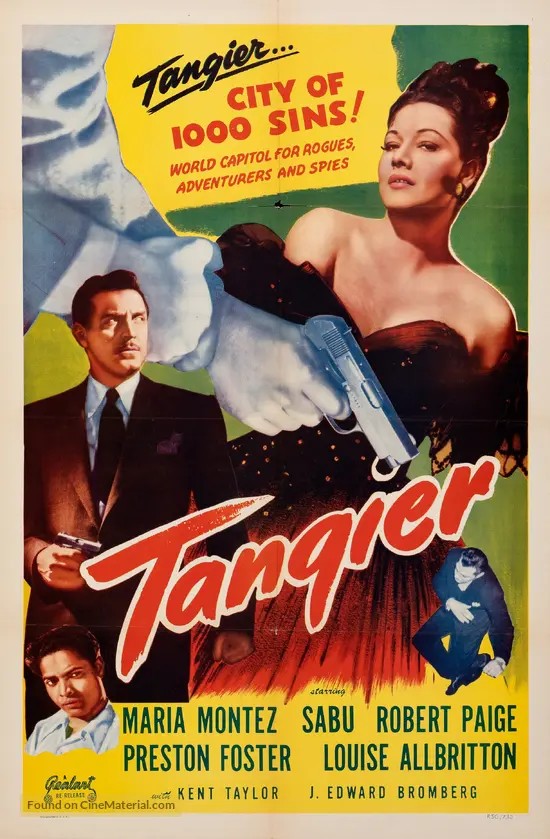
Despite not really working as a couple, Paige and Montez know exactly how to play up the film noir aspect of the story. Paige’s war reporter has a roguish Hemingway flair about him, whereas Montez is totally believable as a femme fatale whose glamour is ultimately a means to end.

The supporting cast is also a rich tapestry of character actors from Hollywood’s Golden Age, who manage to squeeze a lot of life out of what are otherwise stock noir archetypes.

Louise Allbritton shines as a fellow club dancer who is constantly standing in Montez’s shadow, both professionally and romantically. In less talented hands, Allbritton could have come across as whiny or annoying, but she manages to hit all the right notes and make this character a genuinely tragic figure.
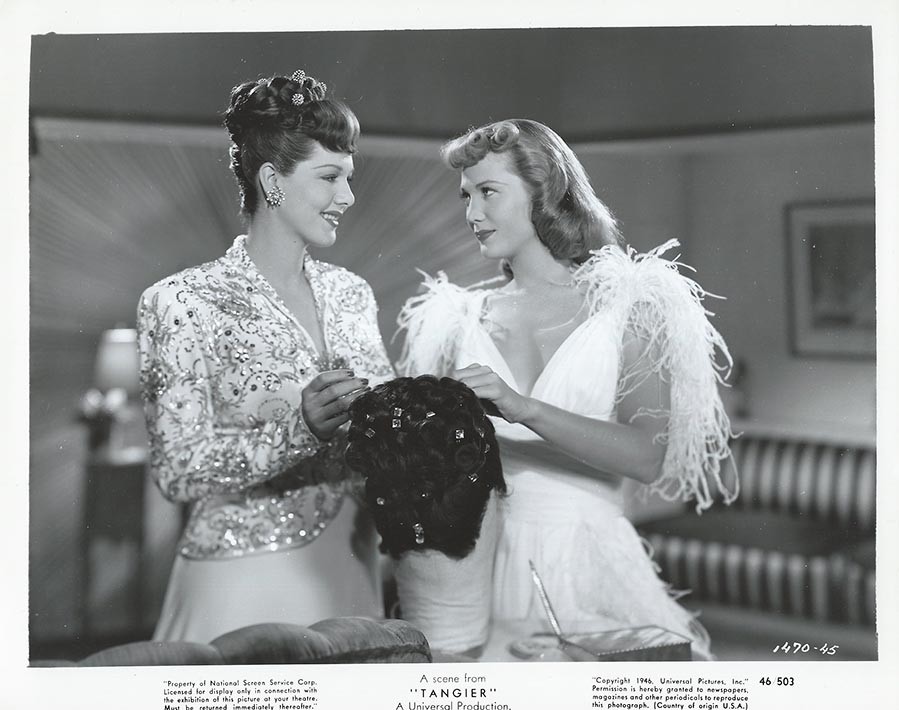
Meanwhile, Sabu is playing largely the same role that Dooley Wilson (Sam) occupied in Casablanca, namely the musical sidekick who is a confidant to the main hero. There’s definitely a lot of cultural baggage to unpack with this type of character, but, for what it’s worth, Sabu uses his natural charisma to inject some much-needed levity into the film.
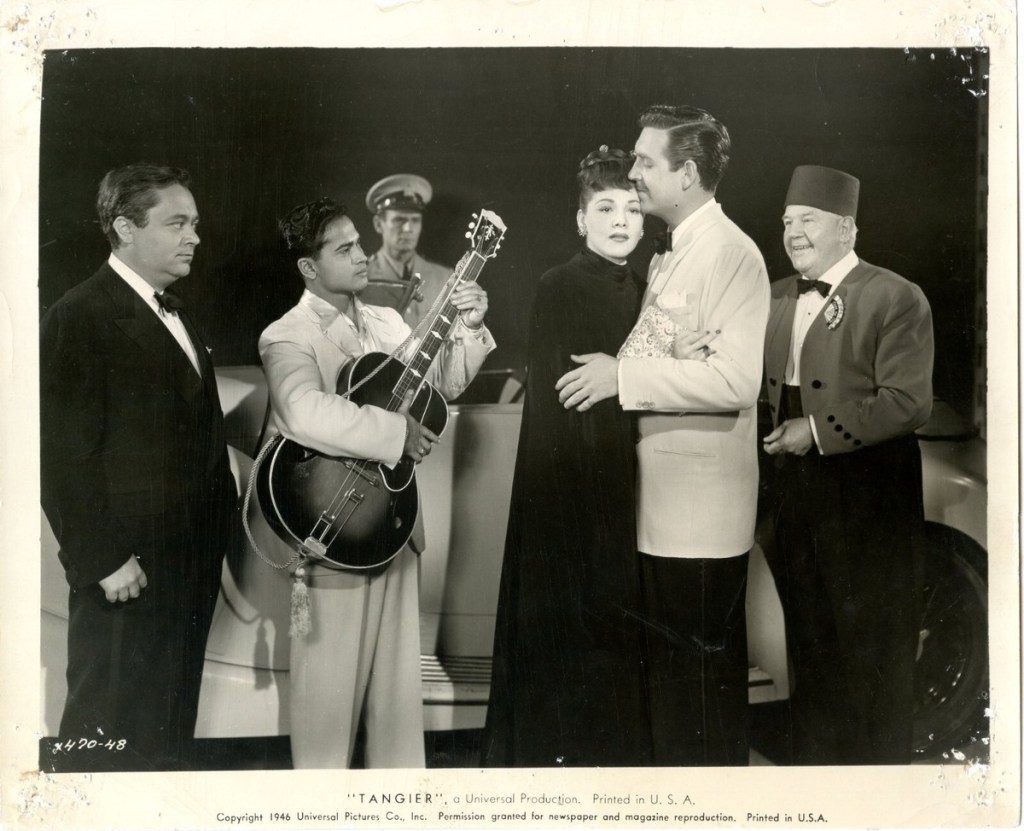
And then there’s Preston Foster as the stuffy military police colonel, who is the main obstacle standing in the heroes’ way. Again, this sounds like a generic villain role on paper, but Foster manages to imbue his character with a kind of gentlemanly poise that makes him at least fun to watch.  
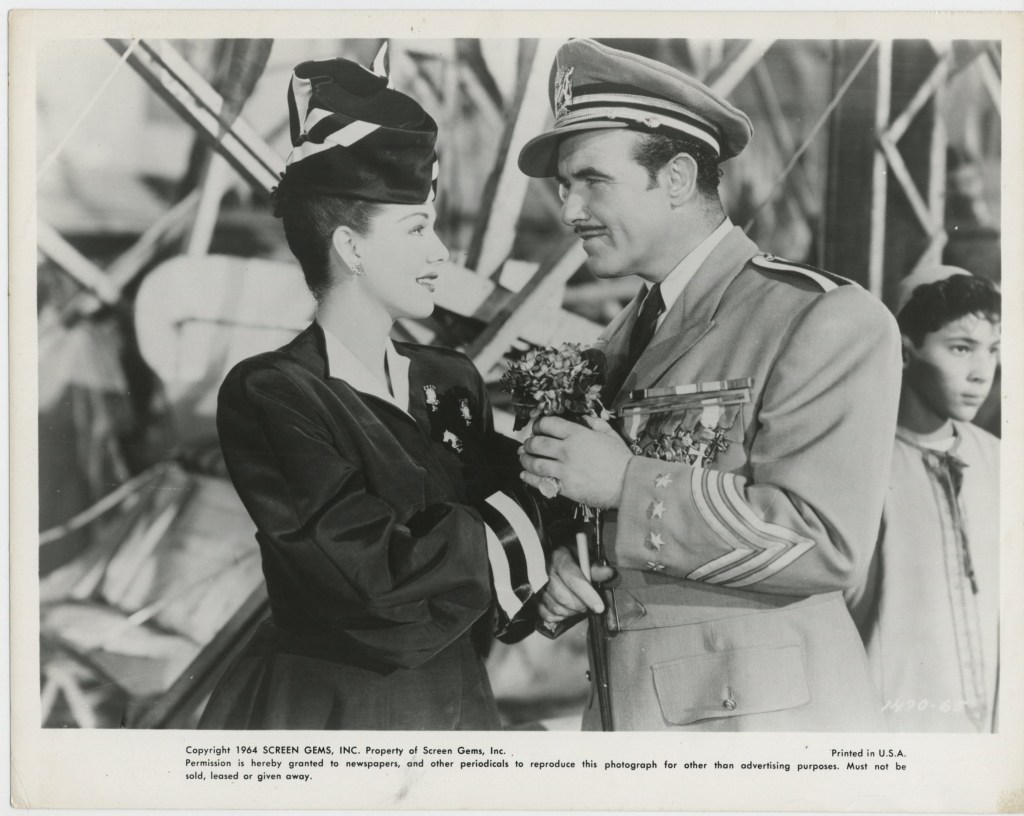
It also doesn’t hurt that the film’s overall production values are quite high, from the sets to the costumes to the classic film noir lighting that scratches a major itch for a certain breed of cinephile.

Like the best examples of the genre, the dramatic lighting filters through blinds, latticework, and prison bars, giving all the action a layer of texture that communicates awe and menace simultaneously.

The snappy dialogue is just the icing on the cake, with the cast effortlessly navigating through a steady stream of quips, comebacks, and double entendres that one would normally associate with an energetic stage play.

Unfortunately, some sound filmmaking around the edges can’t take away from the fact that Tangier doesn’t bring anything new or unique to the table to distinguish itself from other entries in the genre.

The Casablanca parallels really do drag everything down, with the filmmakers behind Tangier even having the gall to end their movie [SPOILERS] with the main characters escaping via an airfield. Where on Earth did they get that idea?
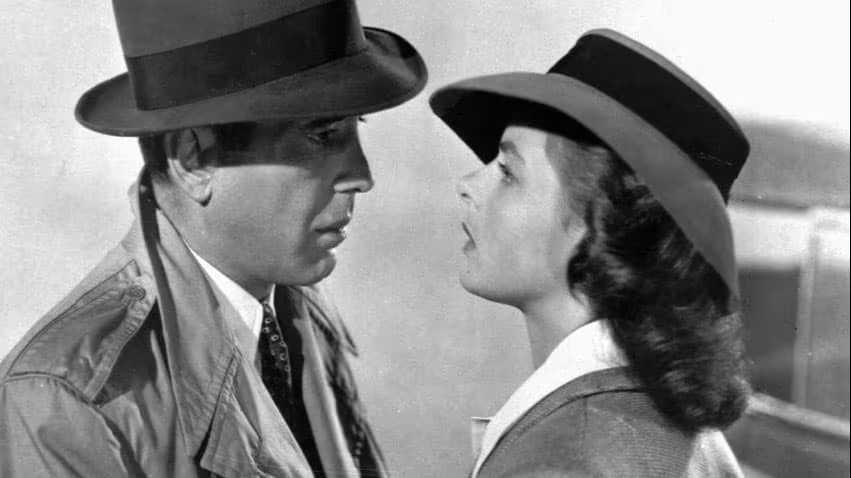
But beyond that, there’s a general sense that the filmmakers are running on autopilot, relying on the talented cast and crew to bail out what’s ultimately an unremarkable script.

Even the casting department didn’t think too deeply about who best to inhabit these characters. This film is inundated with far too many male actors with slicked back hair and pencil-thin mustaches, making it hard to tell who’s who for the first 20 minutes or so.

Still, if you have no knowledge of the films Tangier is cribbing notes from, it’s a fairly entertaining watch. Nothing life-changing of course, but it taps into an appealing vibe and aesthetic that is impossible to deny.
Plus, it’s difficult to be too harsh on a movie that takes inspiration from one of the most influential films of all time. Casablanca left a massive impact on the entertainment industry following its release, so much so that specific clips from that film are still being used as visual shorthand for what classic Hollywood romance is supposed to look like on screen.

So it’s only natural for that influence to worm its way into a bunch of other projects, whether the filmmakers are aware of that or not.  

In the case of Tangier, I’m pretty sure Waggner and his writers knew exactly what they were doing, since there are too many glaring similarities between the two films to ignore.

The end result is like watching a really talented cover band play through all your favourite hits; sure, you appreciate the craft and skill on display, but can’t escape that sinking feeling that a genuine creative spark is missing.

Verdict:

6/10

Corner store companion:

Compliments macaroni and cheese (because it’s a cheap alternative to the real thing, but it still gets the job done)

Fun facts:

Release date: June 6, 1946

-Tangier was one of the last films to be released under the “Universal Pictures” banner before the studio merged with International Pictures and was reorganized as “Universal-International” in July 1946.

-Following the release of Tangier, Maria Montez would only appear in nine other films before suffering a heart attack and drowning in her bathtub on Sept. 7, 1951. She was 39 years old.

-Leading man Robert Paige later became a TV newscaster in the 1960s, reporting out of Los Angeles for ABC News.

-After a multi-decade career in the film business, George Waggner transitioned to working in television in the 1960s, directing episodes of Batman, The Green Hornet, and The Man from U.N.C.L.E.

The Man With The Golden Arm (1955) review-inject this into my veins

This year’s Oscar season birthed no end of controversy, with unearthed racist Tweets, accusations of unethical AI use, and concerns about absent intimacy coordinators clogging up the news cycle. While it’s fun to partake in all this chaos, it’s also important to remember that the Academy Awards do hold some cultural value beyond fueling online discourse.

Not only are the winners immortalized in film history, but even the nominees enjoy an elevated degree of prestige that prevents them from getting completely swallowed up by the relentless march of time.

Otto Preminger’s The Man With The Golden Arm (1955) certainly benefited from being in the Oscar race, with its nods for Best Actor (Frank Sinatra), Best Music, and Best Art Direction ensuring that it remained in the cultural conversation long after it left theatres.

Luckily, this film noir is the kind of movie that actually deserves a longer shelf life. It isn’t some flash-in-the-pan distraction that somehow snuck its way on the Oscar telecast through sleazy backdoor politicking. Preminger’s production is genuinely groundbreaking, being one of the first major Hollywood films to seriously grapple with the issue of hard drug addiction.

But beyond this historical distinction, The Man With The Golden Arm is just a damn good movie in its own right, with stellar performances, dynamic camera work, and a bombastic jazz score that cuts to the bone.

The film follows Frankie Machine (Sinatra), a recovering drug addict who vows to go on the straight and narrow after he’s released from prison. But finding honest work as a musician isn’t so easy for Frankie, especially after ghosts from his past lure him back into the world of illegal card dealing. Frankie also finds himself caught between the affections of two women, his wife Zosh (Eleanor Parker) and old flame Molly (Kim Novak), who represent his possible damnation to or salvation from the cycle of crime and addiction.

Sinatra is obviously the main draw here, coming in hot after winning a Best Supporting Actor Oscar for his role in From Here to Eternity (1953). While the crooner didn’t walk away with another golden statuette for headlining The Man With The Golden Arm, his work here is no less extraordinary.

Given the subject matter, it would have been easy to present a completely deranged character who rapidly shifts between big emotions to sell their less-than-ideal circumstances. But Sinatra usually plays it somewhere in the middle. He’s very restrained in the early parts of the movie, trying desperately to put his past behind him and carve out a new life through measured hope and optimism.

It’s only when the walls start to close in that he begins to lose his cool, resorting to a much broader acting style that some might consider “hammy” by today’s standards.

But considering the fact that he didn’t have a lot of influences to draw from (with the depiction of hard drug use being largely taboo in Hollywood at the time), Sinatra still presents a nuanced portrait of someone suffering through substance abuse, no doubt setting an entertainment industry standard for decades to come.

The rest of the cast put in similarly impressive work.

Even though they inhabit familiar film noir archetypes (the petty crook, the femme fatale, the heartless drug pusher, the hard-boiled cop, etc.), each actor gives their characters enough depth to keep things interesting.

This is especially true for Kim Novak, who could have easily come across as an evil seductress for preying on a married man. Instead, her concern and affection for Sinatra appears genuine and endearing, making her the most sympathetic player in the film’s overarching love triangle.

Another surprisingly charming character is Sparrow (Arnold Stang), a small-time hustler who is always trying to reel Sinatra into his latest scam. But despite Sparrow’s unsavory modus operandi, Stang manages to play him with a degree of kindness and good humour, so much so that he almost becomes the film’s Jiminy Cricket.

And as cliché as this might sound, one of the movie’s most interesting characters doesn’t actually appear on screen.

This is because the camerawork, led by cinematographer Sam Leavitt, is always engaging, constantly moving and finding interesting ways to frame the characters, illustrating their inner thoughts without strictly relying on dialogue.

One of the best examples of this takes place midway through the film, when Sinatra and Novak stroll by a department store window displaying a shiny new kitchen set. By capturing the character’s snappy back-and-forth dialogue within this backdrop, Leavitt offers the audience an aspirational glimpse into a possible domesticated future where the characters no longer have to scratch and claw to carve out a meager living.

It also doesn’t hurt that the movie captures these kinds of moments in mostly long, unbroken takes, which gives the actors lots of room to breathe and make the most of the script.

Said script, penned by Walter Newman and Lewis Meltzer, remains engaging throughout the movie’s runtime, mixing in insightful character moments with the kind of tough-guy dialogue one would expect from a film noir.  

The film’s Oscar-nominated score, composed by Elmer Bernstein, adds to this rhythm, serving as a kind of internal monologue for Sinatra’s state of mind. When those chaotic brass and percussion instruments pick up in speed and intensity, the actor doesn’t have to utter a word about suffering from withdrawal. The music does a lot of the heavy lifting.

Conversely, this emotionally-resonate score also kicks in when Sinatra is sharing a tender moment with Novak or Parker, except this time the composer relies on gentle woodwinds and strings to sell the fact that he is keeping his demons at bay.  

So just like the camerawork, the film’s music almost becomes another colourful member of the cast, or at least some kind of omniscient narrator that adds texture to the story.

That being said, the incorporation of music into the plot itself is a little half-hearted. While Sinatra’s main goal throughout the narrative is to become a professional drummer, his actual talent with the instrument is mostly talked about and only briefly shown. Plus, the big studio audition that the movie’s been building up to is over far too quickly, which slightly blunts the impact of Frankie’s downward spiral.

And while the movie usually does a good job of balancing its goofier elements with hard-hitting drama, that formula can get thrown out of whack sometimes.

Outside of a couple hokey speeches about drug addiction, which wouldn’t be out of place in a 1990s after-school special, the ending leaves a little to be desired.

Without getting into spoilers, one character exits the movie in a very silly fashion right before the credits roll, which caps off the film on a slightly sour note.

But those are just small quibbles, to be sure, and they don’t take away from The Man With The Golden Arm being the real deal.

Anyone who enjoys the look and feel of movies from that era of Hollywood can find it in spades with this production, with plenty of talented people working in front of and behind the camera.

And while it didn’t walk away with any golden statuettes at the 1956 Oscars, the film did legitimately push boundaries by allowing different kinds of stories (in this case, hard drug addiction) to appear on the big screen.

Because of the film’s controversial subject matter, the Production Code Administration (enforcers of the conservative Hays Code) refused to give it a seal of approval, thereby limiting its distribution in North America.

But after the movie garnered a lot of buzz without this seal, the Motion Picture Association of America eventually pressured the PCA to revise its code and allow drug addiction to be allowed in the movies.

And honestly, busting up obtuse censorship guidelines might be a better legacy to leave behind over winning big at the Academy Awards, especially given the tired discourse that plays out every time a movie brings home an Oscar.   

Verdict:

9/10

Corner store companion:

Golden Oreos (because they’re delicious and a lot less addictive than heroin)

Fun facts:

Release date: December 15, 1955

Budget: $1 million

Box office: $4.3 million

The Man With The Golden Arm finally received its PCA production code in 1961, six years after the film’s initial release. The PCA and the Hays Code were discarded in 1968 and were replaced by the modern MPAA rating system that same year.

The Man With The Golden Arm was inducted into the United States’ National Film Registry in 2020 for being “culturally, historically or aesthetically significant.” It was added alongside classic films such as The Blues Brothers (1980), A Clockwork Orange (1971), The Dark Knight (2008), and Grease (1978).

-Actor Arnold Stang (who plays Sparrow) is probably best known for voicing the Hanna-Barbera cartoon character Top Cat for several decades.

The Man With The Golden Arm is currently in the public domain and can be watched in its entirety on YouTube. Please watch using the provided link below and don’t bother with the official YouTube upload (since it’s been colourized and looks awful).

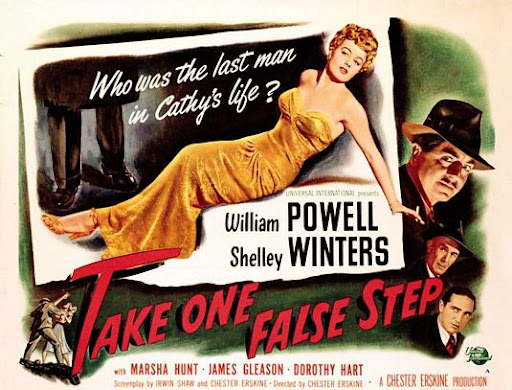
Take One False Step (1949) review-tripped over its own two feet

When it comes to escapist cinema, crime thrillers and film noir always hit that sweet spot for me.

While sci-fi and fantasy movies are often marketed as the ultimate break from earthly concerns, the settings and characters are sometimes a little too outlandish to be relatable.

Film noir, however, always keeps one foot rooted in the real world by focusing on the kinds of gritty crime stories that have been grabbing news headlines since Prohibition.

But at the same time, these movies also present a heightened reality full of broad archetypes, hard-nosed dialogue, and stylized visuals.

Another recurring trope is the protagonist (whether that be a private eye, journeyman boxer, or everyday schmuck) getting wrapped up in a vast criminal conspiracy beyond their comprehension, which serves as an ideal audience surrogate.

All these elements are at play in Chester Erskine’s Take One False Step (1949), one of three movies bundled into Kino Lorber’s Film Noir: The Dark Side of Cinema IX collection.

For the first half-hour or so, this project showcases some of the best that the “classic” era of film noir has to offer, with an intriguing mystery and appealing cast that draws you into the story.

Unfortunately, Erskine’s film kind of falls apart after taking a major plot digression in its second act, resulting in an experience that feels like the cinematic equivalent of a giant red herring.

In Take One False Step, William Powell stars as Andrew Gentling, a respected professor who is visiting the State of California to secure funding for a new university.

However, Gentling’s plans get waylaid by the sudden appearance of an old flame (Shelley Winters), who strong arms him into a night of flirtatious drinking before vanishing the following day.

Fearing he could become the prime suspect in this missing persons case, Gentling must scramble to find out what happened to his former lover and dodge a cadre of shady characters in the process.

Despite its title, and a goofy opening montage showcasing a bunch of random people tripping over themselves, Take One False Step actually kicks off on the right foot.

Powell does such a good job at playing the strait-laced academic that his descent into the criminal underworld, where he is forced to constantly lie and break the law to evade police, feels like a big deal.

This tonal shift is hammered home thanks to a nice selection of colourful characters, who give the film’s first act a lot of weight and texture.

Winters’ femme fatale is an obvious example of this, since her glamorous wardrobe and hot-blooded persona serve as the perfect foil for Powell’s dry everyman.

The two also make for an interesting pair considering their contrasting views towards post-WWII America.

While Winters is content with wallowing in the excitement and uncertainty of wartime, Powell remains committed to leaving his military service in the past and build towards a better future (hence the new university).

However, as the story moves forward, Powell is increasingly put in a position where he must abandon these high-minded ideals for his own self-preservation, which adds a nice psychological wrinkle on top of everything.

His descent into moral ambiguity is made even more compelling thanks to some strong supporting players besides Winters.

This includes Marsha Hunt as Winters’ level-headed best friend and James Gleason as the police detective on Powell’s heels, with the latter projecting an unassuming intelligence reminiscent of Peter Falk’s Columbo.

All this is all tied together with some snappy dialogue and slick visuals that one would expect from the genre, combined with an energetic score that helps move the action along at a nice pace.

Unfortunately, all this good set-up is thrown out the window 33 minutes into the movie when Powell gets bitten by a supposedly rabid dog.

Once that happens, the broader mystery regarding Winters’ disappearance is quickly abandoned in favour of this rabies sub plot, where Powell must avoid the authorities while fighting off any emerging symptoms of the disease.

This leads to a handful of scenes where the movie basically stops so that medical professionals can explain what rabies is and how it affects the human body.

It got to the point that I started to wonder if the film’s budget was subsidized by some advocacy group, with its funding being dependent on the script containing some amount of educational content concerning rabies.

This is extra puzzling given the fact that rabies was hardly considered a scourge in North America at that point, with around 40 cases reported each year in the early 1940s and decreasing to a total of 99 for the entire next decade.

While Erskine eventually circles back to the main mystery plot, the film has lost much of its momentum by that point and must settle for a bunch of rushed resolutions.

We don’t even find out about the true nature of the bad guy’s criminal dealings until the last five minutes of the movie, which comes across as a complete afterthought.

This weak revelation is also preceded by one of the stupidest cinematic deaths I’ve seen in a while, which takes place [SPOILERS] when Powell confronts the bad guy in a rail yard.

After a brief tussle with Powell, the villain is spooked by incoming police and quickly finds himself caught between two trains travelling in the opposite direction.

Even though there is clearly enough space and time to avoid these oncoming locomotives, the bad guy stutter-steps like an idiot and gets crushed.

Despite not being shot in a comedic style, I was instantly reminded of the steamroller scene from the first Austin Powers movie, where a henchman’s severe lack of self-preservation is played up for yuks.

The similarly ridiculous death in Take One False Step is extra confusing since the film is sprinkled with humorous moments throughout, which don’t always land or gel with the more serious story beats.

This points to a broader problem with the film, since it lacks a cohesive vision that can marry the good performances and moody visuals with a complimentary script. 

As a result, watching Take One False Step is a profoundly frustrating experience, since you can tell its merits are being weighed down by a few head-scratching decisions.

Turning this mystery story into a rabies PSA is obviously the filmmakers’ biggest blunder, and it might be one of the strangest narrative detours I’ve witnessed covering movies for this blog.

Admittedly, it is kind of funny that a film called Take One False Step so noticeably trips over itself in its second half, a fate that might have been willed into existence by running with such an unwieldy title in the first place.

Hopefully the remaining two films in this Kino Lorber collection can provide more of that crime thriller escapism I mentioned earlier, while containing at least 50% less canine fear mongering.

Verdict:

5/10

Corner store companion:

Nature’s Recipe Chewy Bites (because dog owners will pick up a lot of useful information watching this film)

Fun facts:

-Release date: Aug. 14, 1949

-Budget: $855,000

-Kino Lorber’s DVD case for Take One False Step claims that actor Tony Curtis makes an uncredited appearance in the film, with AFI listing his role as “hot rod driver.” However, Curtis is not included amongst other uncredited actors on the movie’s IMDB page and I personally didn’t spot him during my multiple viewings of the film.

-William Powell received three Best Actor Oscar nominations throughout his career for his work in The Thin Man (1934), My Man Godfrey (1936), and Life With Father (1947). Powell retired from acting following his supporting role in the Best Picture-nominated Mister Roberts (1955) due to health issues.

-I might have subconsciously selected Take One False Step (1949) for a screening based on its titular similarity to Carl Franklin’s One False Move (1992), another crime thriller that I covered back in 2018.

-Despite her extensive filmography throughout the 1930s and 40s, Marsha Hunt was largely blacklisted from Hollywood in the 1950s for speaking out against the House Committee on Un-American Activities and being branded as a Communist sympathizer. Hunt was mostly relegated to working on TV throughout this time, although she would return to film in the decades to come and received a star on the Hollywood Walk of Fame in 1960. She passed away in 2022 at the age of 104.

Take One False Step can currently be watched in its entirety on YouTube.

Lies and Alibis (2006) review- humble beginnings for Fargo creator

When it comes to the modern slate of TV showrunners, Noah Hawley can always be relied upon to deliver a pleasant surprise.

Not only did he spearhead a cult series based on an obscure X-Men character (Legion), but he also managed to successfully adapt the Coen Brothers’ beloved 1996 crime drama Fargo for the small screen (winning half a dozen Emmys in the process).

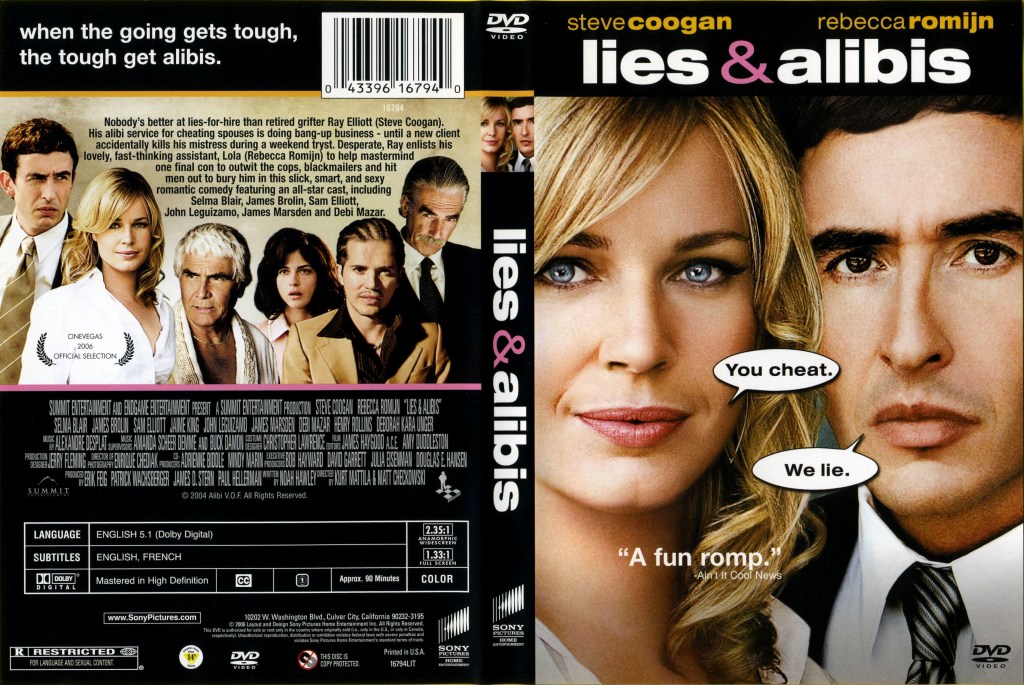
But Hawley’s ability to subvert my expectations can be traced back to the very beginning of his screenwriting career when he penned the script for Lies and Alibies, a 2006 crime thriller that was released straight to home video after a limited theatrical run.

Noah Hawley

Because of its low budget and lack of a wide release, this film has largely been forgotten by vast swaths of the movie-going public, so much so that Mill Creek Entertainment packaged it into their 2014 “Chick Flicks” DVD box set for some reason.

Despite this confusing marketing, I was shocked to discover that Hawley’s writing skills were still sharp in Lies and Alibis, which is particularly impressive given that this is his first produced screenplay.

While elements of this production are a little rough around the edges, it features the same kind of snappy dialogue and quirky criminal archetypes that Hawley would later refine to great success in shows like Fargo.

With that solid script at its core, Lies and Alibis is definitely worth watching for fans of Hawley’s current neo-noir tomfoolery, as long as you can stomach some glaring budgetary restrictions and a couple key casting missteps.  

The plot of Lies and Alibis follows smooth-talking entrepreneur Ray (Steve Coogan), who runs a “risk management” firm that helps men and women cheat on their partners without getting caught.

While Ray runs a pretty tight ship, that all gets upended one day when one of his clients accidently kills his mistress in bed.

The resulting cover-up drags Ray into a seedy underworld full of crooks and Mormon gangsters, with the cops also putting him under heavy scrutiny.

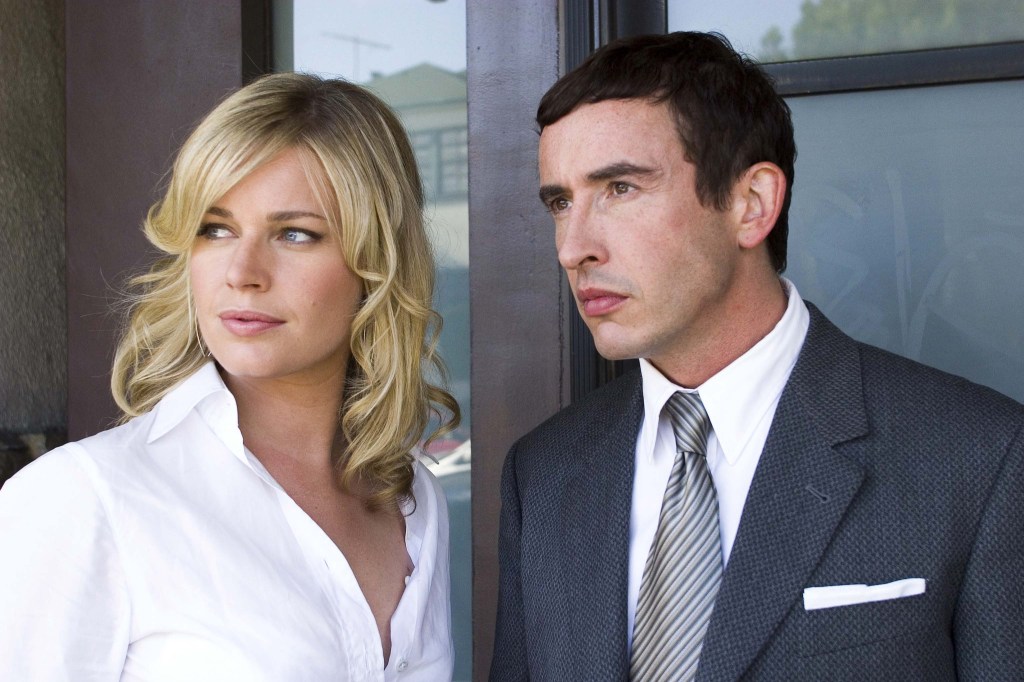
To get out of this predicament unscathed, Ray must rely on his wits and a rag-tag group of allies, including his new alluring assistant played by Rebecca Romijn.

Since I’ve already heaped praise on Hawley’s script, let me at least take a moment to balance the cosmic scales of movie criticism by highlighting this film’s worst elements, which are its two leads.

While Coogan has proven himself to be a more than capable actor in the realm of comedy and drama in other projects, he doesn’t do a good job of fusing those two elements here.

Even though this role calls for a kind of fast-talking slickster with a heart of gold (think Bob Odenkirk in the early seasons of Better Call Saul), Coogan can’t quite tap into that energy and just comes off as a little bland.

Romijn suffers a similar fate playing Coogan’s confidant and love interest, which is made even worse by the fact that these two have absolutely zero romantic chemistry together.

If I were to guess the source of this on-screen dysfunction, I would lay it at the feet of directors Kurt Mattila and Matt Checkowski. Lies and Alibis marks their first feature film project after working as visual effects artists, so perhaps guiding principal actors wasn’t their strength at this point.

Thankfully, the rest of the cast is filled with a treasure trove of veteran character actors who have a much better handle on the material.

Sam Elliot makes a big impression as the head of the Mormon mafia, whose leathery drawl and weather-beaten scowl make for an imposing antagonist.

While not as threatening as Elliot, James Brolin and James Marsden also work well as a father-son team of serial philanderers, whose vast wealth is only outweighed by their blatant sleaziness.

And even though certain film noir stock characters are extremely played out by this point, actors like John Leguizamo (the savvy roughneck), Debi Mazar (the hard-nosed detective), and Selma Blair (the femme fatale) are still used to good effect with the little time they have on screen.

Admittedly, it’s a little difficult to keep track of all these characters and their motivations as the plots barrels along, especially when they start turning on each in the third act.

But all this organized chaos is at least held together with some smooth editing, which rapidly flips between several locations without overwhelming the senses.

This level of craftsmanship is on full display during the last 20 minutes, when all the characters converge on one building (a hotel) for the big finale.

Anyone expecting an explosive climax that’s full of gunfire and blood squibs will be sorely disappointed, since it’s obvious that the filmmakers didn’t have enough money for the kind of theatricality that be found in movies like Joe Carnahan’s Smokin’ Aces (2006) or Tony Scott’s True Romance (1993).

However, directors Mattila and Checkowski at least put their past experience as visual effects artists to good use, staging some impressive floor-by-floor transitions that are reminiscent of their work on Steven Spielberg’s Minority Report.

Hawley’s script also shines in this finale, where he manages to take a bunch of tangled plot threads and resolve them all within the space of a couple minutes (without it feeling too contrived).

This marriage of tight editing and smart writing remains Lies and Alibis’ biggest strength, as it provides the same kind of crime thriller catharsis one can find in an Elmore Leonard or Raymond Chandler novel.

Given that Hawley has published a couple thriller novels of his own, I’m sure he was trying to channel some of that same literary style for his feature film debut.  

And with a svelte 90-minute runtime, the end product definitely succeeds in replicating the look and tone of those old dime-store detective novels that are light on substance but are never-the-less very entertaining.

Admittedly, the narrow confines of a feature film runtime also present a significant drawback for Hawley, since he isn’t given enough time to adequately flesh out the movie’s worldbuilding beyond the first act.

I could actually see the underlying premise of Lies and Alibis functioning much better as a TV series, where the inner workings of this fictional “cheating” agency are given some room to breathe throughout a 10-to-12-episode season.

Hawley obviously shared similar thoughts about the advantages of this format, which is why so much of his later career is defined by crafting long-form stories on television.

But everyone has to start somewhere and Hawley’s ambitions as a writer are still front and centre in Lies and Alibis, even if this early film project has largely faded into obscurity.   

Even so, if Hawley wants to drop some sly references to Ray’s “risk management” firm in the next season of Fargo, he would at least turn me into that meme of Leo DiCaprio pointing at his TV screen.  

Verdict:

7/10

Corner store companion:

Maynards Swedish Berries and Creme (because it’s well-constructed and a lot of fun to consume, even though it largely amounts to a short sugar rush)

Fun facts:

-Release date: Lies and Alibis was screened in various countries throughout 2006, including the CineVegas film festival on June 17. The film later premiered on DVD during the fall and winter that same year.

-This film was also released under the alternate title “The Alibi” and is referred to as such on both Wikipedia and IMDB.

-Noah Hawley is currently developing a new series for FX that’s set within Ridley Scott’s Alien universe. In a recent interview with Esquire, Hawley revealed that this series takes place on earth and will examine the corporate greed that fuels companies like the fictional Weyland-Yutani Corporation. This marks Hawley’s latest attempt to break into a well-established sci-fi franchise after his involvement in a new Star Trek film fizzled out.

Lonely Hearts (2006) review- A sleepy lead performance from Travolta drags down an otherwise solid film noir

As an industry, Hollywood is collectively guilty of many story-telling sins, like the tendency to over-romanticize important people, places, and things.

From botched biopics to anachronistic period pieces, the American film business has shown time and time again that it will go to great lengths to prune away the more unseemly elements of historical fact in favour of presenting a digestible narrative for general audiences.

Even violent criminals will sometimes get this treatment, since films like Bonnie and Clyde (1967) are still considered classics to this day despite being riddled with inaccuracies.

However, my general rule of thumb is that these white lies are forgivable as long the filmmaking behind them is solid, which is why Lonely Hearts (2006) works as a detective story despite the creative liberties its writer/director takes with the source material.

This movie’s plot follows the exploits of the “Lonely Hearts Killers,” a real-life pair of serial murderers who, from 1947 to 1949, lured as many as 20 women to their deaths through answering their personals ads.

While Jared Leto and Salma Hayek are saddled with portraying Raymond Fernandez and Martha Beck (the killers), John Travolta also stars as a hardboiled detective tasked with tracking the couple down. Of course, like any good film noir, this case is never as simple as it seems and Travolta’s ability to bring the killers to justice is always being complicated by his own personal demons.

Lonely Hearts actually serves as a great example of why I’m not so anal about historical accuracy in film, since one its strongest elements is a blatant fabrication on behalf of the filmmakers.

Hayek’s performance as the Martha Beck is completely unnerving, terrifying, and full of surprises, especially when you realize that she is the architect behind a lot of the killings.

In fact, she’s so good that I didn’t even care that the real-life Beck was an overweight, homely white woman, who would have never been able to slip into the skimpy cocktail dresses that Hayek fills out so nicely in this film.

MarthaBeck(1)Salma Hayek(2)

While Leto is a little more willing to look like Raymond Fernandez (receding hairline and all), he’s also able to mix devilish charm with crippling insecurity, which makes him the perfect bait to attract a parade of desperate, lonely women.

And even though the two are playing remorseless serial killers, Leto and Hayek still manage to develop some compelling chemistry similar to other famous outlaw couples in popular culture, like Sid Vicious and Nancy Spungen or (more fittingly) the Joker and Harley Quinn.

Margot-Robbie-as-Harley-Quinn-and-Jared-Leto-as-Joker-in-Suicide-Squad-margot-robbie-39790178-500-213

Now, are the filmmakers guilty of making us sympathize with a pair of degenerates who caused a lot of pain and suffering in real life? Maybe. But the movie’s unflinching look at the brutality these two inflicted on their victims also doesn’t let us forget that their relationship is rooted in fear and jealousy rather than love and trust.

However, the same level of praise can’t be drummed up for Travolta’s performance, since he largely sleepwalks his way through his lead role as a heartbroken detective without any real edge or enthusiasm.

He doesn’t bring anything new to this well-worn character archetype, and can’t even be bothered to delivery his lines properly a lot of the time.

In one scene, Travolta yells “Don’t ever mention my wife again. It’s none of your fucking business!” to a superior officer with all the squeaky bravado of a teenager going through puberty.

It also doesn’t help that his partner is played by James Gandolfini, who acts circles around Travolta in virtually every scene they’re in together.

This weak lead performance really takes the shine away from some of the film’s finer qualities, since director Todd Robinson actually put a lot of work into creating a immersive atmosphere by littering the movie with tasteful tributes to classic film noir.

Not only is the soundtrack suitably jazzy and retro, but the grizzled voice-over narration by Gandolfini does a great job of setting the scene for a post-WWII America that is riddled with crime.

As the film’s sole screenwriter, Robinson also sneaks in some nice character development for Travolta’s character, whose quest to find meaningful intimacy mirrors Fernandez and Beck’s homicidal love story.

It’s too bad that Travolta’s half-baked acting sticks out like a sore thumb, especially when everybody else in front of the camera (and behind it) is firing on all cylinders.

And while the filmmakers definitely play fast and loose with their “based on a true story” hook, Lonely Hearts still manages to retain the dysfunction and creepiness of its real-life subjects, which makes it a compelling watch for anyone who is a fan of serial killer dramas.

Just try not to get distracted by Travolta’s bad acting, or his tough-guy toupee.

Verdict:

7/10

Corner store companion:

Hersey’s Kisses (because if you’re a movie nerd like me, chances are these are the only kisses you’ll be getting on Valentine’s Day).

IMG_1760

Fun facts:

-Original release date:

April 30, 2006 (Tribeca Film Festival)

April 17, 2007 (limited release)

-Budget: $18 million (estimated)

-Box office gross: $2,517,423 (worldwide)

-Director Todd Robinson is the grandson of Elmer Robinson, the real-life detective (played by Travolta in this film) who investigated the Lonely Hearts murders in the late 1940s.

-Despite not being the same race as their real-life counterparts, both Leto and Hayek underwent slight cosmetic alterations to get into their roles. While Leto had to shave the front of his head to match Raymond Fernandez’s hairline, Hayek wore contact lenses to replicate Martha Beck’s blue eyes.

-The story of the “Lonely Hearts Killers” has been portrayed on film a total of four times. Besides Lonely Hearts, the story has been re-told in Mexican with Deep Crimson (1996), in French with Alleluia (2014) and in black and white with the American cult classic The Honeymoon Killers (1970).