Shooter (2007) review-just off the mark

Lately, I’ve been getting this sinking feeling that certain genres of film are becoming completely irrelevant to modern audiences. This endangered species list includes any thriller or drama that touches on contemporary U.S. politics, given how chaotic, fractured, and patently absurd the real-life machinations of the current administration are. After all, how can a Hollywood screenwriter compete with the sheer ludicrousness of SignalGate or top the cartoonish villainy exhibited by a shifty interloper like Elon Musk?
In this context, Antoine Fuqua’s Shooter (2007) seems pretty tame by comparison. This is because the film’s U.S. government baddies are at least marginally intelligent and vaguely discreet when it comes to enacting their evil plans, not at all like their modern, real-world counterparts.

But regardless of the differences between Bush and Trump era politics, these conspiracy-themed thrillers can be a lot of fun, as long as they have a decent script, smooth pacing, and some tight direction.

Shooter definitely excels in a few of these areas, providing the perfect kind of disposable action movie fluff to watch on a lazy Sunday afternoon alongside your dad.

Unfortunately, the film is also weighed down by a weak lead performance and far too many genre cliches, making it hard to distinguish from the dozens of other “one man army” stories clogging up your local DVD bargain bin or drugstore book rack.

The eponymous “Shooter” in this film is Mark Wahlberg, who steps into the boots of elite Marine sniper Bob Lee Swagger. Despite being retired from the U.S. military for several years, Swagger is pulled back into service by Colonel Isaac Johnson (Danny Glover), who needs his help to thwart a presidential assassination attempt. However, the job quickly reveals itself to be a set-up, with Swagger being blamed for killing the Archbishop of Ethiopian (who was standing next to the American president during the shooting). Now on the run, Swagger must clear his name and get to the bottom of a vast conspiracy that reaches all the way to the U.S. Senate.

Like I mentioned at the top, the film’s major weak link is Wahlberg, who does very little to elevate this material above your standard action schlock.

Sure, Marky Mark pulls off the right rugged look and is convincing when he’s holding a gun. But there’s very little in his performance that helps engage the audience on an emotional level.

One moment that stuck out to me was when Swagger’s love interest (Kate Mara) tells him that the bad guys killed his dog. Rather than reacting with piercing sadness or explosive anger over the murder of his best friend, Wahlberg responds with mild annoyance, like someone just told him that he needs to replace his Brita filter.

Unfortunately, Wahlberg remains stuck in this subdued acting mode for most of the film’s runtime, offering only brief glimpses beneath his stoic persona.

I’m not suggesting he needed to break down crying every five minutes to be more relatable or whatever, but some psychological insight would have been welcome.

Maybe this could have been accomplished through casting an older actor, someone capable of bringing a genuine world-weary quality to the role.

According to IMDB, men like Clint Eastwood, Tommy Lee Jones, and Harrison Ford were all considered for the part, which sounds like a much better fit for the vibe the movie was trying to convey.

But to be fair to Wahlberg, the film’s script doesn’t do him any favours.

Despite being established as a conspiratorial shut-in (who lives in the mountains and reads the 9/11 Commission Report for fun), Swagger is surprisingly willing to trust this shadowy government figure (Glover) and fall for the most obvious frame up job of all time.

So when he’s betrayed and literally shot in the back, I was left wondering why Swagger didn’t have any contingency plans in place, since being a rigid individualist who doesn’t trust the government is one of his only defining character traits.

Plot nitpicking aside, Shooter at least delivers the goods once Wahlberg goes on the run.

While nothing approaches the tension director Andrew Davis created for The Fugitive (1993), Fuqua and his team make up for that by staging some impressive kinetic action.

This means juicy blood squibs, bright muzzle flashes, and big practical explosions, all tied together with crisp editing that makes the moment-to-moment carnage easy to follow.

The best example of this technical expertise is on display in the third act, when Wahlberg teams up with a sympathetic FBI agent (Michael Peña) to storm a rural compound full of cannon fodder enemies.

This flashy spectacle is also helped by the cast of great character actors assembled to play the bad guys.

Outside of Glover, this rogue’s gallery includes the likes of Ned Beatty as a corrupt U.S. senator and Elias Koteas as a psychopathic henchman on Wahlberg’s trail.

While these three are suitably over-the-top, and serve as the perfect rivals for Wahlberg’s salt-of-the-earth veteran, the movie does at least carve out some depth for Rade Šerbedžija.

The well-known Croatian actor makes the most of his tiny role as a wheelchair-bound sniper who is working under the thumb of Glover’s corrupt army colonel.

Even though most of his lines are relegated to a single exposition dump, Šerbedžija conveys a lot of potent regret and melancholy through his delivery alone, making me wish the movie was about him instead.  

Unfortunately, familiar action movie tropes eventually pile up and dilute whatever unique sense of identity Shooter had going for it.  Some of these trappings I’m willing to forgive, like all the bad guys not being able to hit the broad side of a barn in a firefight. But other cliches are pretty egregious and took me out of the movie. These moments include:

  • Wahlberg’s soldier buddy pulling out a photo of his wife moments before getting ravaged by bullets
  • Mara delicately dressing the wounds of a naked Wahlberg despite barely knowing him
  • One of the bad guys delivering the “we’re not so different, you and I” speech to Wahlberg as he’s being held at gunpoint
  • Wahlberg being way too cool to look back at the explosion he just set off

Many of these moments were old hat in the 1990s, so the fact that they were smuggled into a 2007 film (without anyone in production batting an eye) is very concerning.

And while Shooter is fairly generic overall, I will at least give the filmmakers credit for grounding it in the specific real-world politics of the time.

Instead of taking the coward’s way out and giving the bad guys vague motivations (as to not offend anyone), the screenwriters zero in on U.S. foreign policy being a pervasive antagonistic force.

Not only is the Abu Ghraib torture scandal mentioned by name, but most of the plot revolves around [SPOILERS] the American military covering up an African village massacre to further Big Oil business interests.

After watching my fair share of military propaganda for this blog, it was refreshing to see U.S. imperialism portrayed in a critical light, even if it is packaged in a movie where the hero solves all his problems with brute force.

In that sense, Shooter may resonate with more people in 2025 than it did in 2007, given that the current American government is explicitly threatening to annex places like Greenland, Panama, and even my home country of Canada

I’m not suggesting that a dumb action movie like Shooter will wake people up to this growing American hegemony or shake them from the kind of political apathy that allows evil to flourish.

But if someone receives a shock to the system by noticing how these goofy movie villains are being eclipsed by the sinister actions of real-world politicians, then maybe this film is a worthwhile watch after all.

Plus, did you see that scene where Wahlberg sniped three guys while standing up in a boat? That was sick!

Verdict:

6/10

Corner store companion:

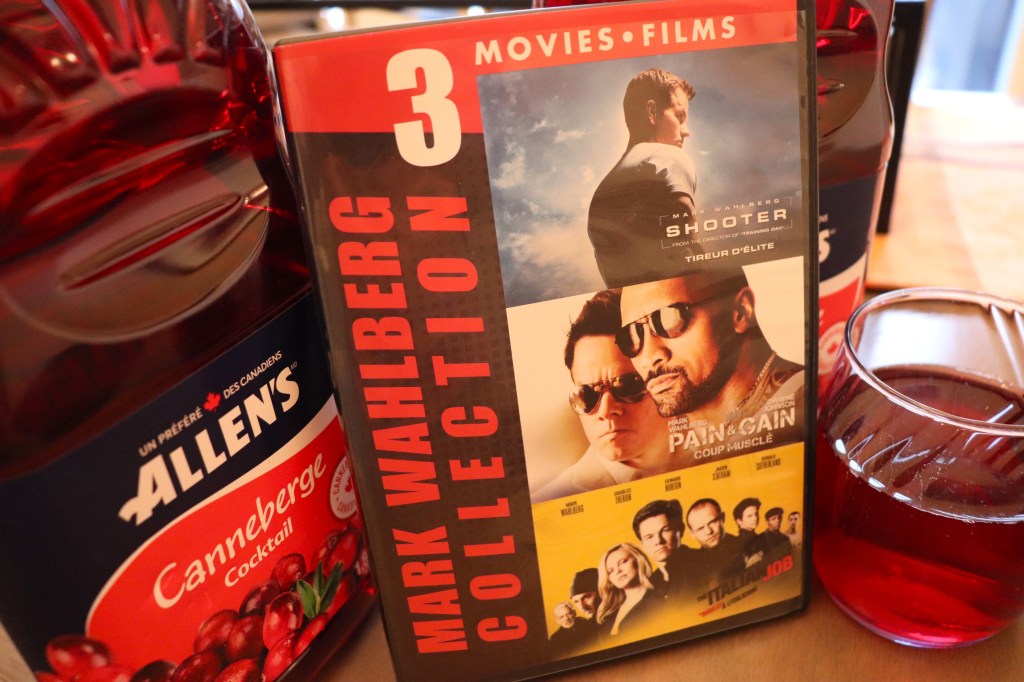
Allen’s Cranberry Juice (because when it comes to resisting U.S. imperialism, buying a Canadian food product is on the same level as watching a vaguely anti-American film from 18 years ago)

Fun facts:

Release date: March 23, 2007

Budget: $61 million

Box office: $95.7 million

-The character Bob Lee Swagger was originally created by author/film critic Stephen Hunter and first appeared in the 1993 novel Point of Impact. Hunter has written 12 books in the Bob Lee Swagger series, with the last story (Targeted) being published in 2022.

-The gun expert Wahlberg meets in the middle of the film is played by musician Levon Helm, who served as a drummer for The Band and was a 1994 inductee into the Rock and Roll Hall of Fame. Outside of his lengthy music career, Helm also appeared in films such as Coal Miner’s Daughter (1980) and The Right Stuff (1983).

-This film was later spun off into a TV series that ran for three seasons (2016-2018) on the USA Network. Ryan Phillippe took over the lead role from Wahlberg and the plot of the TV show revolved around the first three novels in the Bob Lee Swagger book series.

-Musical highlight: “Nasty Letter” by Otis Taylor (plays during the end credits)

In The Navy (1941) review-pratfall propaganda

Much has been written about the manufacturing might of the United States during times of conflict.

This is especially true during the Second World War, which sparked an industrial boom that single-handedly lifted America out of the Great Depression.

But outside of producing tanks, planes, and battleships, the U.S. was also keen on pumping out a flood of pop culture properties that kept the public sympathetic to the war effort.

This was mostly accomplished through the U.S. Office of War Information, which reviewed over 1,600 scripts throughout 1942-1945, excising anything that cast the country in a bad light.

But even before America officially entered the conflict (in December 1941), military officials were already deeply involved in various Hollywood productions, including the escapist comedies of Bud Abbott and Lou Costello.

In fact, the duo got their first big break in the movies through the military-themed Buck Privates (1941), which became so financially successful that it spawned two follow-up “service comedies” that same year.

The second part of this spiritual trilogy, In the Navy, was shot and released four months after the original, and that quick turnaround definitely shows.

While Buck Privates was charming because of its loose plot and slapstick gags, this nautical follow-up feels pretty lazy by comparison, content with coasting off Abbott and Costello’s newfound fame on the big screen.

The filmmakers’ military overseers also had a noticeably heavier hand in production this time around, to the point that the movie’s finale gets completely torpedoed thanks to third-party meddling.

As a result, it’s hard to see In the Navy as anything other than a blatant piece of military recruitment propaganda, despite it being able to squeeze in a couple decent laughs here and there.

After being relegated to a supporting role in Buck Privates, Abbott and Costello get promoted to main-character status for In the Navy, serving as a pair of hapless sailors who are eager to prove themselves on the high seas.

The duo eventually cross paths with a famous crooner (Dick Powell), who enlists in the navy under a fake name to escape the showbiz limelight.

Abbott and Costello agree to help the singer conceal his identity, which is a lot easier said than done now that an ambitious photojournalist (Claire Dodd) is on the hunt for an exclusive.

Many of the observations I made during my original review of Buck Privates hold true in this pseudo sequel, although the formula has hit some diminishing returns.

As expected, Abbott and Costello’s comedic chemistry is beyond reproach, with rapid-fire zingers and swift physical gags being delivered with pinpoint precision.

The pair work wonders even when things don’t go according to plan. An obvious outtake involving Abbott and Costello spitting water at each other is just left in the final cut of the film and remains one of biggest laughs In the Navy has to offer.

However, several of these routines drag on for far too long and bring the movie’s pace to a screeching halt.

One memorable scene involving a chaotic shell game eats up around five minutes of screen time, ending on a punchline that fails to justify such a lengthy, plotless detour.  

Another skit involving Costello’s unique math skills is similarly disconnected from the overarching narrative and is most likely included to pad the film’s runtime.

A lot of these bits are obviously holdovers from the duo’s stint on the vaudeville stage, given how they would continue to recycle this same material in future projects.

While these career callbacks had some novelty in Buck Privates, they’ve grown stale by this point, especially since these digressions are so disconnected from the ongoing plot concerning Powell’s crooner.

This is a shame, since Powell’s attempts to conceal his identity from Dodd’s photojournalist are quite charming. The pair establish a contentious yet flirty back-and-forth early on, which would have given the film another layer of appeal if it was given time to breathe.

But because of director Arthur Lubin’s focus on unrelated schtick (and another factor we’ll get into later), the film fails to synthesize its various plot threads into a cohesive whole, serving as a showcase for its headlining stars more than anything.

That being said, In the Navy does improve over Buck Privates in one area, and that is how the Andrews Sisters are used.

While the singing trio were a glorified Greek chorus last time, here they function as actual characters in the plot, with Costello looking to woo one of the sisters throughout.

Additionally, the sisters offer a wider variety of musical performances this time around, ranging from a military march to a jazzy club number to a luau-themed ditty.

Unfortunately, whatever goodwill In the Navy built up during its runtime is completely washed away in its third act.

Until this point, the movie’s propagandistic aims were visible but nothing I haven’t seen in other films produced during this era.

Just like with Buck Privates or Caught in the Draft (starring Bob Hope), the military is clearly involved in the movie’s production, providing access to vehicles, equipment, and other window dressing to present an appealing vision of service life.

However, the military’s involvement is taken one step further for In the Navy, since they basically vetoed the film’s climax.

U.S. naval officers reportedly took issue with the film’s ending sequence, where Costello [SPOILERS] unwittingly commandeers a battleship and wreaks havoc in a Hawaiian harbour.  

Not being able to edit this scene out of the movie, the studio opted to assuage the navy’s concerns via costly reshoots, which turned the real-life vehicular mayhem into a dream Costello experiences after ingesting a sedative.  

As if the “it was all a dream” ending wasn’t bad enough, the filmmakers also kneecap the ongoing romance storyline by kowtowing to this pressure from the military.

Since Powell and Dodd can’t be included in this dream sequence climax, their development as a couple is squeezed into the dying minutes of the film, having apparently resolved all their personal hangups off screen.

Some may bristle at me putting so much thought into the plot mechanics of a silly slapstick comedy, but sacrificing your big finale due to outside interests really is beyond the pale.

When this kind of meddling is so obvious, even to the naked eye, it really mutes the film’s other admirable qualities, regardless of how appealing Abbott and Costello’s brand of humour remains in the modern day.

And by the time the credits roll, all you’re left with is the feeling that you’re being fed a meal that is severely undercooked, despite there being way too many cooks in the kitchen.

But don’t let these cliched food metaphors mislead you into thinking that I’m above enjoying some World War II movies phantom-produced by Uncle Sam.

In the past, I’ve given a tepid recommendation to glorified recruitment ads starring American golden boy John Wayne (Back to Bataan, Operation Pacific), because the people behind those projects at least 1) knew how to somewhat disguise their propagandistic aims and 2) deliver on what was being advertised.

With In the Navy, the filmmakers largely failed on both of those fronts, with the movie’s only real saving grace being its eclectic soundtrack.

However, the American public obviously didn’t see it that way in 1941, since this film netted Universal Pictures a tidy profit and continued to push Abbott and Costello as a major box office draw.

The pair then used their newfound fame to help the military more directly once the U.S. officially entered the war, conducting a 78-city tour in 1942 that sold $85 million in war bonds.

Perhaps this cross-country campaign was a better venue for the two parties to collaborate, especially if their other service comedies turned out to be as slap-dash and half-baked as In the Navy.

Verdict:

4/10

Corner store companion:

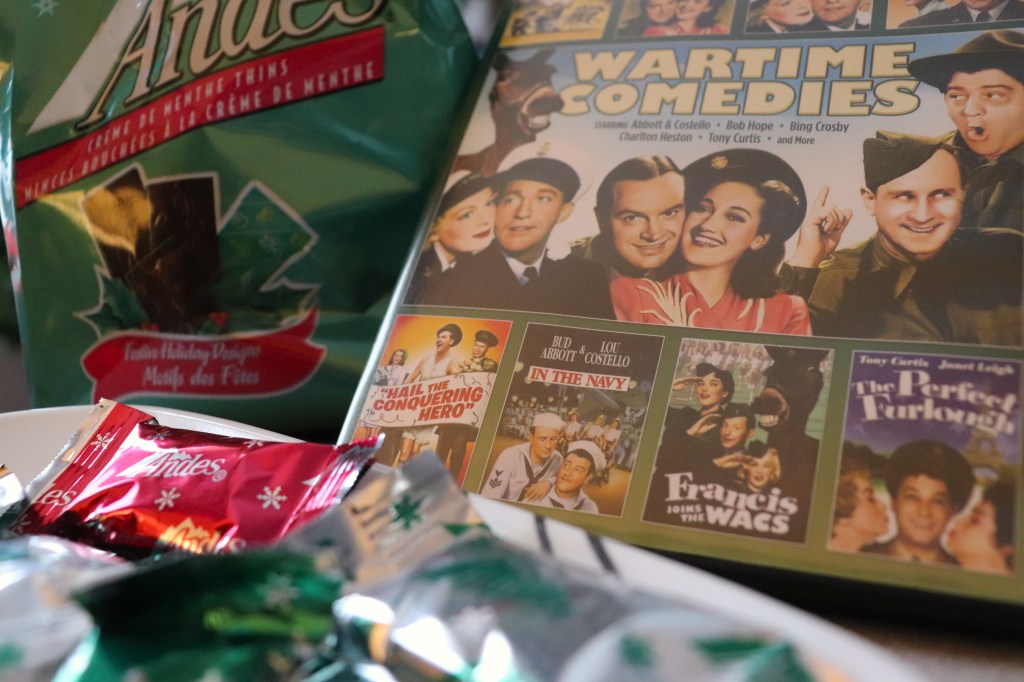
Andes thin chocolate mints (because it’s Christmas, dammit, and I need something sweet!)

Fun facts:

-Release date: May 31, 1941

-Budget: $379,207 (estimated)

-Box office: $2 million (estimated)

-The final entry in Abbott and Costello’s 1941 service comedy trilogy, Keep ‘Em Flying, was released on Nov. 28. This film features the comedy duo enlisting in the U.S. Army Air Corps.

-Outside this 1941 service comedy trilogy (Buck Privates, In the Navy, Keep ‘Em Flying), Arthur Lupin directed Abbott and Costello in Hold that Ghost (1941) and Ride ‘Em Cowboy (1942). Lupin is also responsible for helming five films in the Francis franchise, which features a talking mule enlisting in various branches of the military. 

-Musical highlight: “Gimme Some Skin, My Friend,” by the Andrews Sister

(despite the blatant cultural appropriation on display, originally being recorded by The Delta Rhythm Boys, this is the movie’s catchiest number by far)

The Perfect Man (2005) review-rotten to the core

Sometimes, a movie fails because of poor execution, where a good idea on paper isn’t successfully translated to the screen.

Mark Rosman’s The Perfect Man has an entirely different problem, since its foundational premise is completely faulty and causes the rest of the film to collapse in on itself.

This romantic comedy stars 2000s teen idol Hillary Duff as Holly, a young girl who is tired of having to move across the country every time her mom (Heather Locklear) breaks up with her current boyfriend.

When the family relocates to New York City, Holly vows to find her mom [insert movie title here], even if she has to conjure such a person out of thin air.

So, under the tutelage of a local restaurant owner (Chris Noth), this plucky teenage begins writing her own mother love letters in the hopes of keeping her happy and staying in one location for a longer period of time.

I’m sure you’ve already picked out the massive flaws in this premise, but I’ll spell it out anyway.

For one thing, the movie tries to position Locklear as a relatable single mom who is simply unlucky in love and just doing her best to raise her girls (Duff also has a younger sister played by Aria Wallace).

However, WHAT KIND OF MOM FORCES HER FAMILY TO MOVE EVERY TIME A NEW RELATIONSHIP DOESN’T WORK OUT?!

It would have been way more understandable if Locklear’s character lost her job, giving her at least a financial incentive to uproot her daughters and force them to severe their current friendships.

But no. She just has a terrible taste in men and her children must suffer the consequences, apparently.

And it’s not like this has happened only one or two times either. The film establishes early on that Duff’s character regularly updates a travel blog that details her every move across the country, which means that this process must repeat every couple months.

And keep in mind, all these problems are established in the first five minutes of the film, which doesn’t set a great precedent for the remaining runtime.

Pill

The next line of bullshit this movie expects us to swallow is Duff’s hairbrained scheme to stay in New York permanently, since it involves setting her mom up with a suitor who doesn’t exist.

At no point in the story does Duff’s character divulge how she is going to bring her plan to its natural conclusion, which would have to involve producing some sort of flesh-and-blood man (or at least a robot duplicate).

Instead, she just writes more and more love letters to her mom and eventually moves into email and instant messaging, since that was still a relatively new flavour of courtship in 2005.

This dumb plan isn’t even called into question by the various people who help Holly carry out this scheme, including her nerdy love interest (Adam Forrest) and street-mart best friend (Vanessa Lengies from Popular Mechanics for Kids).

I understand that the movie would have no conflict if Duff’s character concocted an air-tight plan to begin with, but the fact that the movie’s screenwriters never bothered to spell out any sort of endgame is pretty insulting to the audience.

Plus, the mechanics of Duff’s plan to court her mother via an imaginary proxy comes across as extremely creepy, especially when she starts sending Locklear messages online.

If this wasn’t a PG-rated movie aimed at teens, then Duff’s character definitely would have been forced to exchange increasingly lurid emails with her mom.

Now, I don’t usually get hung up on a stupid plot point here and there when watching a romantic comedy (or any genre of film, really). But the people behind The Perfect Man make it impossible for me to suspend my disbelief, since any remotely enjoyable element in this movie is tangled up in a web of dumb plot.

For example, Chris Noth is his usual suave self in his role as Duff’s unwitting Cyrano de Bergerac, and he really makes you believe that he holds all the secrets to wooing any woman.

Noth2

In fact, one of the film’s best scenes involves Duff hilariously unloading a bunch of her teenage angst into Noth’s lap, since he is the first male authority figure she’s been able to confide in for a long time.

But, of course, this cute moment is undercut by the Three Stooges-esque hijinks that immediately follow, where Duff has to prevent Noth and Locklear from bumping into each other in a public place (she previously used his likeness to accompany one of her letters).

Even the legit chemistry between Duff and Forrest can’t escape the plot’s gravitational pull.

Despite establishing a charming back-and-forth early on, it’s only a matter of time before Duff’s love interest gets involved in her idiotic ruse by imitating Locklear’s secret admirer over the phone.

And it’s not like the film has some tight direction or great cinematography to fall back on either.

In fact, most of the shots in this movie come across as extremely flat and uninteresting, like something you would find in a Hallmark or Lifetime Channel movie (albeit with more recognizable actors filling up the screen).

A lot of the character writing isn’t above that low standard either, with side players like Carson Kressley’s flaming gay waiter coming across as particularly annoying.

And the less said about Lengies’ terrible Brooklyn accent the better.

Ultimately, I get the distinct impression that The Perfect Man was put into production solely to capitalize on Duff’s rising star in the early to mid-2000s, without giving too much thought as to how each moving piece would work as a whole.

And while I haven’t seen any of Duff’s other movies or TV shows from that period, I can’t imagine those pieces of media being bad at such a bedrock level.

Judging by the trailer to The Lizzie McGuire Movie, at least the premise of that film doesn’t revolve around the teen idol seducing a family member over the internet.

Verdict:

3/10

Corner store companion:

Chips Ahoy! Sour Patch Kids cookies (because it’s a complete failure at a conceptual level)

IMG_0126(online)

Fun facts:

-Release date: June 17, 2005

-Budget: $10 million (estimated)

-Box office gross: $ 16,535,005 (US) $ 19,770475 (worldwide)

-The story behind The Perfect Man was partially inspired by the life of screenwriter Heather Robison, who sold her first script to Universal Studios in 2004.

-Duff received a Golden Raspberry nomination for her performance in this film and Cheaper by the Dozen 2. She inevitably “lost” to Jenny McCarthy for her role in Dirty Love.

-Mark Rosman directed Duff in 11 episodes of the Lizzie McGuire TV show before helming The Perfect Man.

-Unexpected cameo: Dennis DeYoung, the former lead singer of Styx, makes a brief appearance as the lead singer of a Styx cover band.

-The filmmakers behind The Perfect Man shot an alternate ending where Holly and Adam (her nerdy love interest) meet up at a comic book convention instead of heading to a school dance.

https://www.youtube.com/watch?v=2P1qvH8qYJA

-Musical highlight: “Collide” by Howie Day (plays during the movie’s obligatory sad montage at the end of act two)

Stop! Or My Mom Will Shoot (1992) review-just as bad as you remember

I honestly find no joy in dogpiling on a universally reviled piece of 90s media, mostly because there’s nothing really left for me to add after all this time.

Case in point: Stop! Or My Mom Will Shoot (1992) has been an industry laughing-stock ever since it was released and remains a stain on Sylvester Stallone’s illustrious career.

Not only did the film “win” three big Golden Raspberry awards, but critics across the board absolutely torn it apart, with Roger Ebert famously calling this action-comedy “one of the worst movies I’ve ever seen” twice in a single review.

Even Stallone holds nothing but contempt for this project. In 2006 interview with Ain’t It Cool News the actor pegged it as “maybe one of the worst films in the entire solar system” and that “a flatworm could write a better script.”

The movie-going public also remained largely ambivalent to this star-studded vehicle, since the film only regained 63% of its $45 million budget at the domestic box office (although it did go on to gross around $70 million thanks to international audiences).

But my guiding philosophy is that every famously bad movie is worth a revisit just in case I end up finding something worth recommending (check out my write-up of You Light Up My Life for proof of that).

However, in this instance I’m going to have to fall in line with the critical consensus, because Stop! Or My Mom Will Shoot fucking sucks!

Sly1

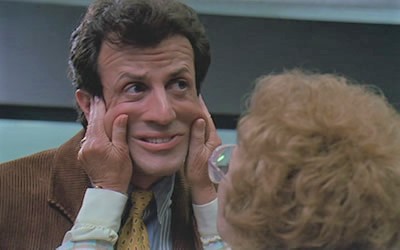
The film’s plot follows Stallone’s tough-as-nails LAPD police sergeant Joseph Bomowski, whose world is turned upside down when he gets a visit from his overbearing, elderly mother Tutti (played by Estelle Getty from The Golden Girls).

When Tutti witnesses a murder on the streets of Los Angeles, Joe is forced to keep her around for a longer period of time and tolerate her excessive mothering as he tries to catch some illegal gun dealers.

Of course, the two eventually team up to nab the bad guys and to make sure the screenwriters have an excuse to shoehorn the movie’s title into a cringe-inducing line of dialogue.

Like Stallone pointed out in that 2006 interview, the film’s biggest offense is its script.

Even though the two leads have decent chemistry, the “overbearing mother-exasperated son” dynamic gets old quickly and doesn’t develop past something you would see in a two-minute SNL sketch.

You never get a real sense of where this familial dysfunction came from or why Joe has allowed it to continue well into his adult life. There’s some passing mention of Joe’s father dying when he was a kid, leaving Tutti all alone to raise him, but it’s not explored in any significant detail.

Beyond that, around 95% of the jokes land with a dull thud, since the screenwriters only find two things funny: Stallone getting embarrassed and Getty using harsh language occasionally.

For some reason, they also thought it was a good idea for this Golden Girl to quote lines from Dirty Harry and The Terminator, which is the comedy equivalent of your own mom tagging you in an outdated meme on Facebook.

Additionally, the screenwriters have a tough time keeping Getty’s character consistent in terms of her intelligence.

Despite the fact that Tutti showcases pretty impeccable crime detection ability, she still can’t grasp pretty basic stuff like how it’s not a good idea to wash your son’s service weapon in the sink.

Tutti

All these script writing problems culminate in the film’s finale, where (SPOILERS) the filmmakers expect us to take Tutti’s side and castigate Joe for being too uptight.

Even though the ending is meant to be heartwarming, I couldn’t help but think that none of their underlying problems were resolved and that Joe is going to turn into Norman Bates somewhere down the line.

If it seems like I’m spending way too much time analyzing this movie’s shallow script, it’s because Stop! Or My Mom Will Shoot doesn’t bring anything else interesting to the table.

Not only is Roger Spottiswoode’s direction flat, but all of the side characters are boring carboard cutouts and the music seems like it was composed by a computer program set on “default.”

Admittedly, some of the stunts and practical effects are well done. There’s a particularly impressive scene during the film’s climax where Stallone drives a big-rig truck into an airplane propeller.

But those moments are few and far between and don’t make up for the rest of the movie being a total misfire.

Stop! Or My Mom Will Shoot also isn’t hilariously bad enough to be put in the same category as other famous 90s disasters like Cool As Ice (1991) or Batman and Robin (1997).

Say what you will about those latter two films, but at least the people behind them had a vision and managed to produce something that was entertaining in terms of how misguided it was.

This Stallone vehicle is pretty lifeless by comparison, since the filmmakers never take any risks and just rely on recycling a bunch of tired buddy-cop clichés instead.

So does Stop! Or My Mom Will Shoot earn its status as one of the worst high-profile movies of that decade? Maybe.

But will I ever watch it again to gleefully gawk at the sheer level of incompetence that managed to make it on screen? Definitely not.

Verdict:

3/10

Corner store companion:

Glad garbage bags (because this movie is trash)

IMG_6553

Fun facts:

-Release date: Feb. 21, 1992

-Budget: $45,000,000

-Box office gross: $28,411,210 (US), $70, 611, 210 (worldwide)

Stop! Or My Mom Will Shoot officially “won” three Razzie Awards in 1993 for Worst Actor (Stallone), Worst Supporting Actor (Getty) and Worst Screenplay (Blake Snyder, William Osborne, William Davies).

-The 20th episode of The Simpsons’ 18 season is titled “Stop! Or My Dog Will Shoot” in reference to this film.

-Unexpected cameo: Ving Rhames plays one of the thugs that Stallone takes out in the opening scene of the movie.

-Director Roger Spottiswoode would recover from this giant flop by directing some much better action films in the future, including the 18th entry in the James Bond franchise Tomorrow Never Dies (1997).

-Arnold Schwarzenegger famously tricked Stallone into starring in this film, feigning interest in the project in order to get his big screen rival to audition. Schwarzenegger confirmed this story during a recent interview with Jimmy Kimmel in October of this year.

The Terror (1963) review-the only thing scary about this movie is how cheap it is

Before we get started let me make one thing very clear: I did not walk into Roger Corman’s The Terror (1963) expecting to see opulent production values.

I was fully aware of Corman’s status as an iconic B-movie director/producer ahead of time and adjusted my expectations accordingly.

But even if I grade this gothic horror film on a curve it’s is still dreadfully boring, confusing, and not scary in the least.

The plot itself follows a fresh-faced, 26-year-old Jack Nicholson, who plays a French soldier in Napoleon’s army who gets separated from his regiment and wanders into a spooky castle occupied by the reclusive Baron Von Leppe (Boris Karloff).

There, Nicholson’s character becomes obsessed with a young woman (Sandra Knight) who resembles the Baron’s dead wife and he attempts to unveil the mystery of what happen to her and why.

And that’s about as succinct a synopsis as I can provide, since the film’s story is all over place and never really provides concrete answers as to what’s going on.

One of the biggest plot points that drove me crazy is the Nicholson’s love interest (Knight), since it’s never clearly established if she’s a zombie or a ghost.

Despite disappearing at random times like an apparition, she also talks about being “possessed” and under the influence of a local witch.

She also might have the ability to Animorph into a hawk, although (again) the screenwriters never make that clear.

Legend has it that Corman only filmed four days worth of footage with Karloff before handing the reins over to a handful of other second-unit directors to bring this film up to feature length.

There was apparently no real script during this part of production either, which probably explains why so many important plot points later on in the film come across as being an afterthought or improvised.TheTerror2

Corman’s corner cutting approach to filmmaking also affects the way the movie looks, since he apparently just re-used some of the same sets from his previous project The Raven (1963).

Because of this, the filmmakers never really establish a consistent mood or atmosphere, and it just feels like they’re throwing any kind of horror movie set dressing at the wall to see what sticks.

It wouldn’t surprise me if Corman recycled old costumes as well, since Nicholson’s period appropriate military garb really clashes with the Hugh Hefner-style robe that Karloff wears most of the time he is on screen.

But those aesthetic discrepancies are the least of the movie’s problems, since The Terror is also littered with shoddy filmmaking techniques like bad ADR, obvious day-for-night shooting, and shockingly incompetent scene transitions.

theterror

The only element of the film that doesn’t come across as being cheap is its score, and that’s only because Corman’s production company found an inexpensive way to record it in Germany.

Now, all of this could be forgiven is the movie wasn’t painfully dull.

But I’d guess that 70% of the runtime features Nicholson and Karloff walking around dark hallways looking confused, with the occasional telegraphed jump scare thrown in to keep the audience awake.

And since the two actors aren’t given any consistent direction, their performances come across as being completely lifeless, with no clear motivation driving their characters’ actions.

Admittedly, there is some novelty in watching Nicholson play a handsome, leading man since most of us have only seen perform him as a balding, middle-aged reprobate.

JackNicholsonJackNicholson(old2)

Unfortunately, that element alone can’t salvage the fact The Terror is a barely qualifies as a movie, with a story that goes nowhere and production values that are on par with a high school play.

Now, this whole diatribe isn’t meant to crap all over Corman’s legacy, since the man’s definitely earned his stripes as a trailblazer in the world of independent cinema.

But it’s obvious that this film didn’t receive his full attention, since he couldn’t even be bothered to come up with one of his trademark zany titles like Angels Hard as They Come (1971) and Attack of the Giant Leeches (1959).

Anyway, Happy Halloween and Hail Satan!

Verdict:

3/10

Corner store companion:

Candy Corn (because it’s barely food, the same way The Terror is barely a movie)

IMG_0773

Fun facts:

-Release date: June 17, 1963

-Five second-unit directors were ultimately tasked with finishing this film after Corman wrapped-up his four days of shooting. This group included Francis Ford Coppola and even Jack Nicholson himself.

-Not only were Nicholson and his co-star Sandra Knight married during the production of The Terror, but Knight was pregnant with the pair’s only daughter, Jennifer, as well.

-IMDB credits Roger Corman with producing 415 films between 1954 and today. He’s also responsible for directing 56 films in his career, with his last full-length feature being Roger Corman’s Frankenstein Unbound (1990).

-If you Google “The Terror,” make sure you don’t get this film mixed up with the AMC horror anthology series of the same name.

The Terror is currently in the public domain, which means you can watch the whole movie on YouTube.

True Believer (1989) review- A compelling legal thriller if you can get past James Woods’ awful ponytail

If there’s one thing I’ve learned from my lifetime of consuming media it’s that people never tire of legal dramas.

Whether it’s watching old re-runs of Law & Order or listening to the latest true crime podcast, the public’s appetite for seeking out some form of justice in a cruel and uncaring world is seemingly bottomless.

Even though it was released in theatres thirty years ago, Joseph Ruben’s True Believer still scratches that itch through presenting a compelling mystery and a trio of rock-solid performances that give its courtroom proceedings even more dramatic weight.

James Woods stars as brilliant lawyer Eddie Dodd, who’s become so disillusioned with the legal system over the years that he’s gone from defending civil rights activists in the 60s to bailing out scummy drug dealers in the 80s.

[insert lame boomer joke about how those two are the same thing]

However, Dodd starts to regain some of his lost mojo after he reluctantly takes on the case of Shu Kai Kim, a man who is currently in jail for a gangland murder that he (according to his family) didn’t commit.

True Believer is by no means a ground breaking story, since it doesn’t radically deviate from the legal drama tropes that were old hat even when the film came out back in 1989.

Even if you’ve haven’t seen a second of this movie, rest assured that legal loopholes will be exploited, surprise witnesses will be conjured out of thin air and objections will be overruled in increasingly dramatic fashion.

However, Cape Fear scribe Wesley Strick makes those clichés a lot more digestible thanks to his tight script, which does a great job of gradually revealing clues and plot information without feeling forced or contrived.

It also helps that Woods and his plucky legal clerk (played by a pre-arc reactor Robert Downey Jr.) have great chemistry and are talented enough to make this overly complicated jargon sound compelling.

You also can’t ask for a better villain than Kurtwood Smith, especially since he plays a smarmy, elitist district attorney who is diametrically opposed to Woods’ champion of the downtrodden in every conceivable fashion.

The only weak link in the cast is Yuji Okumoto as Shu Kai Kim, who isn’t given nearly enough screen time to provide any insight into what it’s like being falsely accused of murder.

Instead, he becomes more of a plot device than an actual character, which is very disappointing since so much of the movie’s tension is built up around his well-being.

And since we’re talking about negatives, I don’t know who thought it was a good idea to saddle Woods with wearing this terrible wig that makes him look like your frumpy, middle-aged aunt.

JamesWoodsPonytail(TrueBeliever)

I know the ponytail is supposed to serve as a tribute to iconic civil rights attorney Tony Serra, who inspired Woods’ character, but that rug just kept taking me out of the story, especially when it is “complimented” by a big purple scrunchie.

Luckily, Woods was able to win me back with his very heartfelt performance, which straddles the line between the sleazy, underhandedness of Saul Goodman and the moral righteousness of Atticus Finch.

It’s also hilarious when you consider that Eddie Dodd’s lefty politics are completely at odds with Woods’ actual world view. In fact, I don’t think it’s a stretch to imagine that the actor would probably blast someone like Dodd as a “cuck” on his Twitter.

james-woods-twitter-ban

All that aside, if you aren’t sick to death of true crime content by this point then you should definitely give True Believer a watch.

It won’t set your world on fire, and you may even roll your eyes at the use of some well-worn tropes, but its potent mix of efficient storytelling and magnetic performances is perfect for the aspiring legal crusader in all of us.

That being said, Woods’ wig is still super gross, so I have to deduct points from this movie’s final score because of that alone.

Sorry. I don’t make the rules.

Verdict:

8/10

Corner store companion:

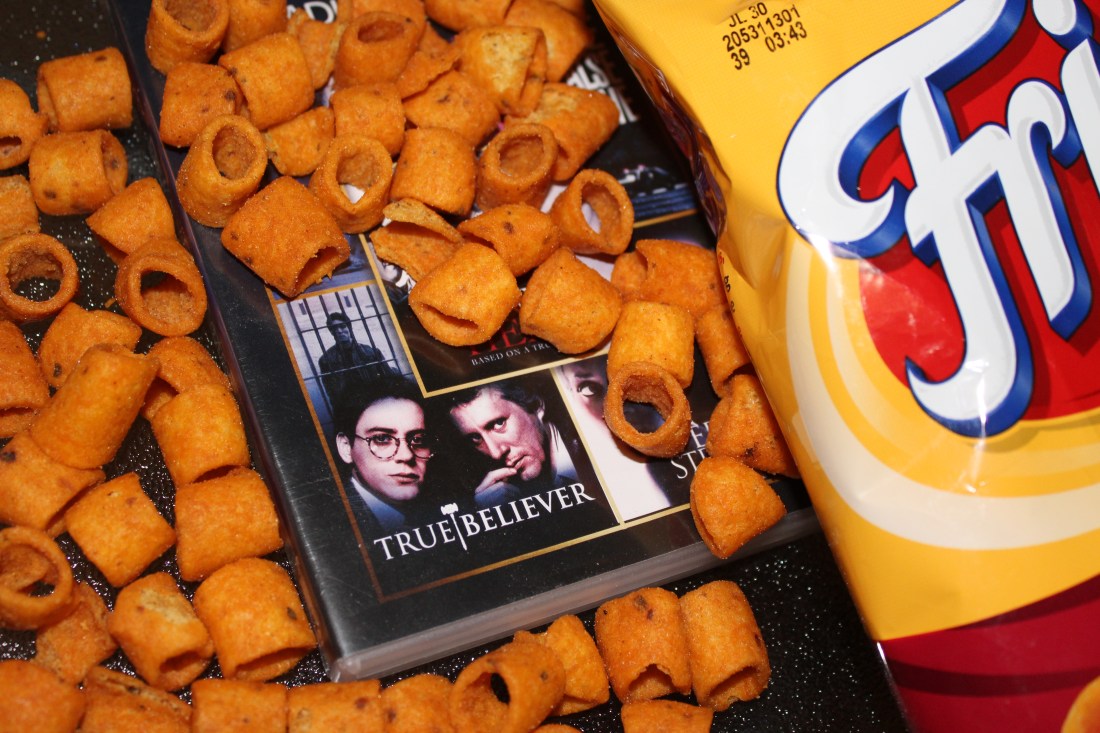
Fritos Hoops (because it’s an acquired taste, but very satisfying once you get to the bottom of it)

IMG_2974.JPG

Fun facts:

-Release date: Feb. 17, 1989

-Box officer gross: $8.7 million

-The plot of True Believer is loosely based on the real-life case of Chol Soo Lee, a Korean American who was wrongly convicted of a gangland killing in 1973 San Francisco. Not only did Chol Soo inspire the film’s character played by Yuji Okumoto, but his real-life attorney Tony Serra (mentioned above) also served as the main inspiration for James Woods’ eccentric lead performance.

-In a season five episode of The Simpsons titled “Homer and Apu” guest star James Woods, playing himself, namedrops True Believer during his job interview to become the temporary manager of the Kwick-E-Mart.

https://www.youtube.com/watch?v=DMYm0QvYoMM

– This film was popular enough to inspire a short-lived television spin-off in 1991 called Eddie Dodd, which starred Treat Williams in the title role. The show only lasted six episodes before it was cancelled by ABC.

True Believer was nominated for an Edgar Allan Poe Award in the “Best Motion Picture” category back in 1990 (based on the strength of Wesley Strick’s screenplay). It eventually lost out to Daniel Waters’ work on the dark teen comedy Heathers.

-Musical highlight: “All Along the Watchtower” by Bob Dylan and Jimi Hendrix (the song marks a major turning point in the story when Dodd decides to stop being cynical and return to his roots are a moral crusader).

Beethoven’s Big Break (2008) review- Beethoven hits the reset button

As a true blue 90s kid, I’m embarrassed to say that I haven’t dipped my toe into the Beethoven cinematic universe until now (I was always more of an Air Bud fan).

Thankfully, Beethoven’s Big Break, the sixth in the series, was specifically designed for newbies like me, since it serves as a complete reboot of the franchise.

For those of you who don’t know, the Beethoven films follow the exploits of the titular St. Bernard, whose big frame and even bigger appetite constantly gets him into trouble.

While the first five Beethoven movies centered around the dog’s adventures with the fictional Newton family, this 2008 entry throws all previous continuity out the window and starts from scratch.

This time around, Beethoven is taken in by struggling animal trainer and single dad Eddie (Jonathan Silverman), who attempts to turn the canine into a movie star.

However, as Eddie tries to control Beethoven’s diva-like behavior on set, he also has to worry about 1) spending enough time with his son Billy and 2) warding off an evil animal trainer who is trying to kidnap the dog and hold him for ransom.

Now, before I nitpick this family movie like some asshole critic, let me just say that Beethoven’s Big Break is a pretty harmless affair.

At no point during the film’s runtime did I raise my eyebrows at some off-colour joke or weird moral that the writers tried to smuggle into the script. Instead, most of the movie is chock-full of broad slapstick and clear-cut messages about the importance of family, which is probably good enough for its target audience (i.e., young kids).

Unfortunately, the parents who will be forced to watch this alongside their children won’t find a lot to engage with, unless they were big fans of the original Beethoven films from back in the early 90s.

This is because the filmmakers use this movie’s status as a reboot to blatantly recycle a lot of old gags from the early films, including the famous scene where Beethoven shakes a bunch of muck all over the protagonist’s bedroom.

While this element could be written off as a J.J. Abrams style tribute, the writers also get lazy when it comes to the film’s antagonist, whose villainous scheme and bumbling henchmen are directly lifted from the 1992 original.

And let’s not even get into the tired single dad drama that permeates most of the movie, with Eddie constantly grappling with the idea of accepting a new family member after his wife’s untimely death.

The one fresh idea that Beethoven’s Big Break brings to the table is its meta-commentary.

Since a lot of the story revolves around film production many of the jokes are aimed at making fun of how notoriously difficult animals are to work with in Hollywood.

The writers are even bold enough to take some subtle jabs at the franchise’s legacy as a vehicle for using a paper-thin plot to string together a bunch of outrageous sight gags.

This mostly comes to play with the story’s love interest, who is constantly asked to re-write the in-universe movie script on a near daily basis (even though the director favours Beethoven’s spontaneous shenanigans on set anyway).

But that kind of clever genre introspection will probably fly over the heads of the movie’s target demographic, and is only interesting to hopeless adult movie geeks like myself.

At the end of the day, all you need to do to deliver the goods in a movie like this is to showcase plenty of cute animals and some cheeky slapstick, and Beethoven’s Big Break succeeds in that regard.

I just wish that the gags were more creative and the filmmakers didn’t rely on distractingly bad CGI animal doubles for some of the more elaborate set pieces.

But again, take my criticism with a grain of salt, because there’s only so much room in my jaded heart for 90s film franchises staring dogs.

AirBudFlukeHomewardBound(1)WhiteFang

101DalmatiansAllDogsGoToHeavenBalto_movie_posterAirBud2

Verdict:

5/10

Corner store companion:

Lay’s Classic potato chips (because you get what you pay for, but not much else).

IMG_0724

Fun facts:

-Release date: Dec. 30, 2008 (straight-to-video).

-As right now, there are eight official Beethoven films, with the last entry (Beethoven’s Treasure Trail) having been released back in 2014.

-While the first two films in the franchise (Beethoven and Beethoven’s 2nd) were theatrical releases in 1992 and 1993, respectively, the rest have been straight-to-video affairs.

-On top of eight feature films, Beethoven even spawned a cartoon series in 1994-95 that lasted 26 episodes.

-Big chunks of Beethoven’s Big Break was filmed in and around Universal Studios Florida.

-Surprise cameo: Despite getting pretty sizable billing, the “Dog Whisperer” Cesar Millan only shows up for a few brief scenes to give some sage advice on animal training.

-The film’s end credits are littered with parody film posters that call back to classic Hollywood movies, like: Frisky Business, Raiders of the Lost Bark, Close Encounters of the Third K9, Drool Hand Luke and The Gradumutt.

-Musical highlight: “Beethoven’s Fifth Symphony” by Ludwig Van Beethoven (the song that inspires one of the main characters to give the lovable dog his name).

Lonely Hearts (2006) review- A sleepy lead performance from Travolta drags down an otherwise solid film noir

As an industry, Hollywood is collectively guilty of many story-telling sins, like the tendency to over-romanticize important people, places, and things.

From botched biopics to anachronistic period pieces, the American film business has shown time and time again that it will go to great lengths to prune away the more unseemly elements of historical fact in favour of presenting a digestible narrative for general audiences.

Even violent criminals will sometimes get this treatment, since films like Bonnie and Clyde (1967) are still considered classics to this day despite being riddled with inaccuracies.

However, my general rule of thumb is that these white lies are forgivable as long the filmmaking behind them is solid, which is why Lonely Hearts (2006) works as a detective story despite the creative liberties its writer/director takes with the source material.

This movie’s plot follows the exploits of the “Lonely Hearts Killers,” a real-life pair of serial murderers who, from 1947 to 1949, lured as many as 20 women to their deaths through answering their personals ads.

While Jared Leto and Salma Hayek are saddled with portraying Raymond Fernandez and Martha Beck (the killers), John Travolta also stars as a hardboiled detective tasked with tracking the couple down. Of course, like any good film noir, this case is never as simple as it seems and Travolta’s ability to bring the killers to justice is always being complicated by his own personal demons.

Lonely Hearts actually serves as a great example of why I’m not so anal about historical accuracy in film, since one its strongest elements is a blatant fabrication on behalf of the filmmakers.

Hayek’s performance as the Martha Beck is completely unnerving, terrifying, and full of surprises, especially when you realize that she is the architect behind a lot of the killings.

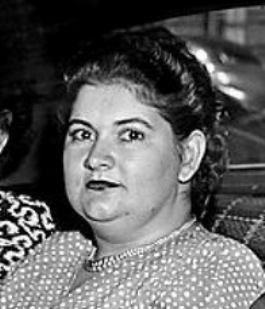
In fact, she’s so good that I didn’t even care that the real-life Beck was an overweight, homely white woman, who would have never been able to slip into the skimpy cocktail dresses that Hayek fills out so nicely in this film.

MarthaBeck(1)Salma Hayek(2)

While Leto is a little more willing to look like Raymond Fernandez (receding hairline and all), he’s also able to mix devilish charm with crippling insecurity, which makes him the perfect bait to attract a parade of desperate, lonely women.

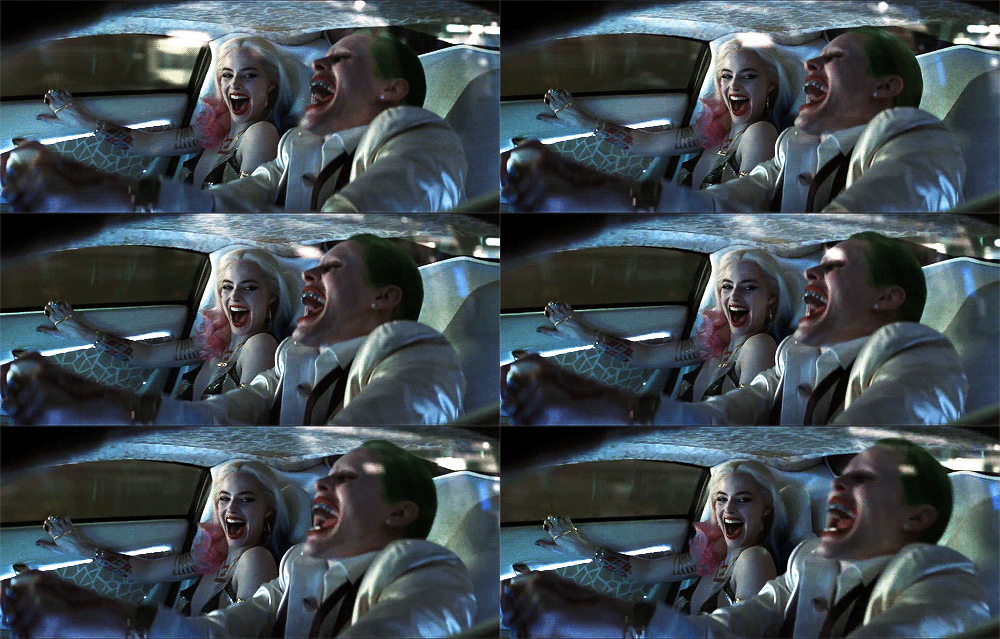
And even though the two are playing remorseless serial killers, Leto and Hayek still manage to develop some compelling chemistry similar to other famous outlaw couples in popular culture, like Sid Vicious and Nancy Spungen or (more fittingly) the Joker and Harley Quinn.

Margot-Robbie-as-Harley-Quinn-and-Jared-Leto-as-Joker-in-Suicide-Squad-margot-robbie-39790178-500-213

Now, are the filmmakers guilty of making us sympathize with a pair of degenerates who caused a lot of pain and suffering in real life? Maybe. But the movie’s unflinching look at the brutality these two inflicted on their victims also doesn’t let us forget that their relationship is rooted in fear and jealousy rather than love and trust.

However, the same level of praise can’t be drummed up for Travolta’s performance, since he largely sleepwalks his way through his lead role as a heartbroken detective without any real edge or enthusiasm.

He doesn’t bring anything new to this well-worn character archetype, and can’t even be bothered to delivery his lines properly a lot of the time.

In one scene, Travolta yells “Don’t ever mention my wife again. It’s none of your fucking business!” to a superior officer with all the squeaky bravado of a teenager going through puberty.

It also doesn’t help that his partner is played by James Gandolfini, who acts circles around Travolta in virtually every scene they’re in together.

This weak lead performance really takes the shine away from some of the film’s finer qualities, since director Todd Robinson actually put a lot of work into creating a immersive atmosphere by littering the movie with tasteful tributes to classic film noir.

Not only is the soundtrack suitably jazzy and retro, but the grizzled voice-over narration by Gandolfini does a great job of setting the scene for a post-WWII America that is riddled with crime.

As the film’s sole screenwriter, Robinson also sneaks in some nice character development for Travolta’s character, whose quest to find meaningful intimacy mirrors Fernandez and Beck’s homicidal love story.

It’s too bad that Travolta’s half-baked acting sticks out like a sore thumb, especially when everybody else in front of the camera (and behind it) is firing on all cylinders.

And while the filmmakers definitely play fast and loose with their “based on a true story” hook, Lonely Hearts still manages to retain the dysfunction and creepiness of its real-life subjects, which makes it a compelling watch for anyone who is a fan of serial killer dramas.

Just try not to get distracted by Travolta’s bad acting, or his tough-guy toupee.

Verdict:

7/10

Corner store companion:

Hersey’s Kisses (because if you’re a movie nerd like me, chances are these are the only kisses you’ll be getting on Valentine’s Day).

IMG_1760

Fun facts:

-Original release date:

April 30, 2006 (Tribeca Film Festival)

April 17, 2007 (limited release)

-Budget: $18 million (estimated)

-Box office gross: $2,517,423 (worldwide)

-Director Todd Robinson is the grandson of Elmer Robinson, the real-life detective (played by Travolta in this film) who investigated the Lonely Hearts murders in the late 1940s.

-Despite not being the same race as their real-life counterparts, both Leto and Hayek underwent slight cosmetic alterations to get into their roles. While Leto had to shave the front of his head to match Raymond Fernandez’s hairline, Hayek wore contact lenses to replicate Martha Beck’s blue eyes.

-The story of the “Lonely Hearts Killers” has been portrayed on film a total of four times. Besides Lonely Hearts, the story has been re-told in Mexican with Deep Crimson (1996), in French with Alleluia (2014) and in black and white with the American cult classic The Honeymoon Killers (1970).


Commandos Strike at Dawn (1942) review- Uncle Sam gets creative with his recruitment techniques

The 1940s was truly a golden age in terms of Hollywood produced war propaganda.

Not only would these productions play as cartoons or documentary shorts before the beginning of a feature film, but sometimes they would take the form of the main attraction itself.

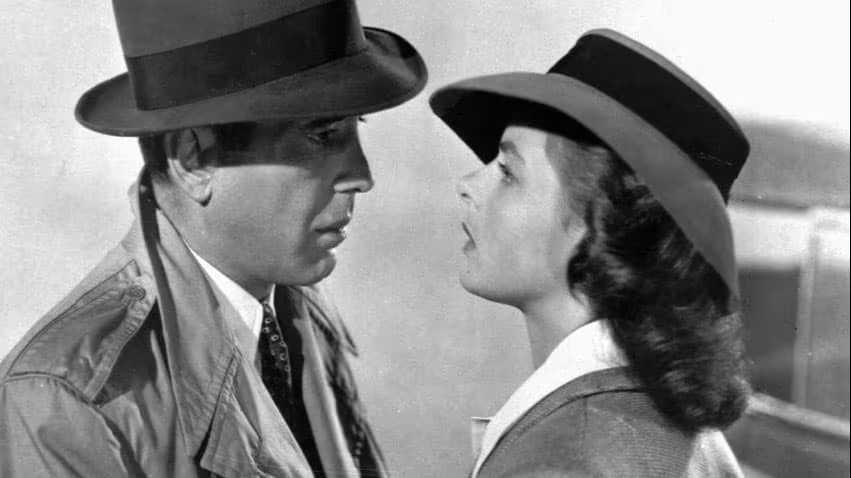
This can even be seen through a screen classic like Casablanca, which was made entirely to capitalize on America’s decision to enter the Second World War and reassure the US public that their government had made the right decision.

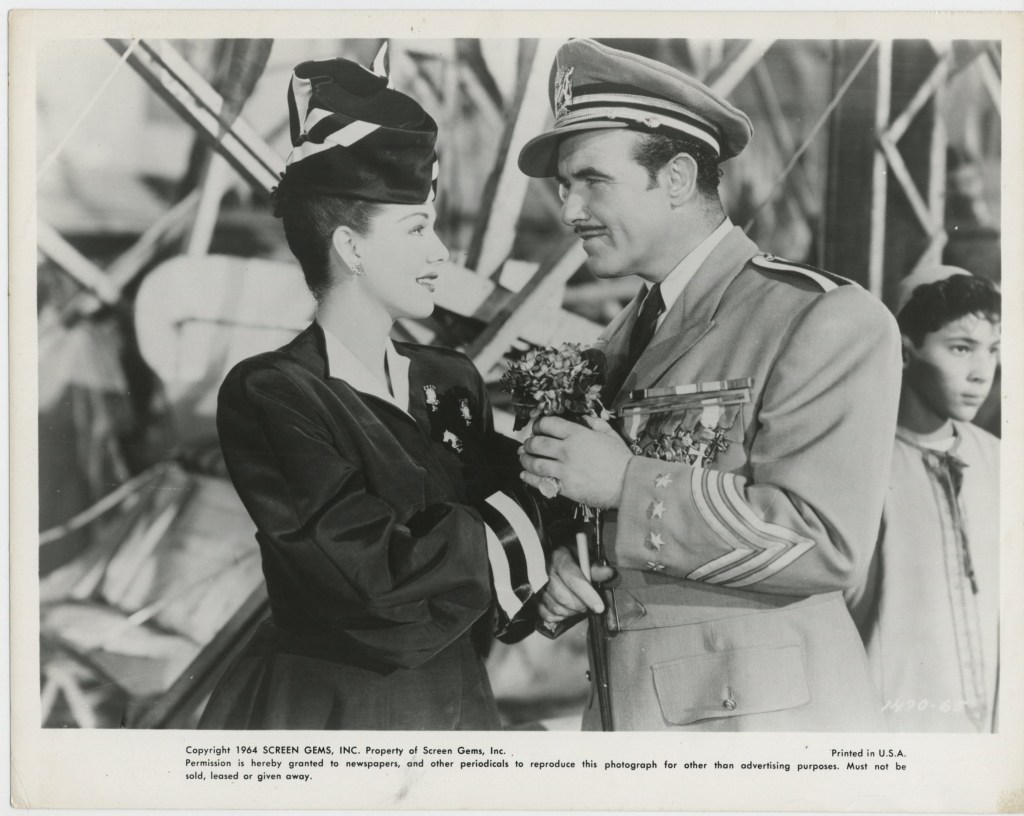
John Farrow’s Commandos Strike at Dawn, released at the very tail end of 1942, operates on that very same logic, since its plot and characters are meant to serve as an stand-in for America’s transition from neutrality to outright involvement in the Allied war effort.

In this film, the role of audience surrogate doesn’t go to Humphrey Bogart but Paul Muni, who plays a mild-mannered Norwegian fisherman whose sleepy village is taken over by the Third Reich in 1939.

While Muni’s character originally believes that the best course of action is to simply cooperate until the war blows over, he’s gradually pushed to violence after witnessing the atrocities committed by the Nazis and recruits a squad of British commandos to help liberate his home.

Now, when I use the term “propaganda” to describe this film, I don’t use it in an entirely negative sense. After all, I’m perfectly willing to stomach some ham-fisted messaging in my entertainment as long as the end product is well-made.

For example, even though Casablanca is a pretty transparent World War II allegory, it’s done with a certain level of sophistication and the film contains a pretty timeless love story that still strikes a cord with audiences to this day.

Unfortunately, the same really can’t be said for Commandos Strike at Dawn, since the filmmakers settle for cheap gimmicks that relegate the production to being simply a product of its time.

This kind of tone is established in the first couple seconds of the film, when the opening credits prominently display all the flags of the Allied powers, including the Soviet Union’s hammer and sickle. This kind of intro immediately dates the film, especially with the Cold War being right around the corner.

Even though there are times where the movie’s attempts to be timely do work out in its favour (like how the characters mention the persecution of Jews at a time when they were being slaughtered in concentration camps in real life) this kind of tacky filmmaking has way more misses than hits.

Although Muni is a compelling lead, he’s saddled with a lot of corny lines about how “nobody’s going to win the war for anybody else,” which sound like they are meant to lecture the 1942 audience rather than inform the movie’s characters.

The rest of the film’s cast is even more disposable.

Despite the fact that all the major players are given a long introduction through a fairly impressive tracking shot, most of them disappear halfway through the movie as the narrative focuses exclusively on Muni and his mission to coordinate a rescue operation.

The worst example of this is probably Muni’s love interest, who doesn’t affect the plot in any way and only seems to exist to reassure the audience that their protagonist has (if I may borrow a term from Red Letter Media) a “case of the not gays.”

The writers don’t even have the decency to provide us with a main antagonist, and settle for flooding the screen with a bunch of nameless German foot soldiers instead.

With that being said, the one segment of the cast who do manage to make an impression are the “British” commandos themselves.

The climactic clash between them and the Nazis feature some really impressive stunt work, which probably has something to do with the fact that they were played by real-life members of the Canadian Armed Forces.

Commandoes(1)

What’s even better is that director John Farrow compliments their military acumen with some good production decisions, since a lot of explosions are done in-camera and aren’t watered down by post-production trickery.

With that being said, basically none of these commandos are given personalities or even a single line of dialogue, which means it’s hard to get emotionally invested in this climax beyond admiring the pure spectacle of it.

And that’s probably the biggest problem with Commandos Strike at Dawn: it doesn’t know what it wants to be.

Sure, the filmmakers make a big show at the beginning about how they want to present an intimate character piece, but it’s clear by the final frame of the film that that’s all window dressing.

Instead, they’d much rather settle for showcasing flashy pyrotechnics and real-life military hardware, something that would have worked as long as they fully committed to this idea.

As a result, Farrow and his team fall victim to the classic filmmaking mistake of trying to make a movie for everyone, which inevitably means that they made a movie for no-one (especially by 2018 standards).

(Side note: it’s clear that the final climactic battle wasn’t shot in the early in the morning, but I guess “Commandos Strike at Mid-Day” wouldn’t have looked great on a movie poster.)

Verdict:

4/10

Corner store companion:

Bits & Bites Original (because it should have stuck to doing one thing, instead of mixing a bunch of stuff that doesn’t belong together).

IMG_0278

Fun facts:

-Release date: Dec. 30, 1942.

-Box office gross: $1.5 million (estimated).

-This film was nominated for an Oscar in the category of Best Scoring of a Dramatic or Comedy Picture at the 1944 Academy Awards (the same year Casablanca won Best Picture).

-Paul Muni is probably best know for starring in the original Scarface from 1932, when the title character was an Italian gangster named Tony Camonte.

-Even though he’s kind of slumming it in this movie, Muni has five Oscar nominations for Best Actor under his belt, with an eventual win in 1937 for starring in The Story of Louis Pasteur.

-Unexpected cameo: Lillian Gish (a silent movie star best known for playing the pivotal role of Elsie Stoneman in the Birth of a Nation) makes her first screen appearance in almost a decade by portraying one the Norwegian villagers under Nazi siege.

-According to IMDB, the entirety of this film was shot on Vancouver Island, British Columbia.

Moscow on the Hudson (1984) review-A warm hug in politically divisive times

Most people my age got introduced to Robin Williams’ real acting chops in the late-90s with Good Will Hunting.

One could be forgiven for believing that this was his first foray into serious drama, since most of his other hit movies during that same time period were broad comedies filled with rapid fire jokes, improvised lines, and tons of celebrity impressions (Aladdin, Patch Adams, Mrs. Doubtfire, Hook).

However, little did we know that Williams had been dedicated to taking on more complex projects a full decade before, with a slew of juicy roles that straddled the line between comedy and drama and netted him a handful of Oscar nominations (Dead Poets Society, Good Morning, Vietnam).

While I’m certainly not an expert on Williams’ filmography throughout the 1980s, I’m confident in saying that Paul Mazursky’s Moscow on the Hudson, released in 1984, is a precursor to the actor’s future success, since he carries the entire movie on his back with a sweet, funny and understated performance.

In the film, Williams plays Vladimir Ivanoff, a Russian saxophone player who decides to defect to the United States once the circus that employs him makes a trip to New York City. From there, we follow Vladimir’s ups and downs as he navigates the country’s immigration system and does his best to adjust to the American way of life.

Obviously, the biggest highlight here is Williams, who makes the wise decision to avoid adopting a cartoonish Russian accent and ridiculously stilted English speaking pattern to try and generate laughs from the audience.

Instead, his character shines through his empathy, work ethic and good-hearted nature, which comes across as being much more authentic and funny than some kind of broad caricature.

While a lot of the credit for this dynamic goes towards Mazursky’s script, Williams also needs to be commended for doing his homework.

Reportedly, the actor spent about a year learning the language and other Soviet customs before principal photography began, which is a hell of a lot more preparation than some other Hollywood stars have undertaken for playing Russians in the past.

SeanConnery(hunt)

But Williams’ performance isn’t the only thing that turns Moscow on the Hudson into a real hidden gem.

On top of featuring a thoroughly likable cast who have great comedic chemistry, the people behind the camera should be given a lot of credit for pulling the film’s different elements together into a cohesive whole.

For example, seasoned director of photography Donald McAlpine does a brilliant job of bringing New York City to life on screen. Not only does he shoot the city’s famous landmarks in a way that perfectly mimics the wide-eyed wonder that a newcomer like Vladimir would feel, but his cinematography also has the added affect of making me feel nostalgic for a place I’ve never visited.

Composer David McHugh also makes a big impression by choosing just the right song or musical sting at just the right moment. Probably one of the funniest sequences in the whole movie is Vladimir’s decision to defect in a large US department store, where Soviet marching music plays overtop of scenes of communist circus performers and their KGB handlers shopping for clothes and jewelry.

But by far the biggest star of this whole enterprise is the script, which really does a great job of crafting a “rah, rah” patriotic American film without veering off into the territory of outright propaganda, like some other 1980s properties I could name ….

LivingInAmericaFirstBloodPartII

With that being said, Moscow on the Hudson still holds the United States in very high regard, portraying it as a global paragon of virtue and morality, especially when compared to the Soviet Union.

But rather than demonstrating the US’s outright superiority through more regressive characteristics like military might or isolationist policies, Mazursky emphasizes that this country is great because of its multiculturalism and welcoming attitude towards immigrants.

Virtually all of the film’s supporting characters are immigrants, whose kindness and strength come from their ability to adapt to their adopted homeland.

Furthermore, most of the film’s second half takes place inside of distinctly ethnic clubs, grocery stores and restaurants, which communicates the idea that American culture is perpetuated through these sorts of institutions.

As a character, Vladimir even embodies this philosophy through his love of playing the saxophone, since jazz is a uniquely American creation.

Some might feel that this ”touchy-feely” approach robs of the film of any tactile conflict, and what conflict exists is rather forced and manufactured, especially after the KGB agents largely leave the picture following Act One.

And I’ll be the first one to admit that this movie is not without its cheesy moments, especially one scene near the end of the film where the characters literally recite passages from the Declaration of Independence out of nowhere.

But given how toxic and divisive the US political climate is right now, Moscow on the Hudson is a breath of fresh air.

And at the end of the day, I’m sure an actor like Williams, who spent his whole career trying to make people laugh, would be happy to know that one of his earlier films still serves as a heart-warming reminder of how the American experiment can be used to bring people together instead of tearing them apart.

Verdict:

9/10

Corner store companion:

Werther’s Original Caramel Hard Candies (because it’s still remarkably sweet, despite how long it’s been in circulation).

IMG_9612

Fun facts:

-Release date: April 6, 1984.

-Budget: $13 million (estimated)

-Box office gross: $25.1 million.

-Unexpected cameo: Comedian Yakov Smirnoff makes a brief appearance as “Lev,” one of Vladimir’s new friends in New York who is also an aspiring celestial mechanic and astrophysicist.

-On top of learning to speak fluent Russian, Williams also spent months studying how to play the saxophone for this role. According to the actor’s music teacher, Williams learned in two months what usually takes normal people two years to master.

-For a while, director Paul Mazursky tried to get a sequel called Moscow on the Rocks made, although it never came to fruition. The plot of this follow-up film would have followed Vladimir, now a cutthroat New York City businessman, as he travels back to his homeland for his sister’s wedding and falls in love with a Russian doctor.

-The portions of the film that are set in Moscow were actually shot at Bavaria Studios in Munich, Germany.

-Musical highlight: “Freedom” by Chaka Khan (plays over the end credits).

https://www.youtube.com/watch?v=m5pp0ndW1BI