Man Hunt (1984) review- a journey into the uncanny valley

If you’re looking to pick a fight on social media these days, a good place to start (outside of the ongoing Israel-Hamas conflict) is talking about generative artificial intelligence.

This is especially true in sections of the internet where people like to discuss the arts, since this new technology is viewed (depending on who you ask) as something that will either revolutionize the entertainment industry or bring about its downfall.

Personally, most of the AI-generated images and videos I’ve seen aren’t a convincing substitute for the projects made by flesh-and-blood creators, since they almost always possess some bizarre alien quality that makes my skin crawl.

However, the recent advances in AI shouldn’t distract you from the fact that humans have always had the potential to produce works of art that are completely uncanny, off-putting, and devoid of logic.

Enter Fabrizio De Angelis’ Man Hunt (1984), a neo western so lazy and nonsensical in its construction that you think the script was written during a drunken round of Mad Libs.

Admittedly, this does result in somewhat of an engaging viewing experience, since you’re constantly left wondering when the next wacky story development or plot hole will pop up. 

But taken as a whole, Man Hunt’s pervasive weirdness can’t sustain a feature-length runtime and it just leaves you with the creeping feeling that your home has sprung a gas leak.

Some may look at this film’s synopsis on IMDB or Wikipedia and conclude that I’m being a little hyperbolic, since the set-up is typical western shenanigans.

The plot of Man Hunt revolves around a nameless stranger (Ethan Wayne), who buys a pair of horses at a rodeo and accidently wanders onto some land belonging to a corrupt rancher (Ernest Borgnine).

After the rancher steals the horses for himself, the stranger gets thrown in prison after attempting to retake his property.

The rest of the film details the stranger’s attempts to escape from captivity and clear his name, all the while trying to stay one step ahead of the law.

You’ve probably seen a variation of this plot in a dozen other movies, but it’s the way that De Angelis and his crew tell this story that’s truly baffling.

For one thing, the stranger’s first escape from prison is never shown or discussed on screen, even though it’s supposed to represent a major turning point in the story.

Before you can get your head around such a weird creative decision, the stranger is immediately caught and gets thrown back behind bars, leading to his second escape minutes later.

After hijacking a bus and blasting his way through an army of cops, the stranger is then given safe passage thanks to Borgnine’s corrupt rancher, whose change of heart comes out of nowhere and is never given any explanation.

This kind of plot progression would make sense if Man Hunt was a comedy or Zucker Brothers-esque parody of old prison break movies.

But the tone of the film is deadly serious throughout its 91-minute runtime, which exposes the grim reality that De Angelis and his team have no idea what they’re doing.

That lack of direction is laid bare in the first four minutes of the film, which consists almost entirely of boring b-roll footage of the rodeo where the stranger buys his horses.

This opening remains a pretty blatant example of “Shooting the Rodeo,” a term coined by RedLetterMedia that describes the tendency for directors of low-budget movies to pad their runtime by filming real public events.

Man Hunt is an especially egregious example of this trope, since De Angelis lingers on this intro for way too long and includes elements like unnecessary slow motion to add insult to injury.  

These strange filmmaking techniques persist throughout the entire narrative, so much so that I was almost convinced that De Angelis was trying to create the kind of surreal, dream-like atmosphere one would find in a David Lynch movie.

But unlike Lynch’s works, Man Hunt is a pretty boring and lifeless affair for long stretches of its runtime, which is made even worse by a lead performance that is dull as dishwater.     

For those of you who are unaware, Ethan Wayne is the son of Hollywood icon John Wayne, who found work as an actor throughout the 1980s, 1990s, and early 2000s.

A brief scan of Wayne Jr.’s acting credits reveal that he never really made it as a major leading man like his dad, and in Man Hunt it’s easy to see why.

Pretty much every line that comes out of his mouth is stiff and robotic, almost like he’s a non-English speaker who learned the language for this role.

Wayne’s monotone performance extends to his blank facial expressions, which I’m assuming he employed to come across as a stoic western hero archetype just like his father.

But Wayne just doesn’t have the presence or charisma to pull this off and ends up looking like a pretender, especially when he’s asked to do anything physical.

This includes a couple of embarrassing running scenes, where Wayne gets to show that he has all the dignified grace and coordination of a young Steven Seagal.

To be fair, even a lauded thespian like Orson Wells would have trouble grasping this material, since it never finds its footing in a consistent style or tone.

Instead, the filmmakers decide to put a bunch of other movies in a blender, with the beginning of Man Hunt serving as a clumsy fusion of First Blood (1982) and Cool Hand Luke (1967).

The last third of the film ultimately becomes a downscaled version of Clint Eastwood’s The Gauntlet (1977), where the stranger has to evade an army of trigger-happy cops.

And to the film’s credit, these chase sequences do at least feature a lot of impressive pyrotechnics and automotive stunt work.

One scene near the end of the film stands out as a particular highlight, where a police cruiser flips over and showers the concrete street with broken glass.

Seconds later, two cruisers collide into each and explode, treating us to the amusing sight of flaming wheels skipping down the road.

All this technical expertise comes to a head in the film’s climax, where [SPOILERS] Wayne gets cornered in a mobile home and the cops open fire on him for what feels like five minutes.

This one-sided shooting is so excessive that it becomes a complete farce and instantly reminded me of a famous gag from The Naked Gun 21/2(1991).

Unfortunately, the filmmakers had to ruin this fun time by delivering one of the dumbest endings that’s ever been committed to celluloid.

Once Wayne emerges from this bullet-riddled trailer, completely unscathed of course, the cops go to arrest him, but he has a secret weapon up his sleeve.

Instead of carrying a gun or smoke bomb, the stranger produces a bill of sale which proves that he legally bought the horses at the beginning of the story.

This magical receipt completely freezes the corrupt cops in their place and forces them to let the stranger go, even though they were trying to unlawfully cut him into Swiss cheese seconds earlier.

Of course, this piece of paper shouldn’t absolve Wayne of all the property damage and lives he put in mortal danger during his multiple escape attempts.

But I guess we’re well past the point of pretending like Man Hunt takes place in a world that adheres to logic or reason, unless there’s some real legal precedent that gives you immunity from all manner of prosecution if you simply yell “It’s okay, officer! I have a receipt!!”

I know I’ve spent a lot of time on this one plot point, but I think it’s a microcosm of how disorienting this film is as a whole.

Almost every aspect of this project feels artificial or randomly generated, from its script to the acting to the musical score.

Part of me feels like this comes down to De Angelis’ inexperience as a director, since Man Hunt is only his third feature film after nearly a decade of producing Italian genre schlock.

Perhaps that jump into the director’s chair was too much to handle, so he resorted to throwing a bunch disparate American film tropes at the wall to see what would stick.  

De Angelis’ scattershot approach to directing Man Hunt is probably what triggered the AI comparison I brought up earlier, since that technology (in its current form) is only able to generate new works of art using pieces of pre-existing material.

Some may argue that this is no different than the creative process most humans undertake, and maybe there is some merit to that line of thinking.

But with a man-made trainwreck like Man Hunt, I can at least trace the creative influences of the people who worked on it and see that the director went on to embrace his exploitation roots by making films like Killer Crocodile (1989), Karate Rock (1990), and Breakfast With Dracula (1993).

This form of film analysis is infinitely more interesting than looking at the prompts and lines of code that went into creating an AI-generated blockbuster, which sounds about as fun as filing my taxes.

I would much rather look into the history of a deeply imperfect filmmaker than stare into the gaping maw of a machine-driven algorithm, even if the former ends up producing a completely incomprehensible piece of shit like Man Hunt.    

Verdict:

3/10

Corner store companion:

Buffalo Ranch Pringles (because this film is seriously lacking in real western flavour)

Fun facts:

-Release date:

Nov. 30, 1984 (West Germany)

Dec. 6, 1984 (Italy)

-Outside of the film’s original Italian title of Cane Arrabbiato (which roughly translates to “Mad Dog”), Man Hunt was also known as Uppercut Man in France.

-For most of his directing career, Fabrizio De Angelis was credited under the more American-sounding name of “Larry Ludman,” including for his work on Man Hunt. De Angelis also directed under the alias of “Ted Russell” for Breakfast With Dracula (1993).

-As an actor, Ethan Wayne is probably best known for portraying Storm Logan on The Bold and the Beautiful. Wayne played this character throughout 217 episodes of the long-running soap opera, eventually retiring from acting after he left the show for good in 2003.

Man Hunt can currently be watched in its entirety on YouTube (with Asian subtitles).
The Duel at Silver Creek (1952) review-western junk food

If you asked somebody who doesn’t like westerns to write a script for a western, they would probably come up with something similar to Don Siegel’s The Duel at Silver Creek (1952).

In other words, this hypothetical person would probably insert a lot of violence, landscape shots and stoic “cowboy” dialogue, neglecting to leave any room for the kind of emotional nuance that transforms typical genre pictures into great films.

As a result, The Duel at Silver Creek feels like a fundamentally hollow viewing experience, even though it does pack a punch on a visceral level.

Admittedly, the film’s screenwriters at least come up with a solid premise, with the plot centering around a gang of claim jumpers who execute honest miners after forcing them to sign over their property at gunpoint.

However, the gang eventually falls into the crosshairs of the Silver Kid (Audie Murphy) and Marshall Lightening Tyrone (Stephen McNally), who decide to team up after these ruthless outlaws murder their father and mentor figure, respectively.

Even though that kind of plot has been recycled in hundreds of different westerns, The Duel at Silver Creek at least captures your attention at the very beginning by showcasing how vicious these claim jumpers can be.

Not only do they murder innocent people in cold blood, but their methods of execution can be downright brutal for 1952, with the gang’s femme fatale character strangling a wounded witness before he can let slip some valuable information to the authorities.

This set-up puts you in the right headspace for a pretty strait-laced western, where you want to see the clean-cut white hats triumph over such obviously amoral black hats.

Unfortunately, the movie doesn’t really have anything else offer beyond that initial sugar rush, especially when it comes to things like character, dialogue, and plot.

The film’s biggest missed opportunity, in my view, is the dynamic between McNally and Murphy, which could have been interesting if the screenwriters decided to dig at least an inch beneath the surface.

After all, both characters recently lost an important person in their life in the same horrific fashion; something that could have made for interesting scenes where the two bond over a shared tragedy.

But McNally and Murphy, while making for convincing gunslingers, don’t get a chance to talk in any meaningful fashion, and are just relegated to swapping factual information about their current circumstances.

I know that a lot of people may joke about how this describes most male relationships in real life, but I feel like even the most macho pairing in the world could have convincingly pulled off an exchange like:

“Your dad died? Damn! Mine too. That sucks.”

“Thanks bro.”

No such dialogue ever makes its way into the script of The Duel at Silver Creek, with McNally and Murphy mostly communicating through sarcastic quips that highlight their difference in age and experience.

Equally flat is the pair’s respective love interests, who aren’t developed in any meaningful way and don’t receive a satisfying send off before the credits roll.

Admittedly, actress Susan Cabot is slightly interesting playing a rough-around-the-edges tomboy, who dresses in jeans and isn’t afraid to get in a gun fight with the boys.

Unfortunately, she gets downgraded to being a damsel in distress for the film’s climax, which is disappointing and undermines any potential her character might have had.

For some reason, the filmmakers also made the baffling decision to give McNally an internal monologue, even though this technique is not used to flesh out his personality or state of mind.

Instead, this voice-over is only wielded to relay extraneous plot information, and it comes across just as unnecessary as Harrison Ford’s narration in the theatrical cut of Blade Runner (1982). 

However, all those half-baked elements aside, The Duel at Silver Creek at least succeeds in activating that primitive part of your brain that just wants to watch cowboys punch and shoot each other, which is here in spades.

A lot of the stunt work is pretty impressive too, especially one scene where McNally tosses a bad guy through a window just to make a point.

And the story climaxes with an exciting shoot-out near the eponymous Silver Creek, even though the gun battle itself takes place between over a dozen men rather than the two hinted at in the movie’s title.

Still, all that technical expertise kind of goes to waste if you don’t care about any of the characters, and Siegel never managed to master that secret formula with this project.

And In the end, I don’t think it’s too much to ask for emotional depth in a classic Hollywood western, since cerebral genre pictures already existed in droves around that time.

In fact, I stumbled across one such example last September with Leslie Fenton’s Whispering Smith (1948), which features a touching male friendship at its core in addition to all your typical western window dressing.

Howard Hawks’ Rio Bravo (1959) also presents a much better story about cross generational gunslingers, mostly because that film gives its characters room to breathe and chat with each other in between every obligatory bar fight.

Heck, even Siegel would eventually discover some thematic maturity later in his career, managing to pry a sensitive performance out of John Wayne for his final acting role in The Shootist (1976).

So, in this sense, it might be a little harsh to pinpoint Siegel as being the sole architect of this painfully by-the-book genre picture, especially since this marks his first western and his fourth feature film as a director.

But that doesn’t take away from the reality that The Duel at Silver Creek is in serious need of some nutritional value as far as things like characters, plot and dialogue go.

Instead, all you’re left with is the cinematic equivalent of empty calories that taste good in the moment, but don’t make a lasting impression in the long run.

In other words: it’s western junk food.

Verdict:

5/10

Corner store companion:

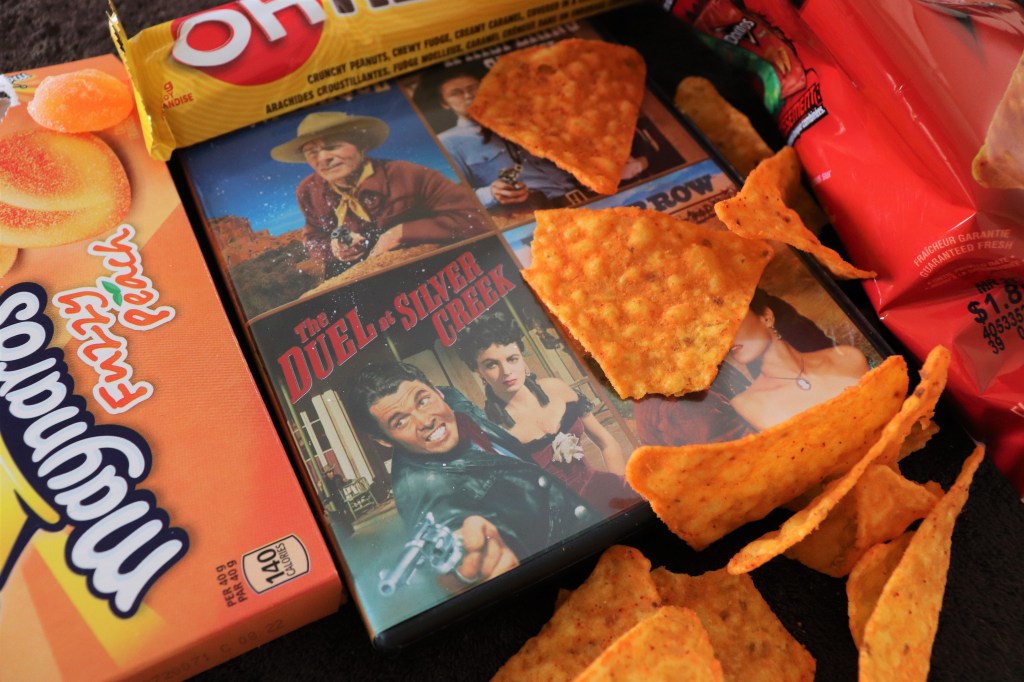
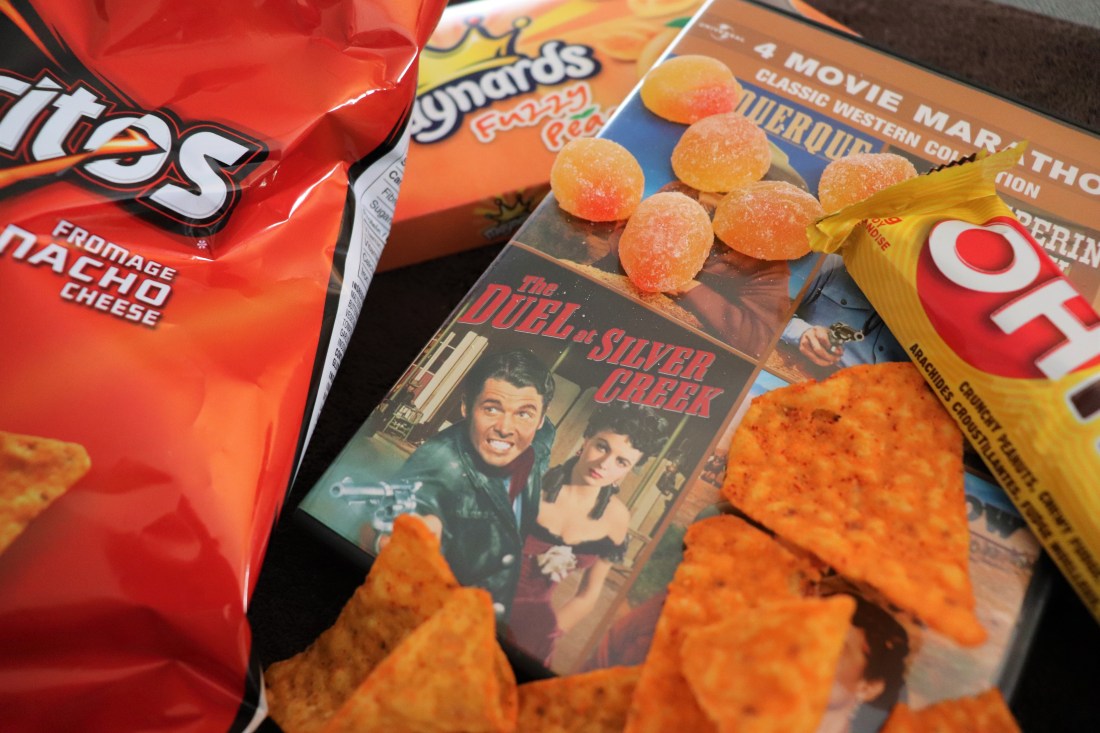
Doritos, Maynards Fuzzy Peach candy and an Oh Henry! bars (because these items will give you the sugar rush you need to get through the more derivative parts of this film)

Fun facts:

-Release date: Sept. 5, 1952

-Box office: $1.25 million

-Director Don Siegel was renowned for collaborating with actor Clint Eastwood on a variety of high-profile projects, including: Two Mules for Sister Sara (1970), The Beguiled (1971), Dirty Harry (1971) and Escape from Alcatraz (1979).

– Surprise cameo: Famous Hollywood tough guy Lee Marvin has a small supporting role playing a local roughneck who becomes a pawn in the bad guy’s overall scheme.

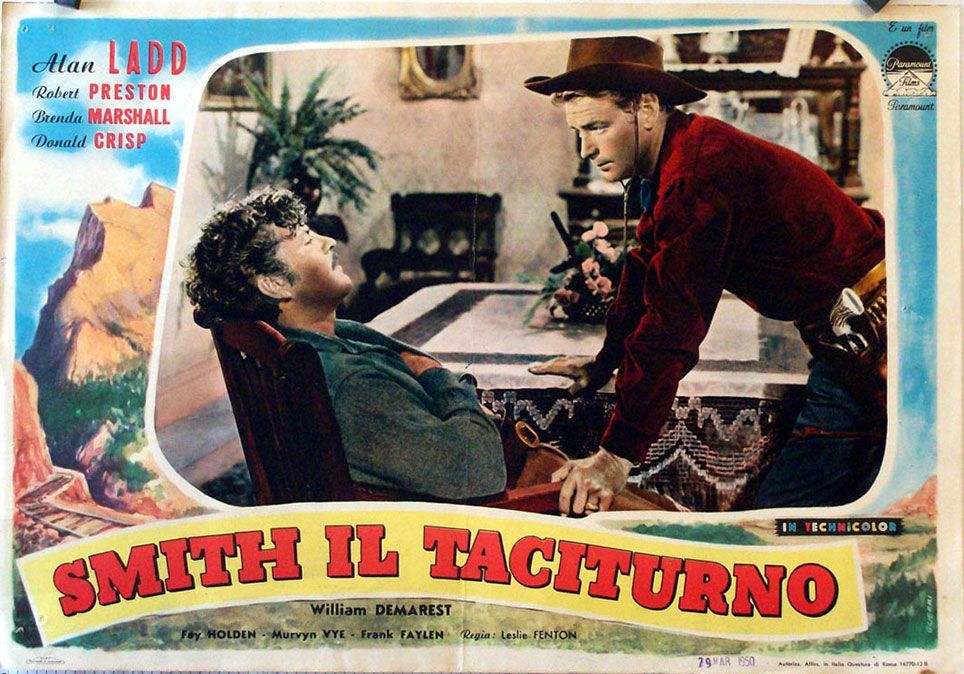
Whispering Smith (1948) review-soft-spoken cowboy makes a good first impression

While some old school heroes manage to endure over time, others fade into relative obscurity, which the fate that befell western gunslinger Whispering Smith.

Originally conceived by American novelist Frank H. Spearman in 1906, the railroad detective went on to headline several silent films and eventually a couple talkies, with the first of these being titled, appropriately enough, Whispering Smith Speaks (1935).

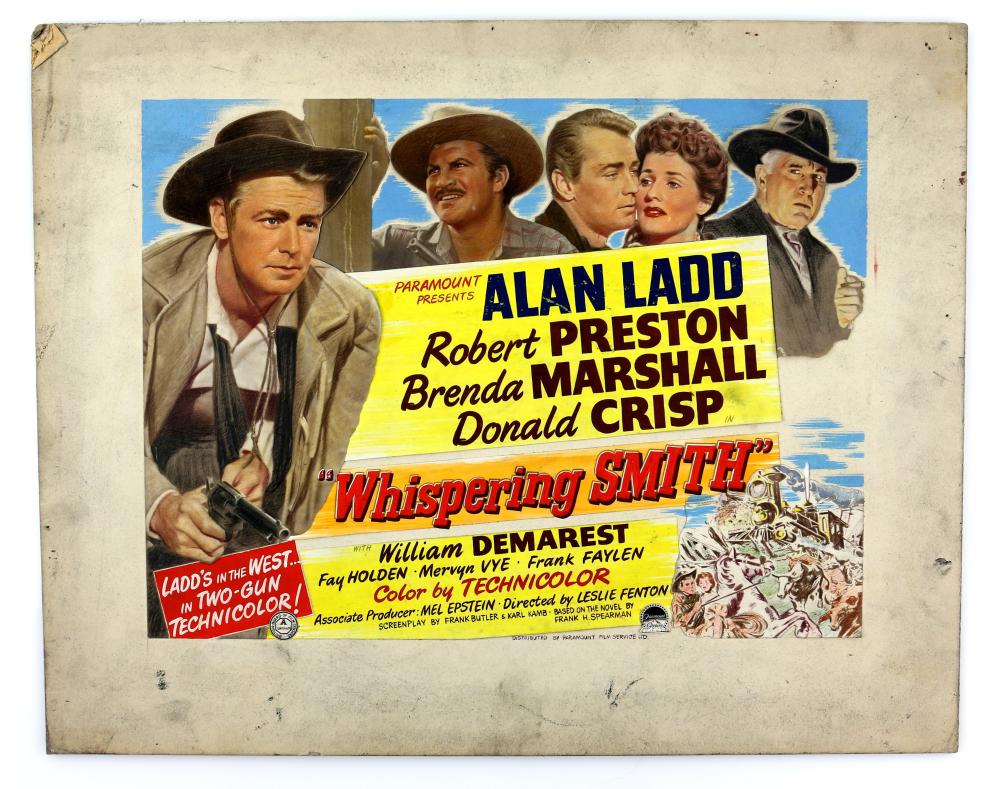
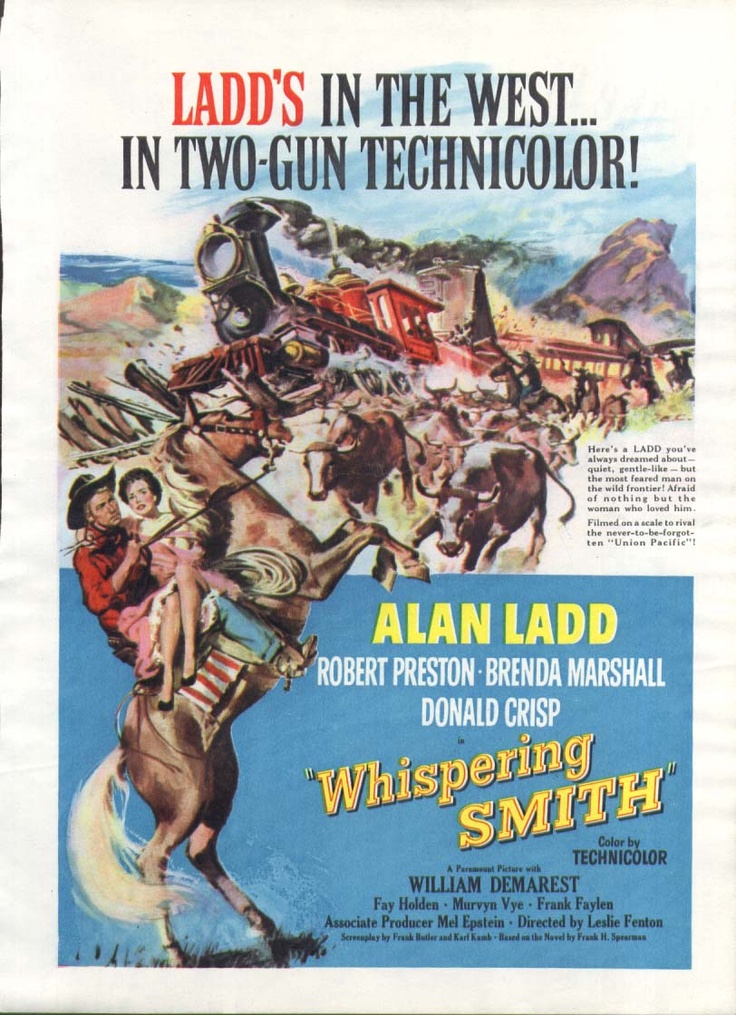
However, the character’s biggest showcase came in 1948 with Leslie Fenton’s Whispering Smith that starred Alan Ladd and was shot in vivid Technicolor.

But unlike a lot of other popular book-to-screen heroes of the Post-WWII era, like Zorro or Sherlock Homes, the Whispering Smith character never really got to achieve that transcendent level of popularity again outside of a short-lived TV show in 1961.

In hindsight, it’s too bad that Ladd never got the chance to reprise his role as the soft-spoken cowboy in a proper series of films, since his 1948 version of the character showed a lot of potential.

The plot of Whispering Smith (1948) follows a lot of the same beats as the character’s previous incarnations, where a stoic railroad detective gets entangled with some outlaws who are looking to pull off a series of increasing daring train heists.

However, Smith’s latest case hits a little too close to home after he suspects that life-long friend Murray Sinclair (Robert Preston) has become involved with a group of bandits.

This situation is made even more complicated thanks to the involvement of Murray’s wife Marian (Brenda Marshall), who still has feelings for Smith despite the fact that she chose to marry his best bud.

On a surface level, Whispering Smith has all the scenery and aesthetics that one would want from a Golden Age Hollywood western: vast landscapes, dingy saloons, grimacing bad guys and revolvers that generate clouds of smoke whenever they are fired.

But all those standard cowboy trimmings are elevated to a whole new level thanks to the movie’s astounding presentation.

Not only does the Technicolor processing make all of the film’s reds, greens and blues really pop off the screen, but cinematographer Ray Rennahan utilizes a lot of fluid camera movements that gives you a better look at all the impressive set dressing.

For example, when Smith enters a bar midway through the film to confront a villain, the camera follows him pretty much every step of the way without cutting, giving the audience a perfect view of every nearby extra and their unique costuming.

As a result, the world of Whispering Smith doesn’t look like a cheap studio backlot like so many lesser-quality westerns of the time. Instead, everything feels simultaneously lived-in and larger-than-life, which isn’t an easy feat to pull off on film.

But the movie’s main draw outside of all its gorgeous surroundings is the core relationship between Smith and Sinclair, which forms the thematic and narrative backbone of the entire story.

In a very short amount of time, the movie establishes everything you need to know about these two men, their past adventures and the decisions that have brought them to this point in their respective lives.

Smith’s obviously chosen the path that’s more befitting of an archetypal western hero: a travelling loner and gun-for-hire who doesn’t leave a lot of room for personal attachments.

Meanwhile, Sinclair decided to carve out a life that is much more relatable to a post-WWII audience, where he’s left his fighting days behind him to settle down and run his own business (in this case, a ranch).

But, in a bold move, the filmmakers decided to make the relatable everyman the antagonist of the picture, with Sinclair’s growing resentment towards Smith and his dissatisfaction with the idea of making an honest living gradually turning him to the dark side.

This central conflict works well on the page and it is made even better thanks to Ladd and Preston’s stellar performances. Not only do the pair have great chemistry as life-long friends, but they also do a great job of playing off each other as reluctant enemies.

In fact, the duo’s bond is so strong that you wish they could just put their guns down and resolve everything with a couple shots of whiskey instead of resorting to shots of lead.

Admittedly, Sinclair’s heel turn in the latter half of the film does feel a little rushed.

One second the rancher is deeply conflicted about the prospect of teaming up with a group of outlaws, and the next he’s gleefully robbing trains in a fast-paced montage.

I understand that the filmmakers didn’t have a lot of time to work with, with the runtime clocking in at just under 90 minutes, but they could have included at least a couple extra scenes to make his transition a little more believable.

And without getting into too many spoilers, the film’s ending suffers from a similar kind of problem.

Like a lot of older movies, Whispering Smith (1948) doesn’t really feature a prominent denouement, which means the credits roll basically the microsecond the climax is over.

As a result, several plot threads are left dangling, with the film’s main romantic storyline between Smith and Marian not getting a proper resolution. 

But despite these shortcomings, Whispering Smith (1948) still packs a real wallop on a visceral level, with enough emotional complexity bubbling beneath the surface to give the film real depth.

It also doesn’t hurt that the movie is rounded out by a terrific supporting cast, who give standard western archetypes like the old train conductor and town sheriff just enough dimension to keep things interesting.

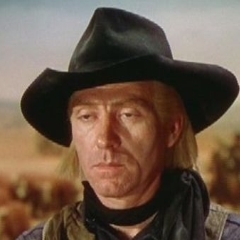
A special mention should go out to veteran character actor Frank Faylen, whose Whitey Du Sang should really belong in the Henchman Hall of Fame for his cold-blooded stare alone.

Frank Faylen as Whitey Du Sang.

And while this film doesn’t represent the peak of Ladd’s talents as a leading man in a western , that would come later in Shane (1953), he still injects Whispering Smith (1948) with enough pathos and gravitas to give the story the emotional anchor it needs.

With all this in mind, I still think its strange how Frank Spearman’s original creation largely disappeared from the entertainment landscape following this 1948 film, with NBC providing the character with a brief 26-episode revival on the small screen 13 years later.

I guess some pop culture figures just don’t stand the test of time or are limited in terms of their ability to adapt to emerging cultural trends.

But if you want to take a break from all the morally compromised anti-heroes that dominate most modern movies and TV shows, you could do a lot worse than the classic good-guy heroics featured in Leslie Fenton’s Whispering Smith.

Verdict:

8/10

Corner store companion:

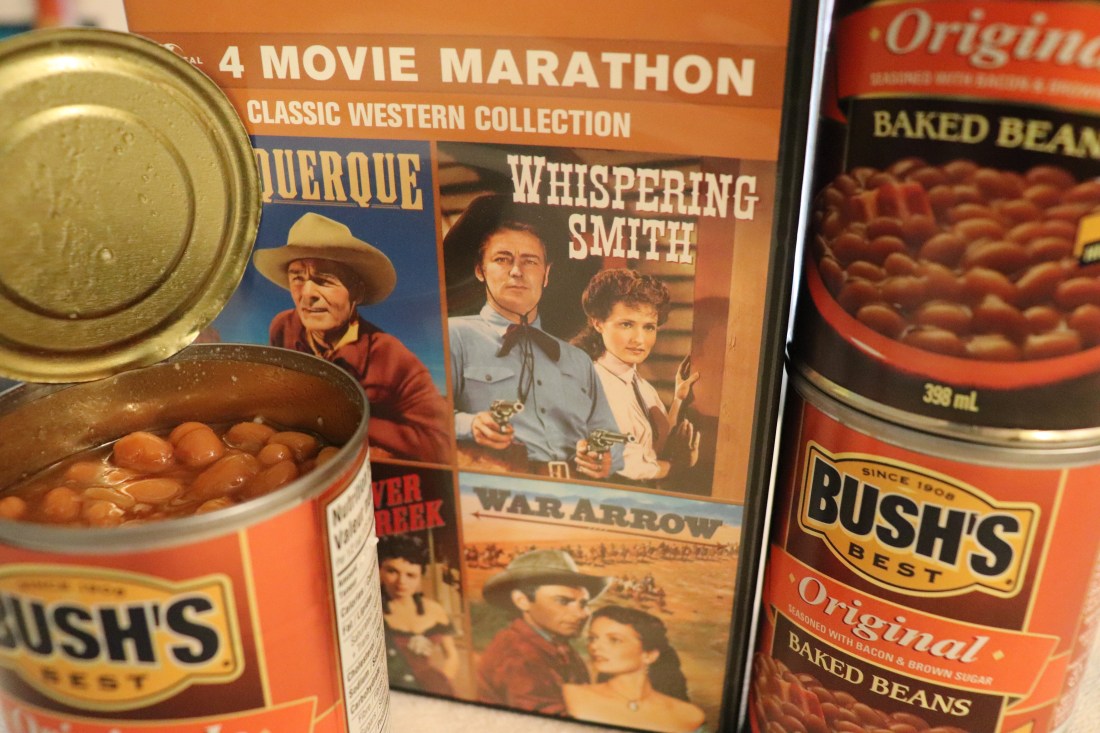
Bush’s Best Original Baked Beans (because it’s not fancy, but it gets the job done)

Fun facts:

-Release date: Dec. 9, 1948

-Budget: $2 million (estimated)

-Box office gross: $2.8 million (US)

-Author Frank Spearman modeled the character of Whispering Smith off of real-life lawmen from the old west, including Timothy Keliher, Joe Lefors and James L. “Whispering” Smith.

-Screenwriters Frank Butler and Karl Kamb were nominated for a WGA Award (Best Written American Western) for their work on Whispering Smith (1948).

-Outside of the 1948 film, Whispering Smith’s most famous outing is probably the short-lived 1961 TV series of the same name. The show starred Audie Murphy in the title role, with his version of the old west police detective operating out Denver, Colorado. NBC only ended up airing 20 of the program’s original 26 episodes, since the studio was constantly defending the show’s “mature content” from various groups, including the US Senate. Currently, you can watch the entire 1961 series on YouTube.