
When it comes to escapist cinema, crime thrillers and film noir always hit that sweet spot for me.
While sci-fi and fantasy movies are often marketed as the ultimate break from earthly concerns, the settings and characters are sometimes a little too outlandish to be relatable.
Film noir, however, always keeps one foot rooted in the real world by focusing on the kinds of gritty crime stories that have been grabbing news headlines since Prohibition.
But at the same time, these movies also present a heightened reality full of broad archetypes, hard-nosed dialogue, and stylized visuals.
Another recurring trope is the protagonist (whether that be a private eye, journeyman boxer, or everyday schmuck) getting wrapped up in a vast criminal conspiracy beyond their comprehension, which serves as an ideal audience surrogate.
All these elements are at play in Chester Erskine’s Take One False Step (1949), one of three movies bundled into Kino Lorber’s Film Noir: The Dark Side of Cinema IX collection.
For the first half-hour or so, this project showcases some of the best that the “classic” era of film noir has to offer, with an intriguing mystery and appealing cast that draws you into the story.
Unfortunately, Erskine’s film kind of falls apart after taking a major plot digression in its second act, resulting in an experience that feels like the cinematic equivalent of a giant red herring.
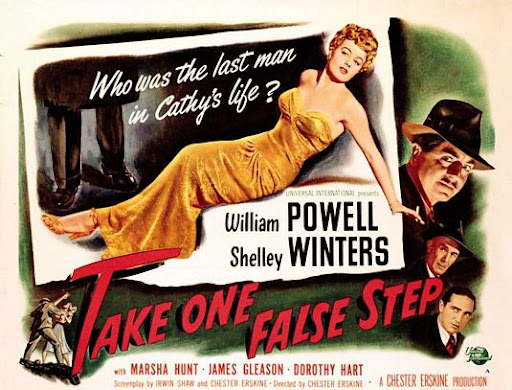
In Take One False Step, William Powell stars as Andrew Gentling, a respected professor who is visiting the State of California to secure funding for a new university.
However, Gentling’s plans get waylaid by the sudden appearance of an old flame (Shelley Winters), who strong arms him into a night of flirtatious drinking before vanishing the following day.
Fearing he could become the prime suspect in this missing persons case, Gentling must scramble to find out what happened to his former lover and dodge a cadre of shady characters in the process.

Despite its title, and a goofy opening montage showcasing a bunch of random people tripping over themselves, Take One False Step actually kicks off on the right foot.
Powell does such a good job at playing the strait-laced academic that his descent into the criminal underworld, where he is forced to constantly lie and break the law to evade police, feels like a big deal.
This tonal shift is hammered home thanks to a nice selection of colourful characters, who give the film’s first act a lot of weight and texture.
Winters’ femme fatale is an obvious example of this, since her glamorous wardrobe and hot-blooded persona serve as the perfect foil for Powell’s dry everyman.
The two also make for an interesting pair considering their contrasting views towards post-WWII America.
While Winters is content with wallowing in the excitement and uncertainty of wartime, Powell remains committed to leaving his military service in the past and build towards a better future (hence the new university).
However, as the story moves forward, Powell is increasingly put in a position where he must abandon these high-minded ideals for his own self-preservation, which adds a nice psychological wrinkle on top of everything.
His descent into moral ambiguity is made even more compelling thanks to some strong supporting players besides Winters.
This includes Marsha Hunt as Winters’ level-headed best friend and James Gleason as the police detective on Powell’s heels, with the latter projecting an unassuming intelligence reminiscent of Peter Falk’s Columbo.
All this is all tied together with some snappy dialogue and slick visuals that one would expect from the genre, combined with an energetic score that helps move the action along at a nice pace.
Unfortunately, all this good set-up is thrown out the window 33 minutes into the movie when Powell gets bitten by a supposedly rabid dog.

Once that happens, the broader mystery regarding Winters’ disappearance is quickly abandoned in favour of this rabies sub plot, where Powell must avoid the authorities while fighting off any emerging symptoms of the disease.
This leads to a handful of scenes where the movie basically stops so that medical professionals can explain what rabies is and how it affects the human body.
It got to the point that I started to wonder if the film’s budget was subsidized by some advocacy group, with its funding being dependent on the script containing some amount of educational content concerning rabies.
This is extra puzzling given the fact that rabies was hardly considered a scourge in North America at that point, with around 40 cases reported each year in the early 1940s and decreasing to a total of 99 for the entire next decade.
While Erskine eventually circles back to the main mystery plot, the film has lost much of its momentum by that point and must settle for a bunch of rushed resolutions.
We don’t even find out about the true nature of the bad guy’s criminal dealings until the last five minutes of the movie, which comes across as a complete afterthought.
This weak revelation is also preceded by one of the stupidest cinematic deaths I’ve seen in a while, which takes place [SPOILERS] when Powell confronts the bad guy in a rail yard.
After a brief tussle with Powell, the villain is spooked by incoming police and quickly finds himself caught between two trains travelling in the opposite direction.
Even though there is clearly enough space and time to avoid these oncoming locomotives, the bad guy stutter-steps like an idiot and gets crushed.
Despite not being shot in a comedic style, I was instantly reminded of the steamroller scene from the first Austin Powers movie, where a henchman’s severe lack of self-preservation is played up for yuks.
The similarly ridiculous death in Take One False Step is extra confusing since the film is sprinkled with humorous moments throughout, which don’t always land or gel with the more serious story beats.
This points to a broader problem with the film, since it lacks a cohesive vision that can marry the good performances and moody visuals with a complimentary script.
As a result, watching Take One False Step is a profoundly frustrating experience, since you can tell its merits are being weighed down by a few head-scratching decisions.
Turning this mystery story into a rabies PSA is obviously the filmmakers’ biggest blunder, and it might be one of the strangest narrative detours I’ve witnessed covering movies for this blog.
Admittedly, it is kind of funny that a film called Take One False Step so noticeably trips over itself in its second half, a fate that might have been willed into existence by running with such an unwieldy title in the first place.
Hopefully the remaining two films in this Kino Lorber collection can provide more of that crime thriller escapism I mentioned earlier, while containing at least 50% less canine fear mongering.
Verdict:
5/10
Corner store companion:
Nature’s Recipe Chewy Bites (because dog owners will pick up a lot of useful information watching this film)

Fun facts:
-Release date: Aug. 14, 1949
-Budget: $855,000
-Kino Lorber’s DVD case for Take One False Step claims that actor Tony Curtis makes an uncredited appearance in the film, with AFI listing his role as “hot rod driver.” However, Curtis is not included amongst other uncredited actors on the movie’s IMDB page and I personally didn’t spot him during my multiple viewings of the film.
-William Powell received three Best Actor Oscar nominations throughout his career for his work in The Thin Man (1934), My Man Godfrey (1936), and Life With Father (1947). Powell retired from acting following his supporting role in the Best Picture-nominated Mister Roberts (1955) due to health issues.
-I might have subconsciously selected Take One False Step (1949) for a screening based on its titular similarity to Carl Franklin’s One False Move (1992), another crime thriller that I covered back in 2018.
-Despite her extensive filmography throughout the 1930s and 40s, Marsha Hunt was largely blacklisted from Hollywood in the 1950s for speaking out against the House Committee on Un-American Activities and being branded as a Communist sympathizer. Hunt was mostly relegated to working on TV throughout this time, although she would return to film in the decades to come and received a star on the Hollywood Walk of Fame in 1960. She passed away in 2022 at the age of 104.

–Take One False Step can currently be watched in its entirety on YouTube.
 Corner Store Cinema